Comparison map
Organic Chemistry: relationships and examples
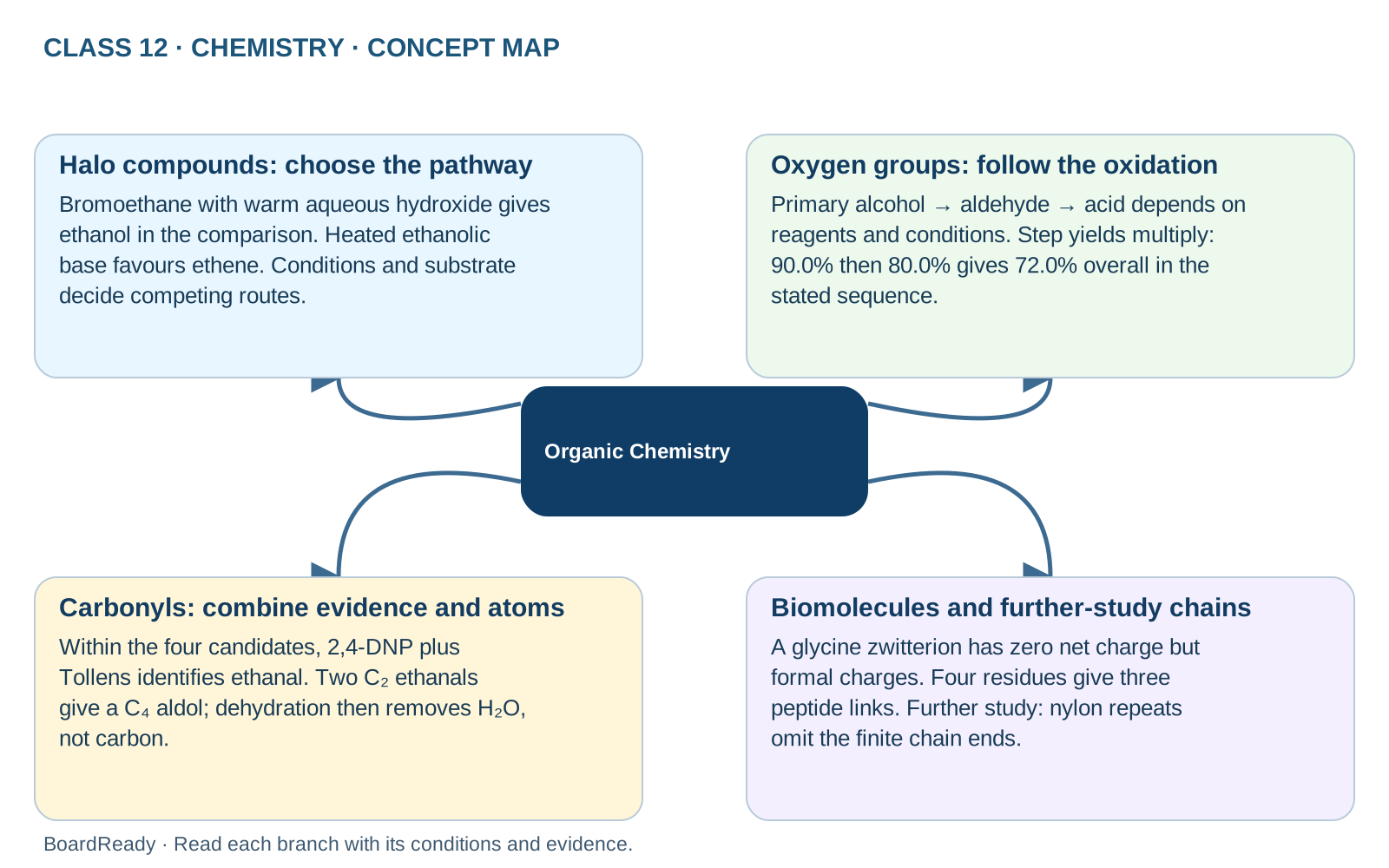
Connect the reacting bond, experimental evidence, carbon balance and chain ends across the four organic lessons. Halo compounds: choose the pathway: Bromoethane with warm aqueous hydroxide gives ethanol in the comparison. Heated ethanolic base favours ethene. Conditions and substrate decide competing routes. Oxygen groups: follow the oxidation: Primary alcohol → aldehyde → acid depends on reagents and conditions. Step yields multiply: 90.0% then 80.0% gives 72.0% overall in the stated sequence. Carbonyls: combine evidence and atoms: Within the four candidates, 2,4-DNP plus Tollens identifies ethanal. Two C₂ ethanals give a C₄ aldol; dehydration then removes H₂O, not carbon. Biomolecules and further-study chains: A glycine zwitterion has zero net charge but formal charges. Four residues give three peptide links. Further study: nylon repeats omit the finite chain ends.Exam cue: Write the functional group, conditions and changed bond. Conserve atoms, interpret tests within their candidate set, and distinguish repeating units from complete finite chains.
- 1Organic Chemistry -> Halo compounds: choose the pathway: Bromoethane with warm aqueous hydroxide gives ethanol in the comparison. Heated ethanolic base favours ethene. Conditions and substrate decide competing routes.
- 2Organic Chemistry -> Oxygen groups: follow the oxidation: Primary alcohol → aldehyde → acid depends on reagents and conditions. Step yields multiply: 90.0% then 80.0% gives 72.0% overall in the stated sequence.
- 3Organic Chemistry -> Carbonyls: combine evidence and atoms: Within the four candidates, 2,4-DNP plus Tollens identifies ethanal. Two C₂ ethanals give a C₄ aldol; dehydration then removes H₂O, not carbon.
- 4Organic Chemistry -> Biomolecules and further-study chains: A glycine zwitterion has zero net charge but formal charges. Four residues give three peptide links. Further study: nylon repeats omit the finite chain ends.