Comparison map
States of Matter: relationships and examples
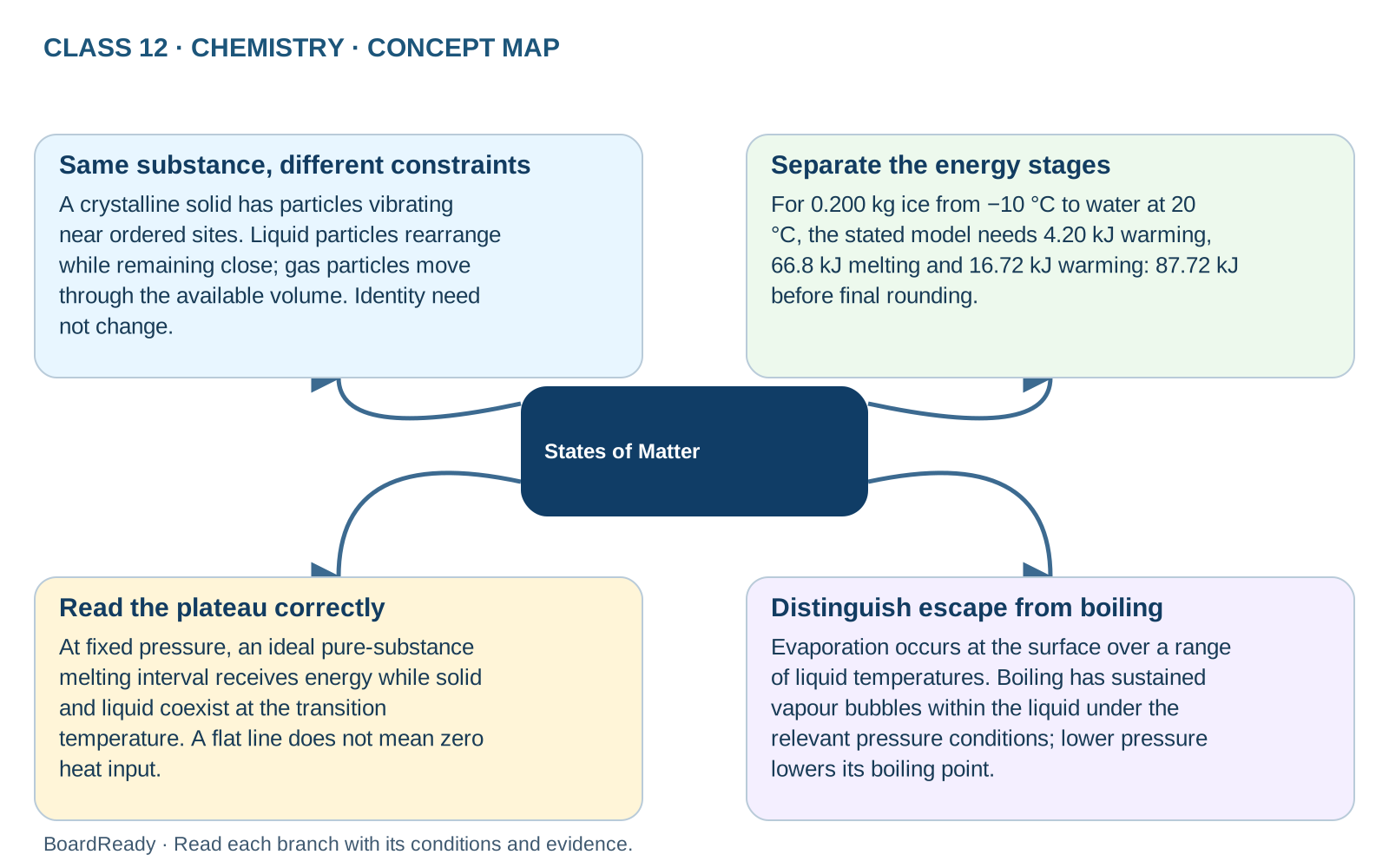
Foundation refresher: distinguish particle rearrangement, sensible heating, latent heat and pressure-dependent vaporisation. Same substance, different constraints: A crystalline solid has particles vibrating near ordered sites. Liquid particles rearrange while remaining close; gas particles move through the available volume. Identity need not change. Separate the energy stages: For 0.200 kg ice from −10 °C to water at 20 °C, the stated model needs 4.20 kJ warming, 66.8 kJ melting and 16.72 kJ warming: 87.72 kJ before final rounding. Read the plateau correctly: At fixed pressure, an ideal pure-substance melting interval receives energy while solid and liquid coexist at the transition temperature. A flat line does not mean zero heat input. Distinguish escape from boiling: Evaporation occurs at the surface over a range of liquid temperatures. Boiling has sustained vapour bubbles within the liquid under the relevant pressure conditions; lower pressure lowers its boiling point.Exam cue: State mass, phase, pressure and assumptions before choosing Q = mcΔT or Q = mL. Count only the mass changing phase. For a boiling claim distinguish vapour from air bubbles, and invisible water vapour from visible condensed droplets.
- 1States of Matter -> Same substance, different constraints: A crystalline solid has particles vibrating near ordered sites. Liquid particles rearrange while remaining close; gas particles move through the available volume. Identity need not change.
- 2States of Matter -> Separate the energy stages: For 0.200 kg ice from −10 °C to water at 20 °C, the stated model needs 4.20 kJ warming, 66.8 kJ melting and 16.72 kJ warming: 87.72 kJ before final rounding.
- 3States of Matter -> Read the plateau correctly: At fixed pressure, an ideal pure-substance melting interval receives energy while solid and liquid coexist at the transition temperature. A flat line does not mean zero heat input.
- 4States of Matter -> Distinguish escape from boiling: Evaporation occurs at the surface over a range of liquid temperatures. Boiling has sustained vapour bubbles within the liquid under the relevant pressure conditions; lower pressure lowers its boiling point.