Comparison map
p-Block Elements: relationships and examples
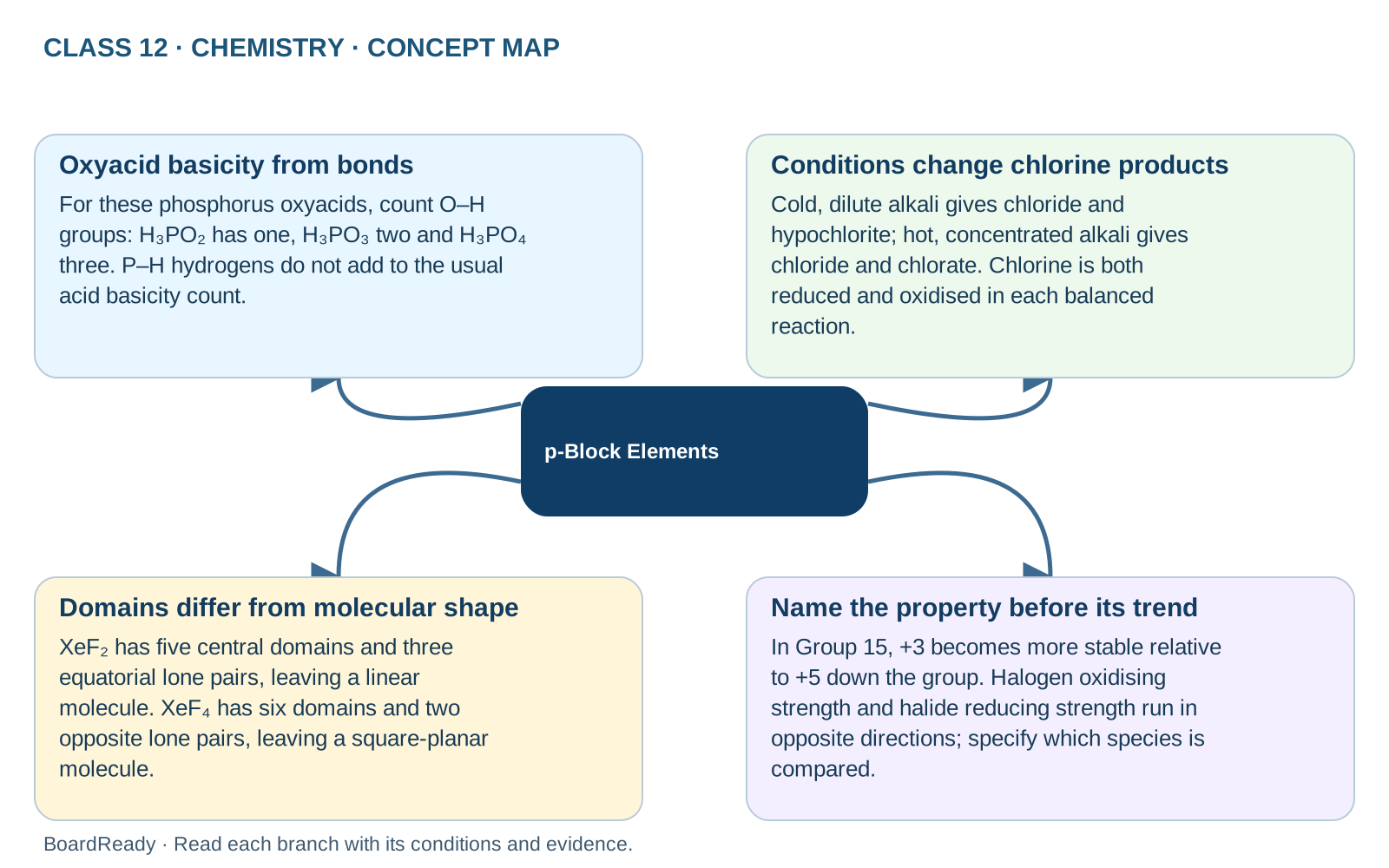
Use bond connectivity, reaction conditions and electron domains to explain p-block chemistry. Oxyacid basicity from bonds: For these phosphorus oxyacids, count O–H groups: H₃PO₂ has one, H₃PO₃ two and H₃PO₄ three. P–H hydrogens do not add to the usual acid basicity count. Conditions change chlorine products: Cold, dilute alkali gives chloride and hypochlorite; hot, concentrated alkali gives chloride and chlorate. Chlorine is both reduced and oxidised in each balanced reaction. Domains differ from molecular shape: XeF₂ has five central domains and three equatorial lone pairs, leaving a linear molecule. XeF₄ has six domains and two opposite lone pairs, leaving a square-planar molecule. Name the property before its trend: In Group 15, +3 becomes more stable relative to +5 down the group. Halogen oxidising strength and halide reducing strength run in opposite directions; specify which species is compared.Exam cue: Draw the connectivity or domain arrangement before naming basicity or shape. For chlorine, include reaction conditions and balance atoms and electron changes rather than memorising a product without context.
- 1p-Block Elements -> Oxyacid basicity from bonds: For these phosphorus oxyacids, count O–H groups: H₃PO₂ has one, H₃PO₃ two and H₃PO₄ three. P–H hydrogens do not add to the usual acid basicity count.
- 2p-Block Elements -> Conditions change chlorine products: Cold, dilute alkali gives chloride and hypochlorite; hot, concentrated alkali gives chloride and chlorate. Chlorine is both reduced and oxidised in each balanced reaction.
- 3p-Block Elements -> Domains differ from molecular shape: XeF₂ has five central domains and three equatorial lone pairs, leaving a linear molecule. XeF₄ has six domains and two opposite lone pairs, leaving a square-planar molecule.
- 4p-Block Elements -> Name the property before its trend: In Group 15, +3 becomes more stable relative to +5 down the group. Halogen oxidising strength and halide reducing strength run in opposite directions; specify which species is compared.