Comparison map
Inorganic Chemistry: relationships and examples
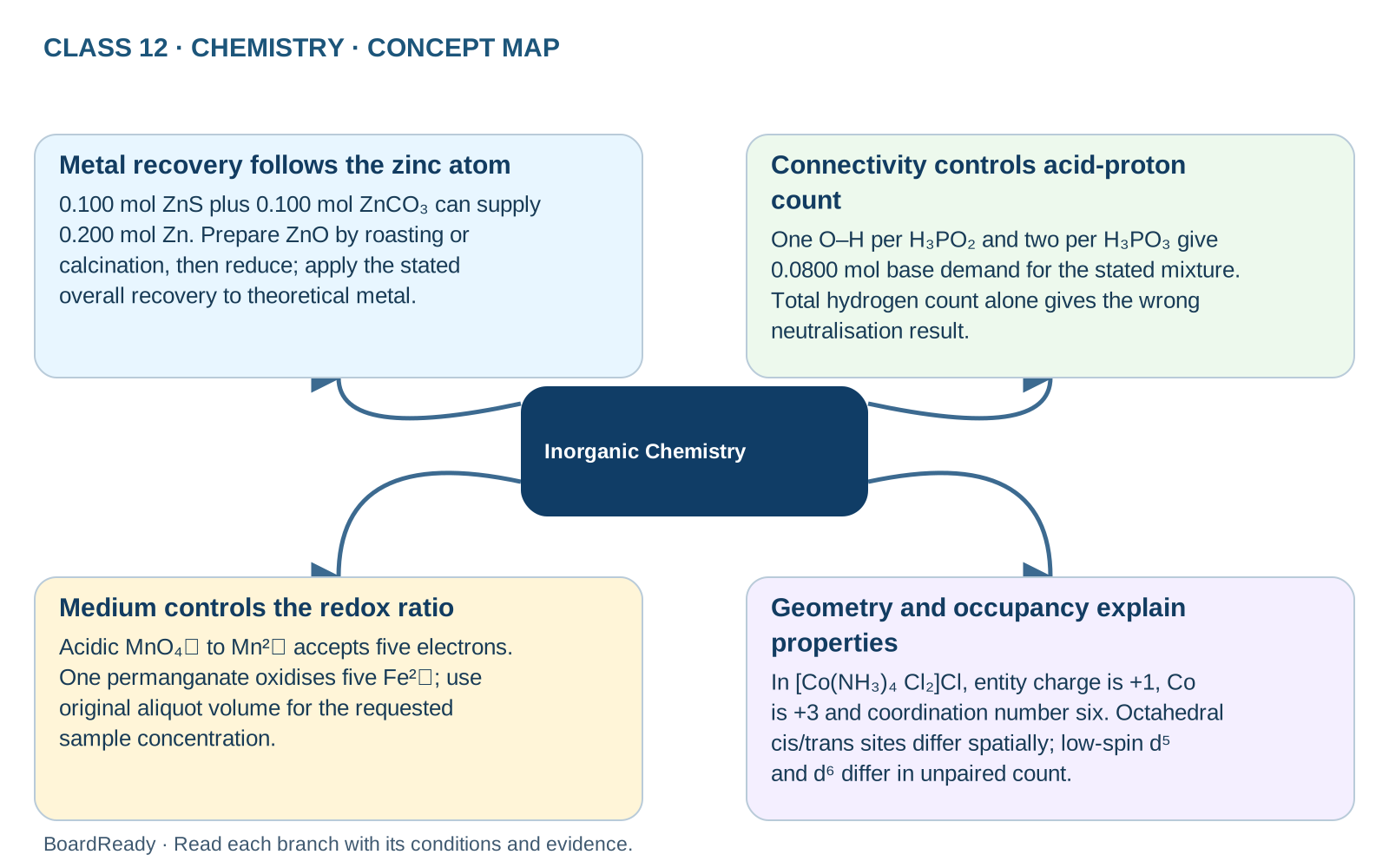
Connect ore routes, bond-based proton counts, redox electrons and donor geometry across the four lessons. Metal recovery follows the zinc atom: 0.100 mol ZnS plus 0.100 mol ZnCO₃ can supply 0.200 mol Zn. Prepare ZnO by roasting or calcination, then reduce; apply the stated overall recovery to theoretical metal. Connectivity controls acid-proton count: One O–H per H₃PO₂ and two per H₃PO₃ give 0.0800 mol base demand for the stated mixture. Total hydrogen count alone gives the wrong neutralisation result. Medium controls the redox ratio: Acidic MnO₄⁻ to Mn²⁺ accepts five electrons. One permanganate oxidises five Fe²⁺; use original aliquot volume for the requested sample concentration. Geometry and occupancy explain properties: In [Co(NH₃)₄ Cl₂]Cl, entity charge is +1, Co is +3 and coordination number six. Octahedral cis/trans sites differ spatially; low-spin d⁵ and d⁶ differ in unpaired count.Exam cue: Choose the right count: metal atoms, O–H acid protons, redox electrons or donor attachments. State reaction medium, structure and ligand-field assumptions before drawing the final conclusion.
- 1Inorganic Chemistry -> Metal recovery follows the zinc atom: 0.100 mol ZnS plus 0.100 mol ZnCO₃ can supply 0.200 mol Zn. Prepare ZnO by roasting or calcination, then reduce; apply the stated overall recovery to theoretical metal.
- 2Inorganic Chemistry -> Connectivity controls acid-proton count: One O–H per H₃PO₂ and two per H₃PO₃ give 0.0800 mol base demand for the stated mixture. Total hydrogen count alone gives the wrong neutralisation result.
- 3Inorganic Chemistry -> Medium controls the redox ratio: Acidic MnO₄⁻ to Mn²⁺ accepts five electrons. One permanganate oxidises five Fe²⁺; use original aliquot volume for the requested sample concentration.
- 4Inorganic Chemistry -> Geometry and occupancy explain properties: In [Co(NH₃)₄ Cl₂]Cl, entity charge is +1, Co is +3 and coordination number six. Octahedral cis/trans sites differ spatially; low-spin d⁵ and d⁶ differ in unpaired count.