Comparison map
Reproduction Review: relationships and examples
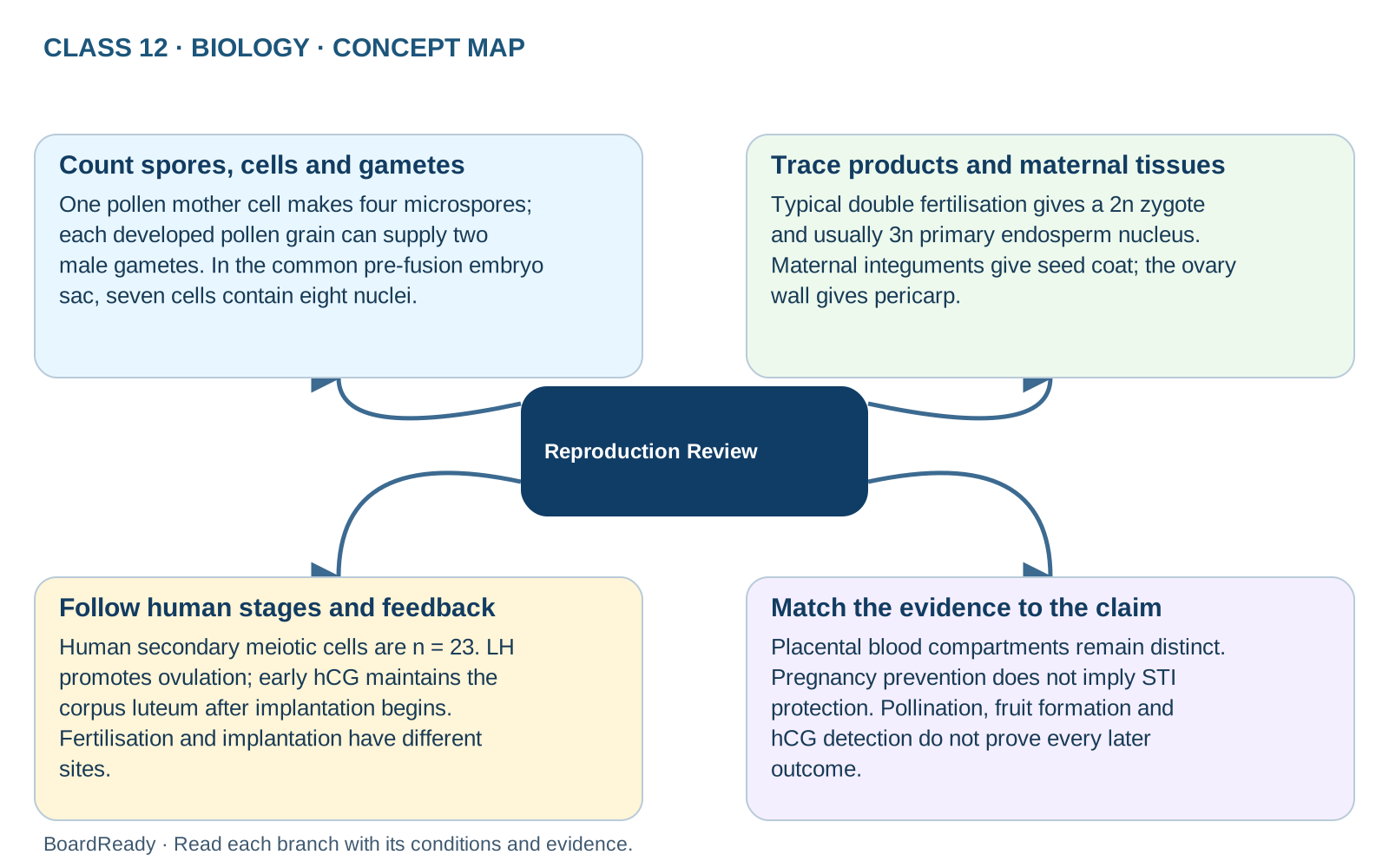
Compare plant and human cell counts, separate developmental events and justify reproductive-health claims through mechanisms. Count spores, cells and gametes: One pollen mother cell makes four microspores; each developed pollen grain can supply two male gametes. In the common pre-fusion embryo sac, seven cells contain eight nuclei. Trace products and maternal tissues: Typical double fertilisation gives a 2n zygote and usually 3n primary endosperm nucleus. Maternal integuments give seed coat; the ovary wall gives pericarp. Follow human stages and feedback: Human secondary meiotic cells are n = 23. LH promotes ovulation; early hCG maintains the corpus luteum after implantation begins. Fertilisation and implantation have different sites. Match the evidence to the claim: Placental blood compartments remain distinct. Pregnancy prevention does not imply STI protection. Pollination, fruit formation and hCG detection do not prove every later outcome.Exam cue: Use the named organism, stage and stated assumptions before counting. Link source, target and feedback sign for hormones. Distinguish an observation from an unsupported claim about fertilisation, developmental success or protection.
- 1Reproduction Review -> Count spores, cells and gametes: One pollen mother cell makes four microspores; each developed pollen grain can supply two male gametes. In the common pre-fusion embryo sac, seven cells contain eight nuclei.
- 2Reproduction Review -> Trace products and maternal tissues: Typical double fertilisation gives a 2n zygote and usually 3n primary endosperm nucleus. Maternal integuments give seed coat; the ovary wall gives pericarp.
- 3Reproduction Review -> Follow human stages and feedback: Human secondary meiotic cells are n = 23. LH promotes ovulation; early hCG maintains the corpus luteum after implantation begins. Fertilisation and implantation have different sites.
- 4Reproduction Review -> Match the evidence to the claim: Placental blood compartments remain distinct. Pregnancy prevention does not imply STI protection. Pollination, fruit formation and hCG detection do not prove every later outcome.