Comparison map
Circulatory System: relationships and examples
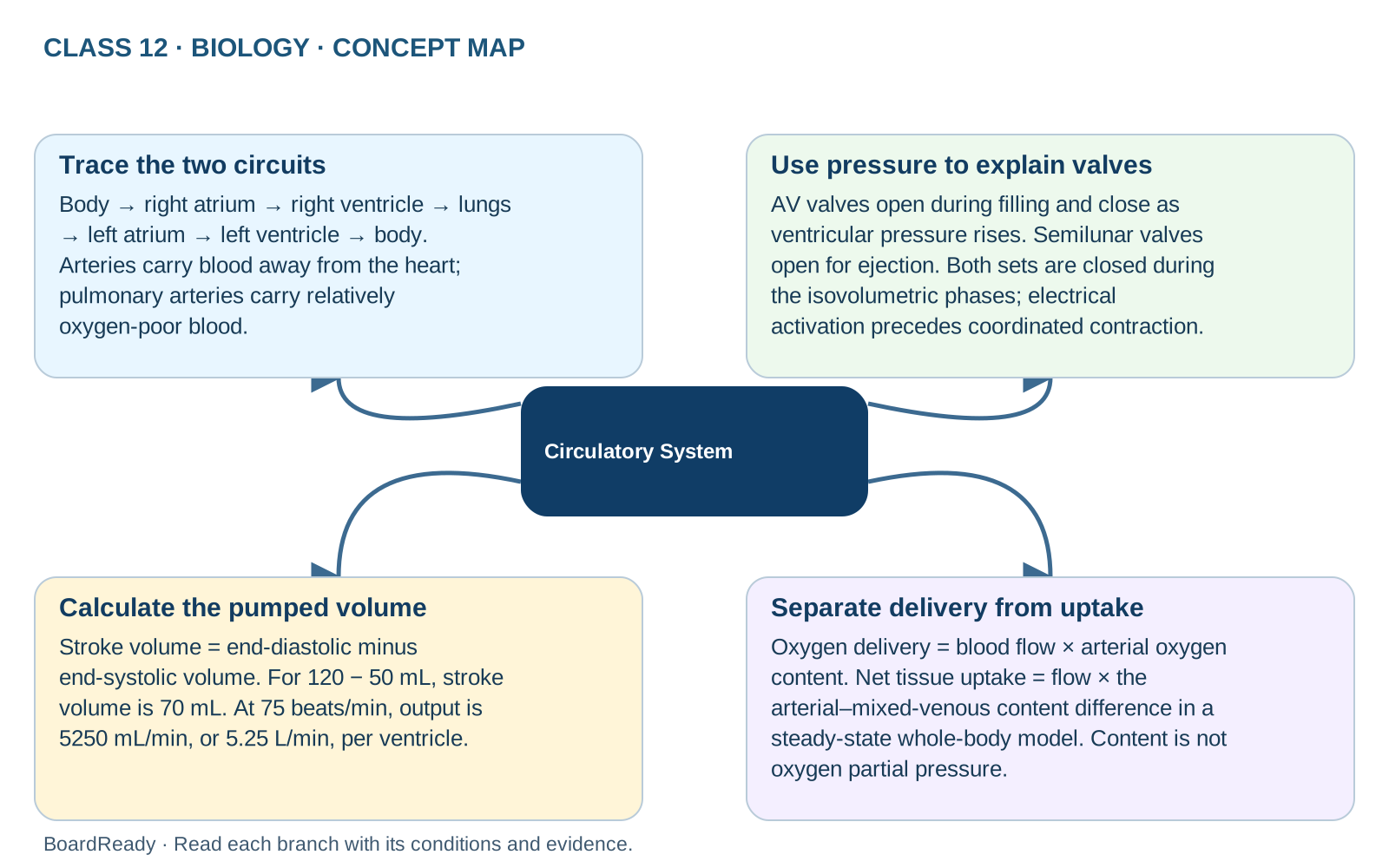
Connect two serial circuits, pressure-driven valves, pumping volume and oxygen transport with consistent units. Trace the two circuits: Body → right atrium → right ventricle → lungs → left atrium → left ventricle → body. Arteries carry blood away from the heart; pulmonary arteries carry relatively oxygen-poor blood. Use pressure to explain valves: AV valves open during filling and close as ventricular pressure rises. Semilunar valves open for ejection. Both sets are closed during the isovolumetric phases; electrical activation precedes coordinated contraction. Calculate the pumped volume: Stroke volume = end-diastolic minus end-systolic volume. For 120 − 50 mL, stroke volume is 70 mL. At 75 beats/min, output is 5250 mL/min, or 5.25 L/min, per ventricle. Separate delivery from uptake: Oxygen delivery = blood flow × arterial oxygen content. Net tissue uptake = flow × the arterial–mixed-venous content difference in a steady-state whole-body model. Content is not oxygen partial pressure.Exam cue: Name vessels by flow direction, explain valve states using pressure differences, and keep blood-volume units distinct from oxygen-volume units. The two ventricles pump equal average flow in an unshunted steady state; do not add them as parallel supplies.
- 1Circulatory System -> Trace the two circuits: Body → right atrium → right ventricle → lungs → left atrium → left ventricle → body. Arteries carry blood away from the heart; pulmonary arteries carry relatively oxygen-poor blood.
- 2Circulatory System -> Use pressure to explain valves: AV valves open during filling and close as ventricular pressure rises. Semilunar valves open for ejection. Both sets are closed during the isovolumetric phases; electrical activation precedes coordinated contraction.
- 3Circulatory System -> Calculate the pumped volume: Stroke volume = end-diastolic minus end-systolic volume. For 120 − 50 mL, stroke volume is 70 mL. At 75 beats/min, output is 5250 mL/min, or 5.25 L/min, per ventricle.
- 4Circulatory System -> Separate delivery from uptake: Oxygen delivery = blood flow × arterial oxygen content. Net tissue uptake = flow × the arterial–mixed-venous content difference in a steady-state whole-body model. Content is not oxygen partial pressure.