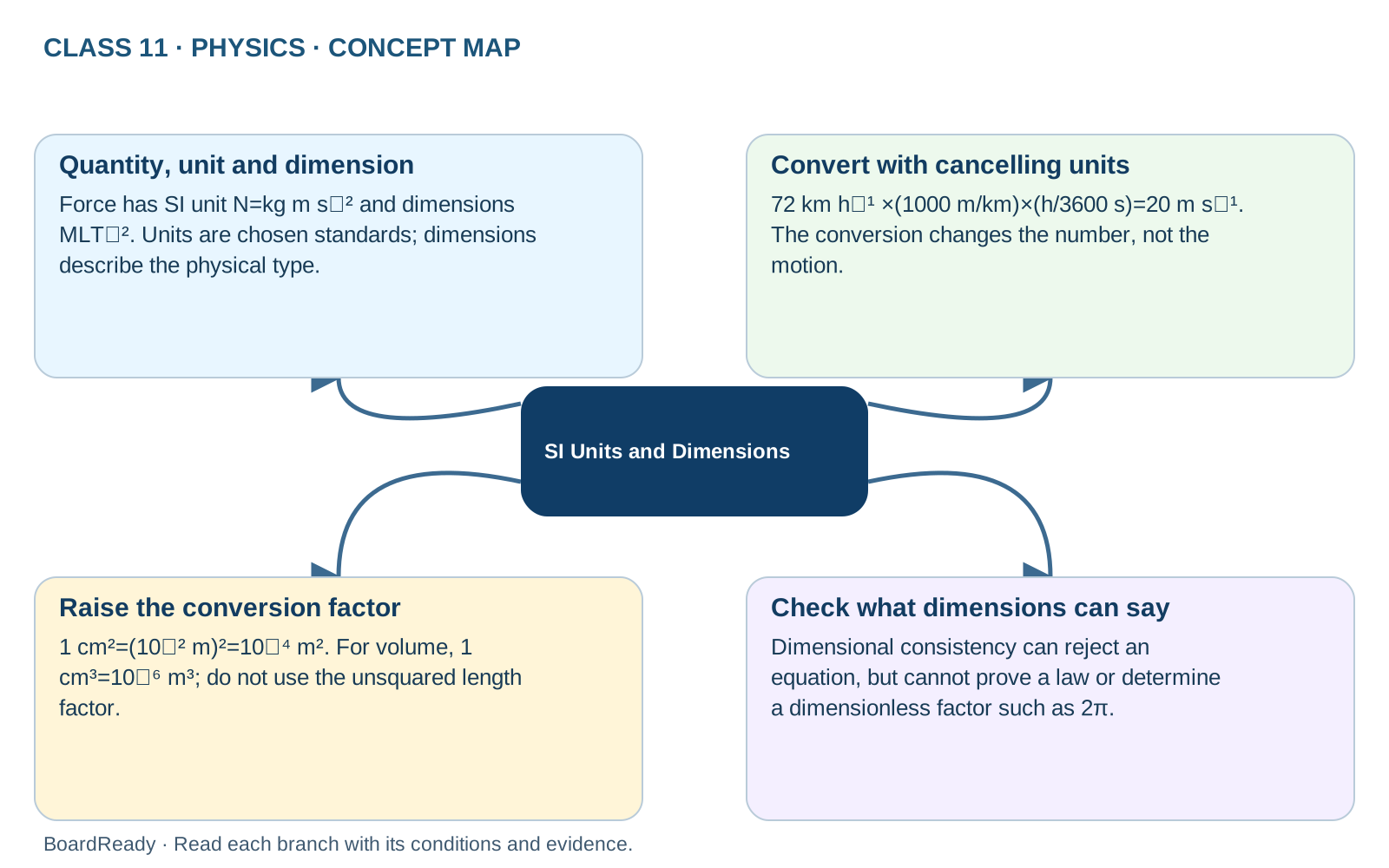
Comparison map
SI Units and Dimensions: relationships and examples
A measured quantity keeps its meaning while units and numerical values change. Quantity, unit and dimension: Force has SI unit N=kg m s⁻² and dimensions MLT⁻². Units are chosen standards; dimensions describe the physical type. Convert with cancelling units: 72 km h⁻¹ ×(1000 m/km)×(h/3600 s)=20 m s⁻¹. The conversion changes the number, not the motion. Raise the conversion factor: 1 cm²=(10⁻² m)²=10⁻⁴ m². For volume, 1 cm³=10⁻⁶ m³; do not use the unsquared length factor. Check what dimensions can say: Dimensional consistency can reject an equation, but cannot prove a law or determine a dimensionless factor such as 2π.Exam cue: Carry units through conversions and check dimensions independently of numerical values.
- 1SI Units and Dimensions -> Quantity, unit and dimension: Force has SI unit N=kg m s⁻² and dimensions MLT⁻². Units are chosen standards; dimensions describe the physical type.
- 2SI Units and Dimensions -> Convert with cancelling units: 72 km h⁻¹ ×(1000 m/km)×(h/3600 s)=20 m s⁻¹. The conversion changes the number, not the motion.
- 3SI Units and Dimensions -> Raise the conversion factor: 1 cm²=(10⁻² m)²=10⁻⁴ m². For volume, 1 cm³=10⁻⁶ m³; do not use the unsquared length factor.
- 4SI Units and Dimensions -> Check what dimensions can say: Dimensional consistency can reject an equation, but cannot prove a law or determine a dimensionless factor such as 2π.