Comparison map
Friction: relationships and examples
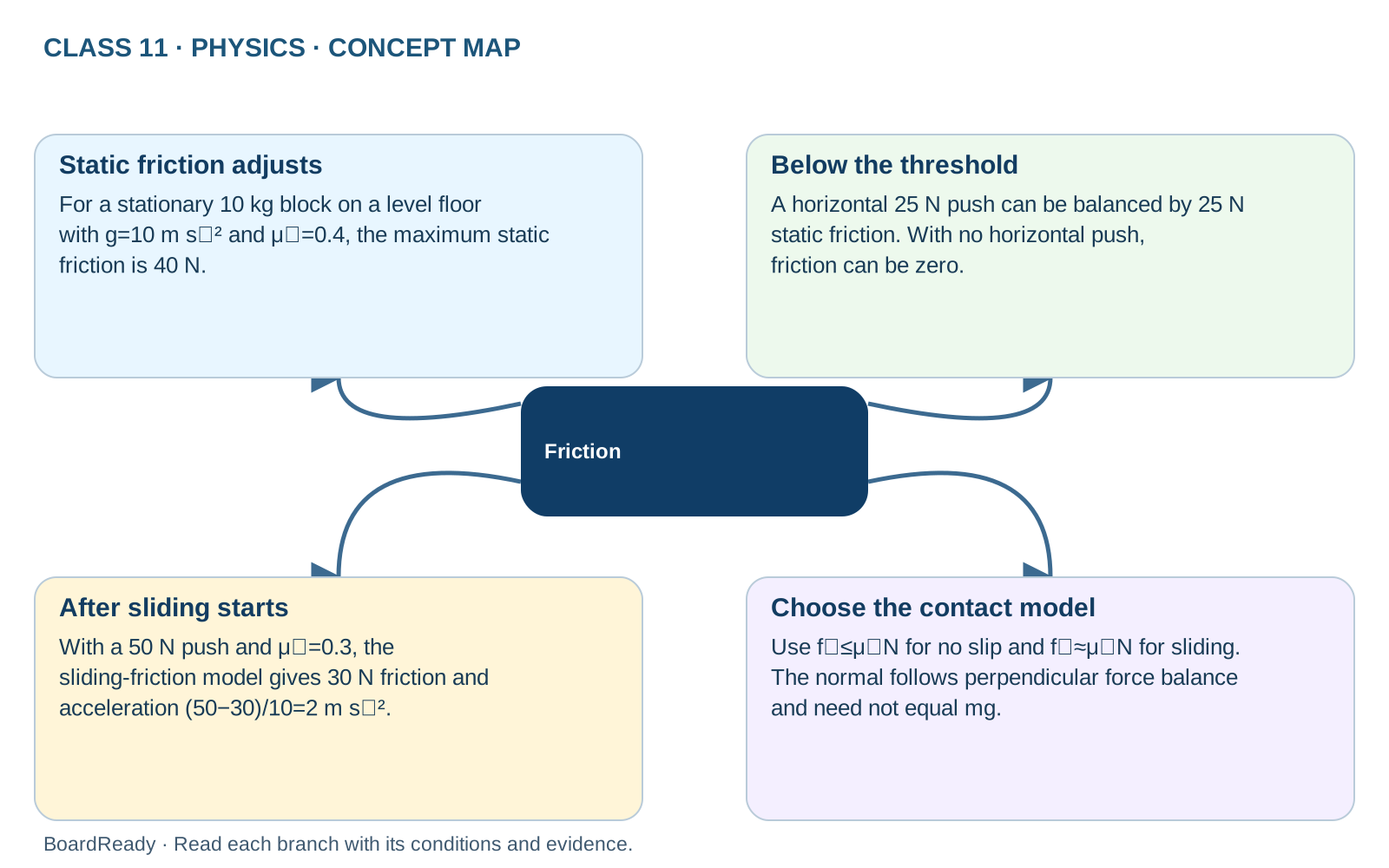
Friction depends on contact conditions and the tendency to slip, not a compulsory fixed value. Static friction adjusts: For a stationary 10 kg block on a level floor with g=10 m s⁻² and μₛ=0.4, the maximum static friction is 40 N. Below the threshold: A horizontal 25 N push can be balanced by 25 N static friction. With no horizontal push, friction can be zero. After sliding starts: With a 50 N push and μₖ=0.3, the sliding-friction model gives 30 N friction and acceleration (50−30)/10=2 m s⁻². Choose the contact model: Use fₛ≤μₛN for no slip and fₖ≈μₖN for sliding. The normal follows perpendicular force balance and need not equal mg.Exam cue: Test whether no-slip balance is possible before using a limiting or kinetic-friction value.
- 1Friction -> Static friction adjusts: For a stationary 10 kg block on a level floor with g=10 m s⁻² and μₛ=0.4, the maximum static friction is 40 N.
- 2Friction -> Below the threshold: A horizontal 25 N push can be balanced by 25 N static friction. With no horizontal push, friction can be zero.
- 3Friction -> After sliding starts: With a 50 N push and μₖ=0.3, the sliding-friction model gives 30 N friction and acceleration (50−30)/10=2 m s⁻².
- 4Friction -> Choose the contact model: Use fₛ≤μₛN for no slip and fₖ≈μₖN for sliding. The normal follows perpendicular force balance and need not equal mg.