Comparison map
Distance and Section Formula in 3D: relationships and examples
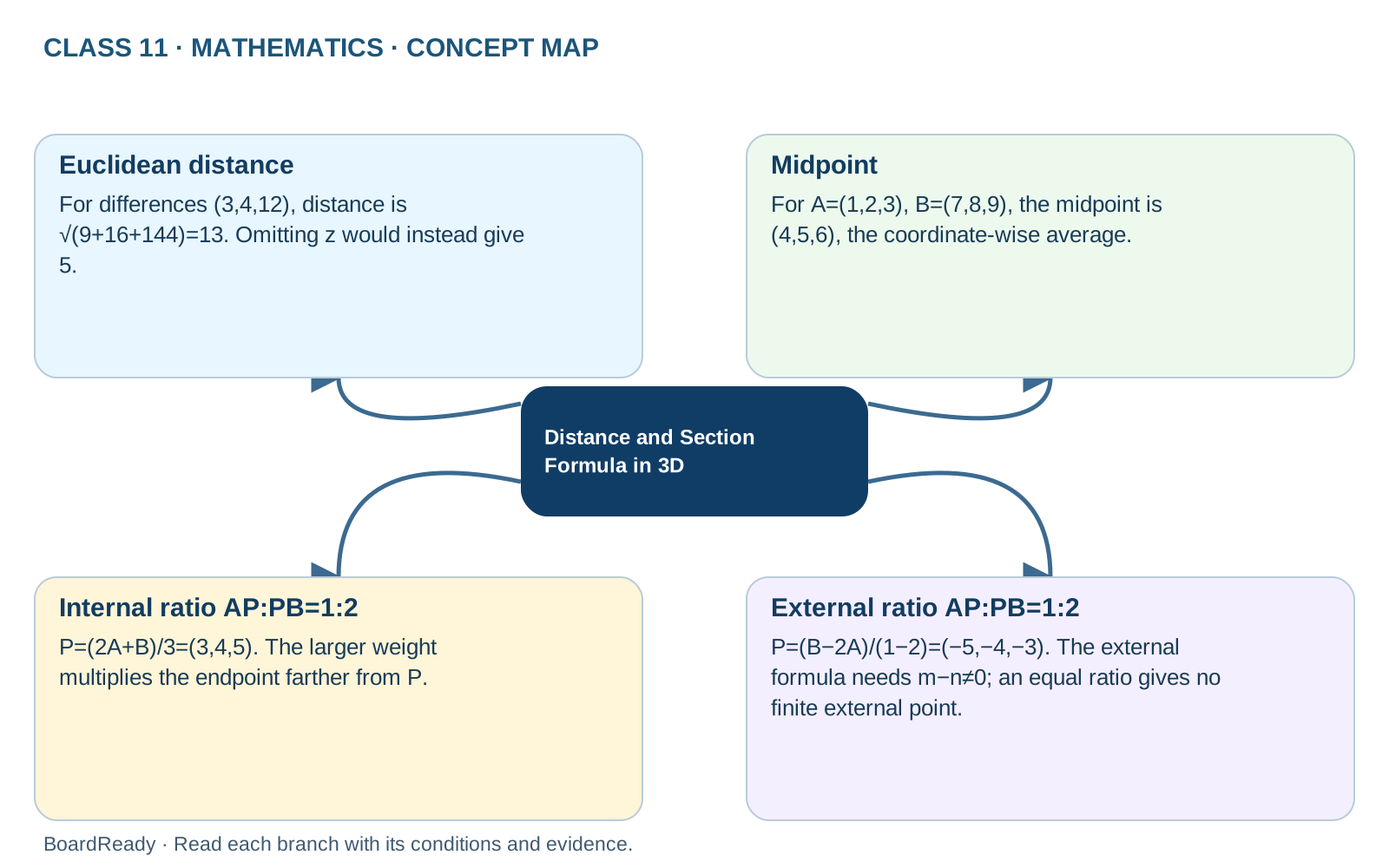
A spatial segment uses all three differences and a consistently oriented ratio. Euclidean distance: For differences (3,4,12), distance is √(9+16+144)=13. Omitting z would instead give 5. Midpoint: For A=(1,2,3), B=(7,8,9), the midpoint is (4,5,6), the coordinate-wise average. Internal ratio AP:PB=1:2: P=(2A+B)/3=(3,4,5). The larger weight multiplies the endpoint farther from P. External ratio AP:PB=1:2: P=(B−2A)/(1−2)=(−5,−4,−3). The external formula needs m−n≠0; an equal ratio gives no finite external point.Exam cue: Check the distances AP and PB independently; internal and external division give different points.
- 1Distance and Section Formula in 3D -> Euclidean distance: For differences (3,4,12), distance is √(9+16+144)=13. Omitting z would instead give 5.
- 2Distance and Section Formula in 3D -> Midpoint: For A=(1,2,3), B=(7,8,9), the midpoint is (4,5,6), the coordinate-wise average.
- 3Distance and Section Formula in 3D -> Internal ratio AP:PB=1:2: P=(2A+B)/3=(3,4,5). The larger weight multiplies the endpoint farther from P.
- 4Distance and Section Formula in 3D -> External ratio AP:PB=1:2: P=(B−2A)/(1−2)=(−5,−4,−3). The external formula needs m−n≠0; an equal ratio gives no finite external point.