Comparison map
Index Numbers: relationships and examples
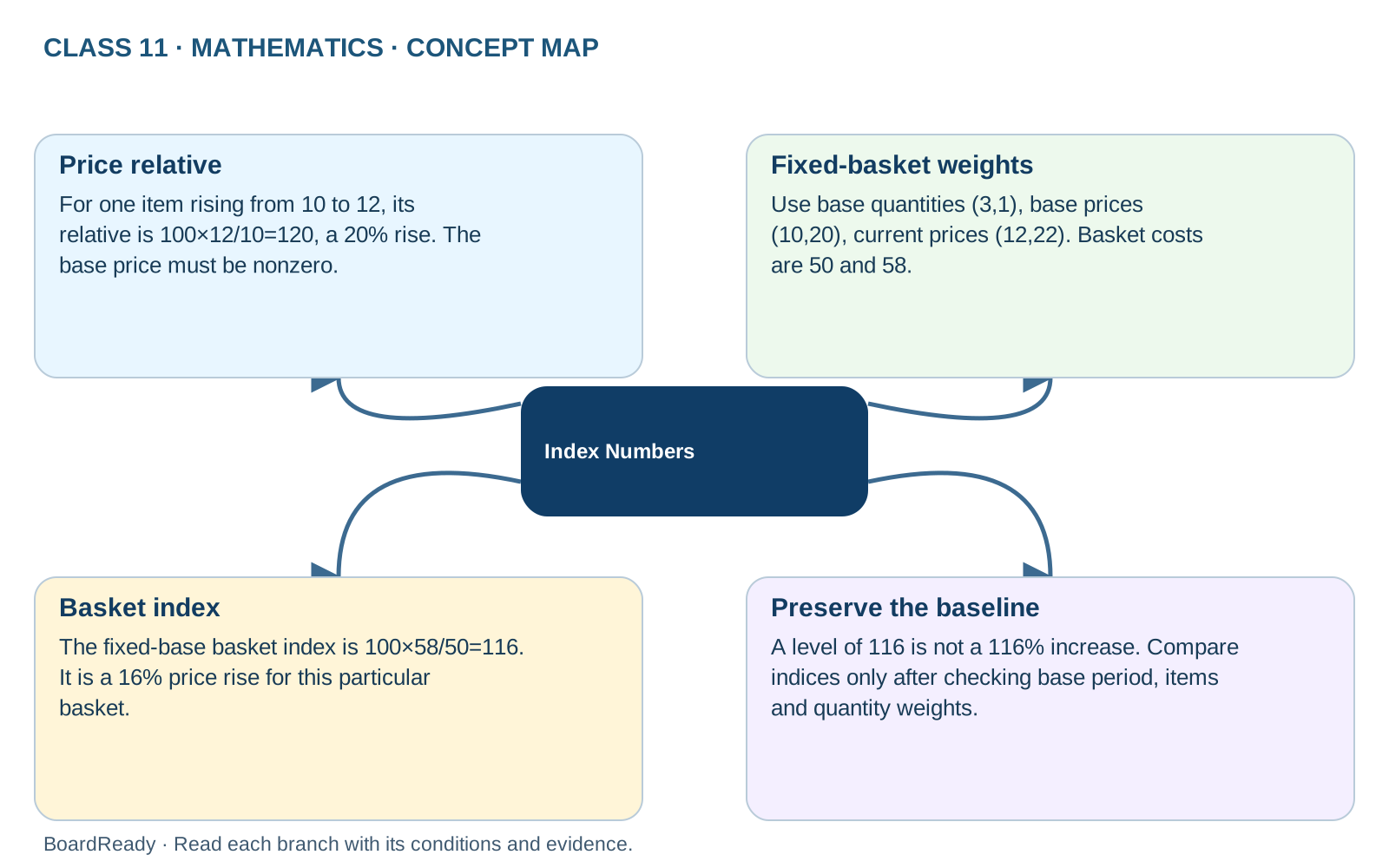
A price index compares like-for-like baskets against a declared base. Price relative: For one item rising from 10 to 12, its relative is 100×12/10=120, a 20% rise. The base price must be nonzero. Fixed-basket weights: Use base quantities (3,1), base prices (10,20), current prices (12,22). Basket costs are 50 and 58. Basket index: The fixed-base basket index is 100×58/50=116. It is a 16% price rise for this particular basket. Preserve the baseline: A level of 116 is not a 116% increase. Compare indices only after checking base period, items and quantity weights.Exam cue: Show the basket costs before the index, and distinguish an index level from a percentage change.
- 1Index Numbers -> Price relative: For one item rising from 10 to 12, its relative is 100×12/10=120, a 20% rise. The base price must be nonzero.
- 2Index Numbers -> Fixed-basket weights: Use base quantities (3,1), base prices (10,20), current prices (12,22). Basket costs are 50 and 58.
- 3Index Numbers -> Basket index: The fixed-base basket index is 100×58/50=116. It is a 16% price rise for this particular basket.
- 4Index Numbers -> Preserve the baseline: A level of 116 is not a 116% increase. Compare indices only after checking base period, items and quantity weights.