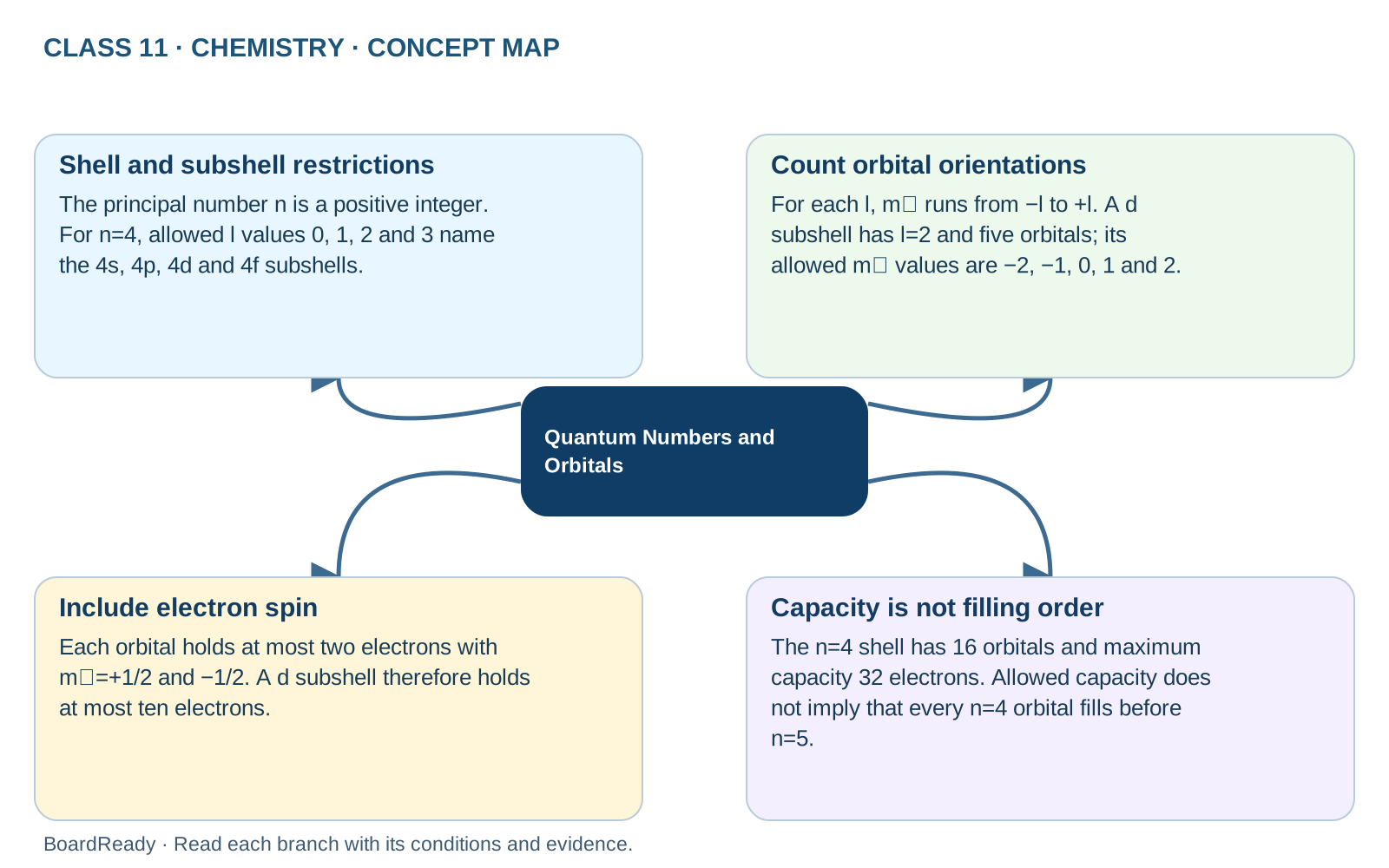
Comparison map
Quantum Numbers and Orbitals: relationships and examples
Four quantum numbers identify allowed orbital and electron states; they are not coordinates of a trajectory. Shell and subshell restrictions: The principal number n is a positive integer. For n=4, allowed l values 0, 1, 2 and 3 name the 4s, 4p, 4d and 4f subshells. Count orbital orientations: For each l, mₗ runs from −l to +l. A d subshell has l=2 and five orbitals; its allowed mₗ values are −2, −1, 0, 1 and 2. Include electron spin: Each orbital holds at most two electrons with mₛ=+1/2 and −1/2. A d subshell therefore holds at most ten electrons. Capacity is not filling order: The n=4 shell has 16 orbitals and maximum capacity 32 electrons. Allowed capacity does not imply that every n=4 orbital fills before n=5.Exam cue: Check n, then l, then mₗ and spin; an orbital is a probability-state description rather than a fixed orbit.
- 1Quantum Numbers and Orbitals -> Shell and subshell restrictions: The principal number n is a positive integer. For n=4, allowed l values 0, 1, 2 and 3 name the 4s, 4p, 4d and 4f subshells.
- 2Quantum Numbers and Orbitals -> Count orbital orientations: For each l, mₗ runs from −l to +l. A d subshell has l=2 and five orbitals; its allowed mₗ values are −2, −1, 0, 1 and 2.
- 3Quantum Numbers and Orbitals -> Include electron spin: Each orbital holds at most two electrons with mₛ=+1/2 and −1/2. A d subshell therefore holds at most ten electrons.
- 4Quantum Numbers and Orbitals -> Capacity is not filling order: The n=4 shell has 16 orbitals and maximum capacity 32 electrons. Allowed capacity does not imply that every n=4 orbital fills before n=5.