Comparison map
Electronic Configuration: relationships and examples
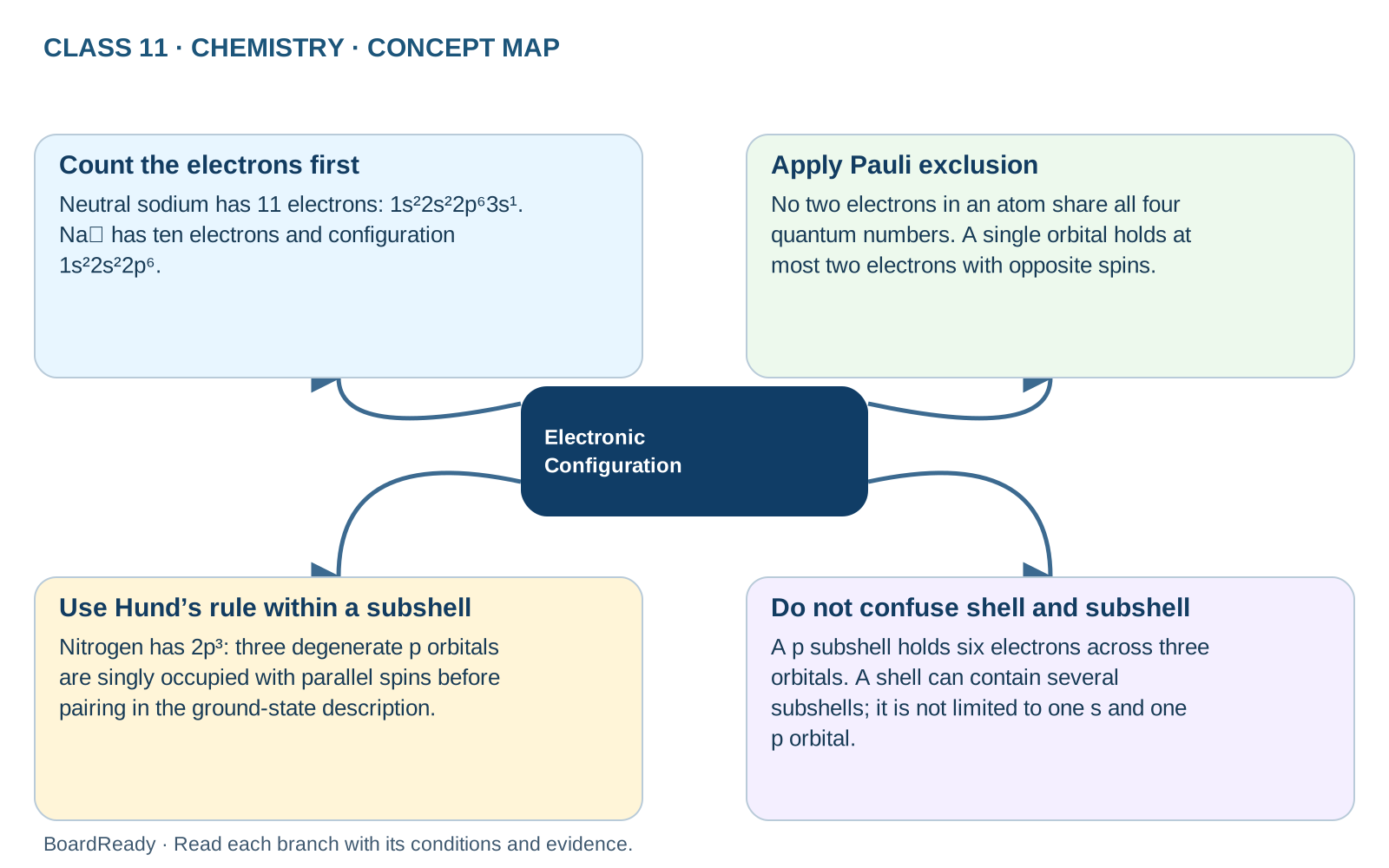
Ground-state configurations combine electron count with orbital energies, exclusion and electron-pairing rules. Count the electrons first: Neutral sodium has 11 electrons: 1s²2s²2p⁶3s¹. Na⁺ has ten electrons and configuration 1s²2s²2p⁶. Apply Pauli exclusion: No two electrons in an atom share all four quantum numbers. A single orbital holds at most two electrons with opposite spins. Use Hund’s rule within a subshell: Nitrogen has 2p³: three degenerate p orbitals are singly occupied with parallel spins before pairing in the ground-state description. Do not confuse shell and subshell: A p subshell holds six electrons across three orbitals. A shell can contain several subshells; it is not limited to one s and one p orbital.Exam cue: Account for ionic charge and show individual orbital occupancy when a pairing or spin argument is required.
- 1Electronic Configuration -> Count the electrons first: Neutral sodium has 11 electrons: 1s²2s²2p⁶3s¹. Na⁺ has ten electrons and configuration 1s²2s²2p⁶.
- 2Electronic Configuration -> Apply Pauli exclusion: No two electrons in an atom share all four quantum numbers. A single orbital holds at most two electrons with opposite spins.
- 3Electronic Configuration -> Use Hund’s rule within a subshell: Nitrogen has 2p³: three degenerate p orbitals are singly occupied with parallel spins before pairing in the ground-state description.
- 4Electronic Configuration -> Do not confuse shell and subshell: A p subshell holds six electrons across three orbitals. A shell can contain several subshells; it is not limited to one s and one p orbital.