Comparison map
Chemical Thermodynamics: relationships and examples
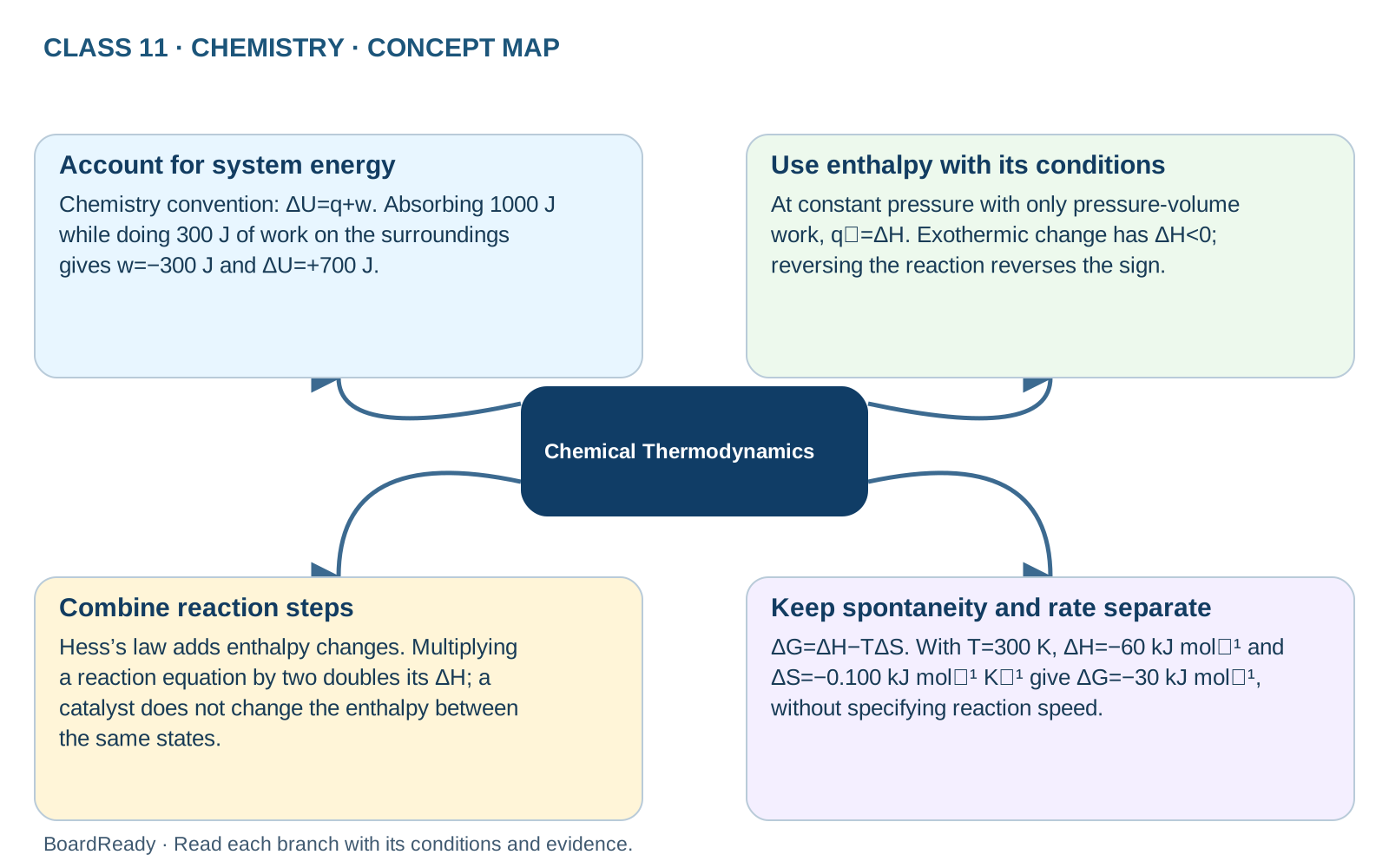
State functions and path-dependent transfers need compatible units and an explicit work-sign convention. Account for system energy: Chemistry convention: ΔU=q+w. Absorbing 1000 J while doing 300 J of work on the surroundings gives w=−300 J and ΔU=+700 J. Use enthalpy with its conditions: At constant pressure with only pressure-volume work, qₚ=ΔH. Exothermic change has ΔH<0; reversing the reaction reverses the sign. Combine reaction steps: Hess’s law adds enthalpy changes. Multiplying a reaction equation by two doubles its ΔH; a catalyst does not change the enthalpy between the same states. Keep spontaneity and rate separate: ΔG=ΔH−TΔS. With T=300 K, ΔH=−60 kJ mol⁻¹ and ΔS=−0.100 kJ mol⁻¹ K⁻¹ give ΔG=−30 kJ mol⁻¹, without specifying reaction speed.Exam cue: Convert entropy units before TΔS, use kelvin and state which system receives heat or work.
- 1Chemical Thermodynamics -> Account for system energy: Chemistry convention: ΔU=q+w. Absorbing 1000 J while doing 300 J of work on the surroundings gives w=−300 J and ΔU=+700 J.
- 2Chemical Thermodynamics -> Use enthalpy with its conditions: At constant pressure with only pressure-volume work, qₚ=ΔH. Exothermic change has ΔH<0; reversing the reaction reverses the sign.
- 3Chemical Thermodynamics -> Combine reaction steps: Hess’s law adds enthalpy changes. Multiplying a reaction equation by two doubles its ΔH; a catalyst does not change the enthalpy between the same states.
- 4Chemical Thermodynamics -> Keep spontaneity and rate separate: ΔG=ΔH−TΔS. With T=300 K, ΔH=−60 kJ mol⁻¹ and ΔS=−0.100 kJ mol⁻¹ K⁻¹ give ΔG=−30 kJ mol⁻¹, without specifying reaction speed.