Comparison map
Chemical Bonding and Molecular Structure: relationships and examples
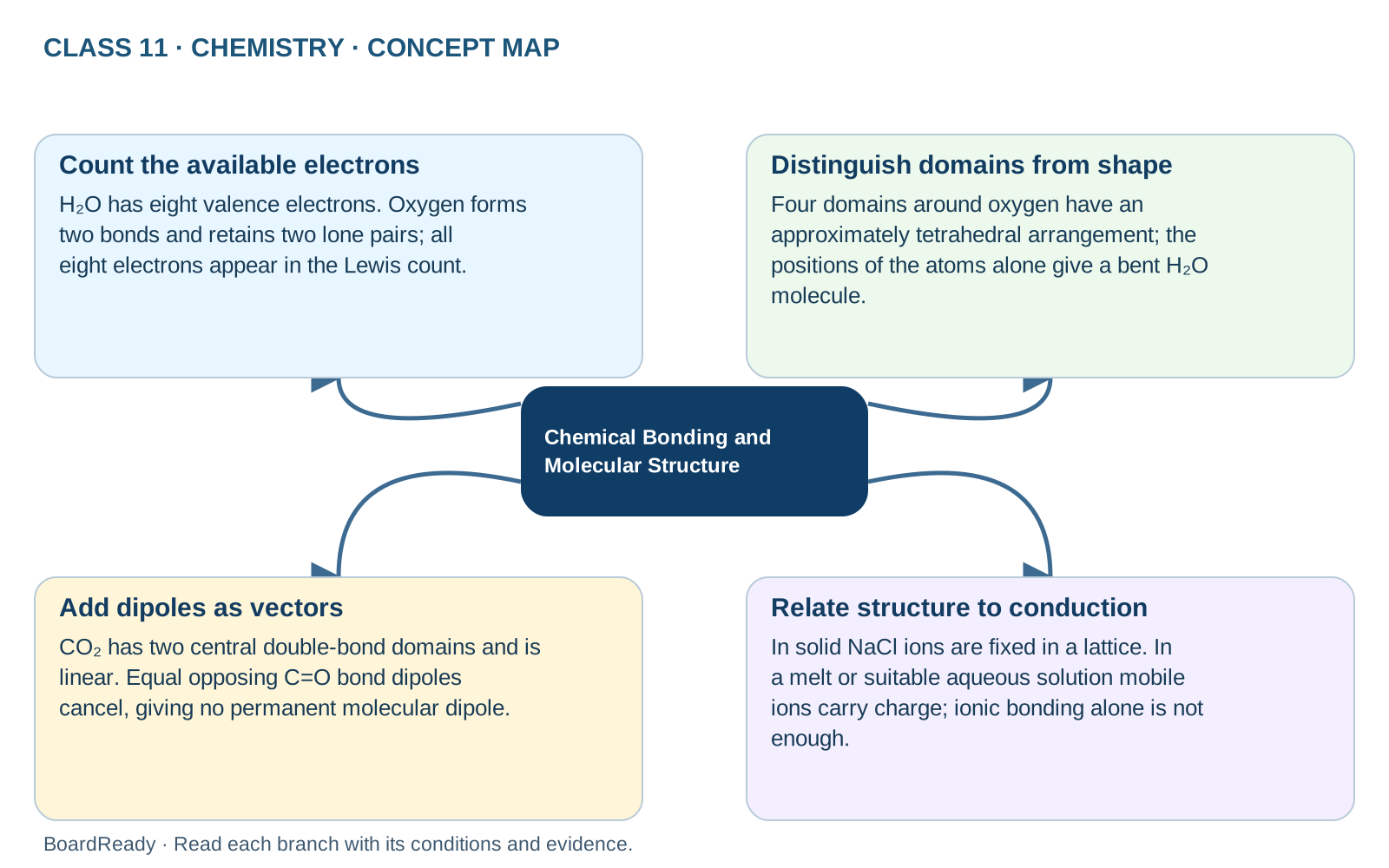
Electron counting, local electron domains and whole-molecule symmetry explain different aspects of bonding. Count the available electrons: H₂O has eight valence electrons. Oxygen forms two bonds and retains two lone pairs; all eight electrons appear in the Lewis count. Distinguish domains from shape: Four domains around oxygen have an approximately tetrahedral arrangement; the positions of the atoms alone give a bent H₂O molecule. Add dipoles as vectors: CO₂ has two central double-bond domains and is linear. Equal opposing C=O bond dipoles cancel, giving no permanent molecular dipole. Relate structure to conduction: In solid NaCl ions are fixed in a lattice. In a melt or suitable aqueous solution mobile ions carry charge; ionic bonding alone is not enough.Exam cue: A multiple bond counts as one VSEPR domain. Separate bond polarity, molecular geometry and the resulting property.
- 1Chemical Bonding and Molecular Structure -> Count the available electrons: H₂O has eight valence electrons. Oxygen forms two bonds and retains two lone pairs; all eight electrons appear in the Lewis count.
- 2Chemical Bonding and Molecular Structure -> Distinguish domains from shape: Four domains around oxygen have an approximately tetrahedral arrangement; the positions of the atoms alone give a bent H₂O molecule.
- 3Chemical Bonding and Molecular Structure -> Add dipoles as vectors: CO₂ has two central double-bond domains and is linear. Equal opposing C=O bond dipoles cancel, giving no permanent molecular dipole.
- 4Chemical Bonding and Molecular Structure -> Relate structure to conduction: In solid NaCl ions are fixed in a lattice. In a melt or suitable aqueous solution mobile ions carry charge; ionic bonding alone is not enough.