Comparison map
Morphology of Flowering Plants: relationships and examples
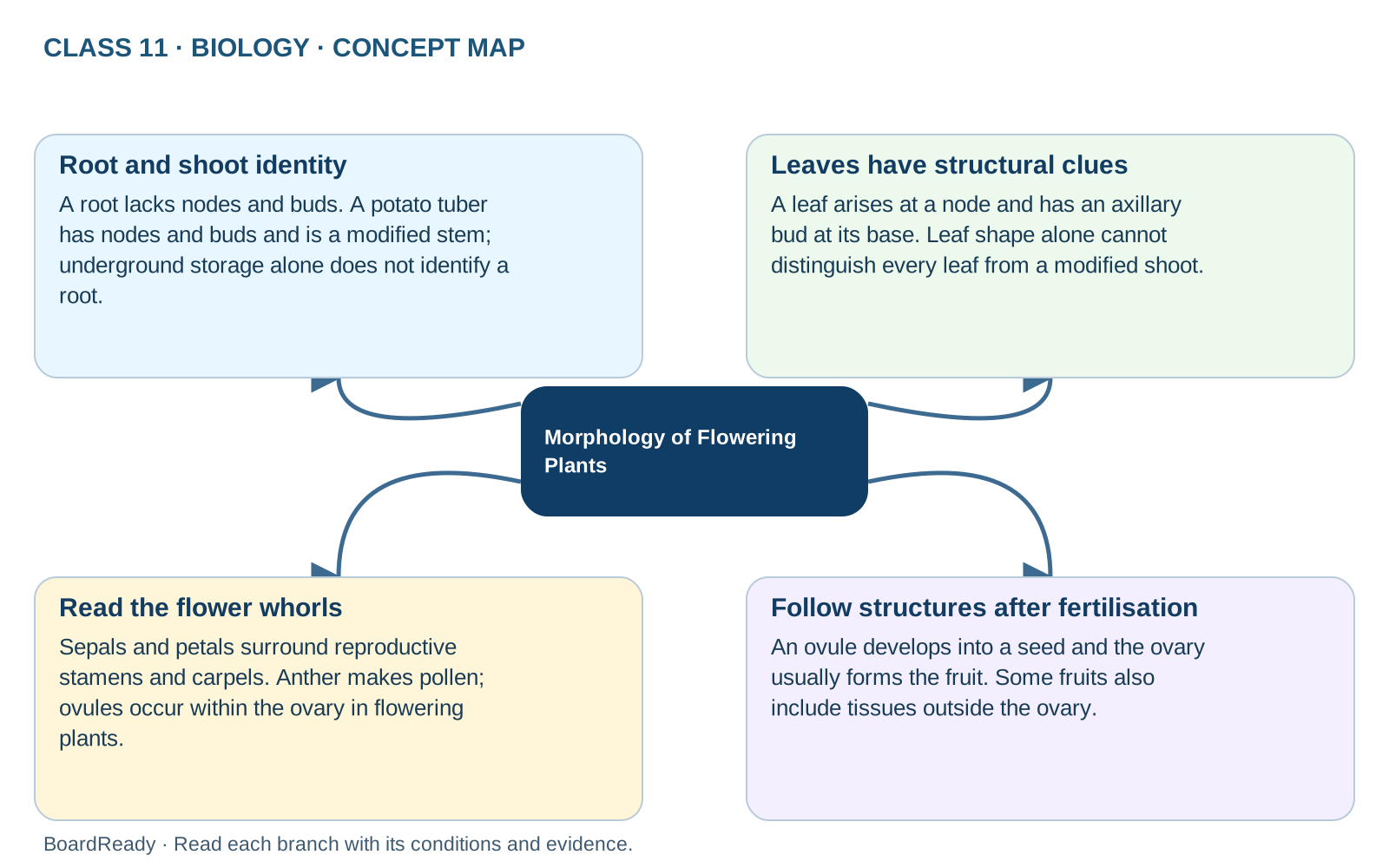
Identify flowering-plant organs from position, origin and structural features, then connect their modifications to function. Root and shoot identity: A root lacks nodes and buds. A potato tuber has nodes and buds and is a modified stem; underground storage alone does not identify a root. Leaves have structural clues: A leaf arises at a node and has an axillary bud at its base. Leaf shape alone cannot distinguish every leaf from a modified shoot. Read the flower whorls: Sepals and petals surround reproductive stamens and carpels. Anther makes pollen; ovules occur within the ovary in flowering plants. Follow structures after fertilisation: An ovule develops into a seed and the ovary usually forms the fruit. Some fruits also include tissues outside the ovary.Exam cue: Name the organ using diagnostic features before explaining its storage, support, protection or reproductive role.
- 1Morphology of Flowering Plants -> Root and shoot identity: A root lacks nodes and buds. A potato tuber has nodes and buds and is a modified stem; underground storage alone does not identify a root.
- 2Morphology of Flowering Plants -> Leaves have structural clues: A leaf arises at a node and has an axillary bud at its base. Leaf shape alone cannot distinguish every leaf from a modified shoot.
- 3Morphology of Flowering Plants -> Read the flower whorls: Sepals and petals surround reproductive stamens and carpels. Anther makes pollen; ovules occur within the ovary in flowering plants.
- 4Morphology of Flowering Plants -> Follow structures after fertilisation: An ovule develops into a seed and the ovary usually forms the fruit. Some fruits also include tissues outside the ovary.