Comparison map
Anatomy of Flowering Plants: relationships and examples
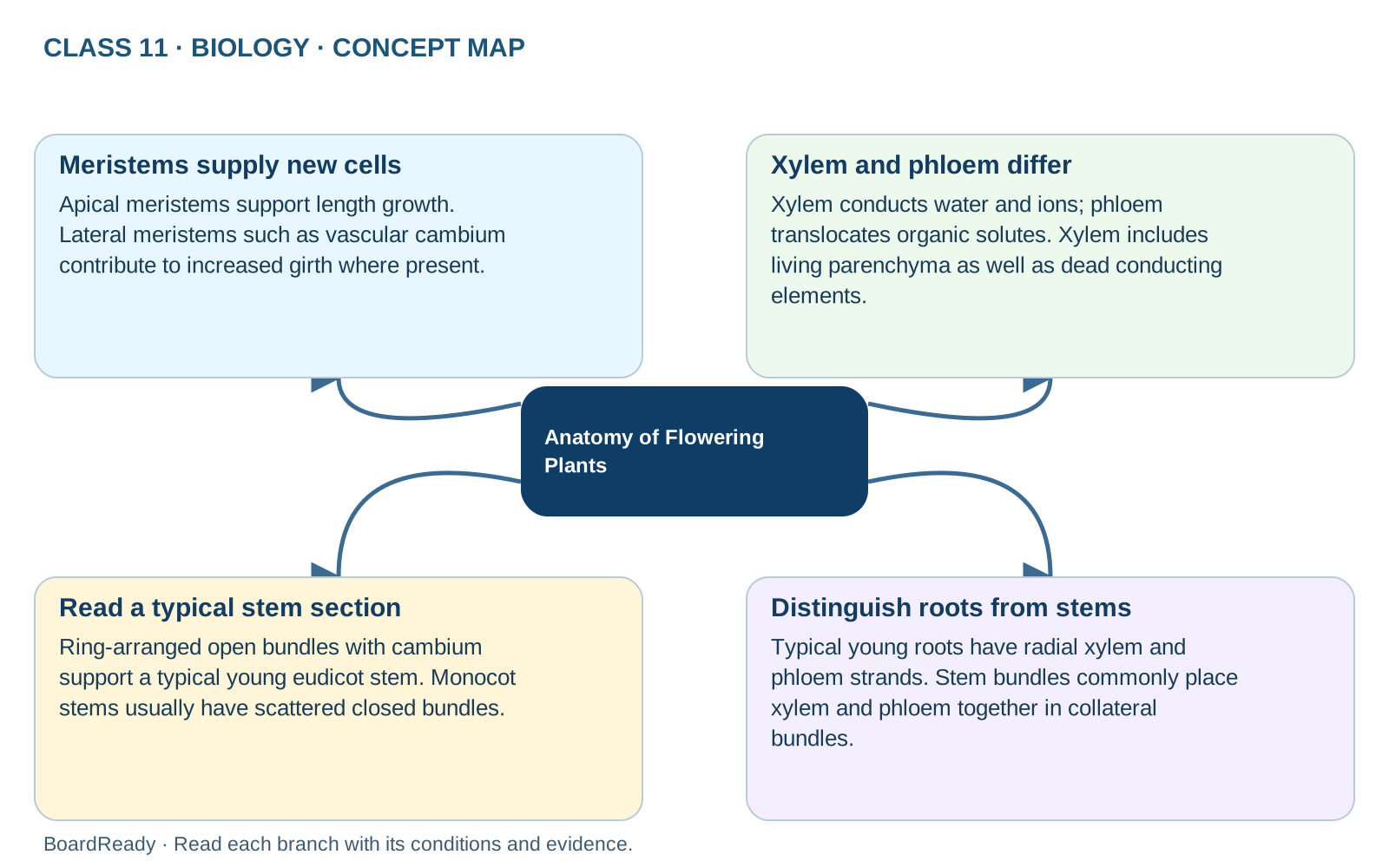
Connect plant tissue arrangements to growth and transport while distinguishing typical patterns from universal rules. Meristems supply new cells: Apical meristems support length growth. Lateral meristems such as vascular cambium contribute to increased girth where present. Xylem and phloem differ: Xylem conducts water and ions; phloem translocates organic solutes. Xylem includes living parenchyma as well as dead conducting elements. Read a typical stem section: Ring-arranged open bundles with cambium support a typical young eudicot stem. Monocot stems usually have scattered closed bundles. Distinguish roots from stems: Typical young roots have radial xylem and phloem strands. Stem bundles commonly place xylem and phloem together in collateral bundles.Exam cue: Identify tissue position and cell type, then explain the growth or transport consequence of the arrangement.
- 1Anatomy of Flowering Plants -> Meristems supply new cells: Apical meristems support length growth. Lateral meristems such as vascular cambium contribute to increased girth where present.
- 2Anatomy of Flowering Plants -> Xylem and phloem differ: Xylem conducts water and ions; phloem translocates organic solutes. Xylem includes living parenchyma as well as dead conducting elements.
- 3Anatomy of Flowering Plants -> Read a typical stem section: Ring-arranged open bundles with cambium support a typical young eudicot stem. Monocot stems usually have scattered closed bundles.
- 4Anatomy of Flowering Plants -> Distinguish roots from stems: Typical young roots have radial xylem and phloem strands. Stem bundles commonly place xylem and phloem together in collateral bundles.