Comparison map
Neural and Chemical Coordination: relationships and examples
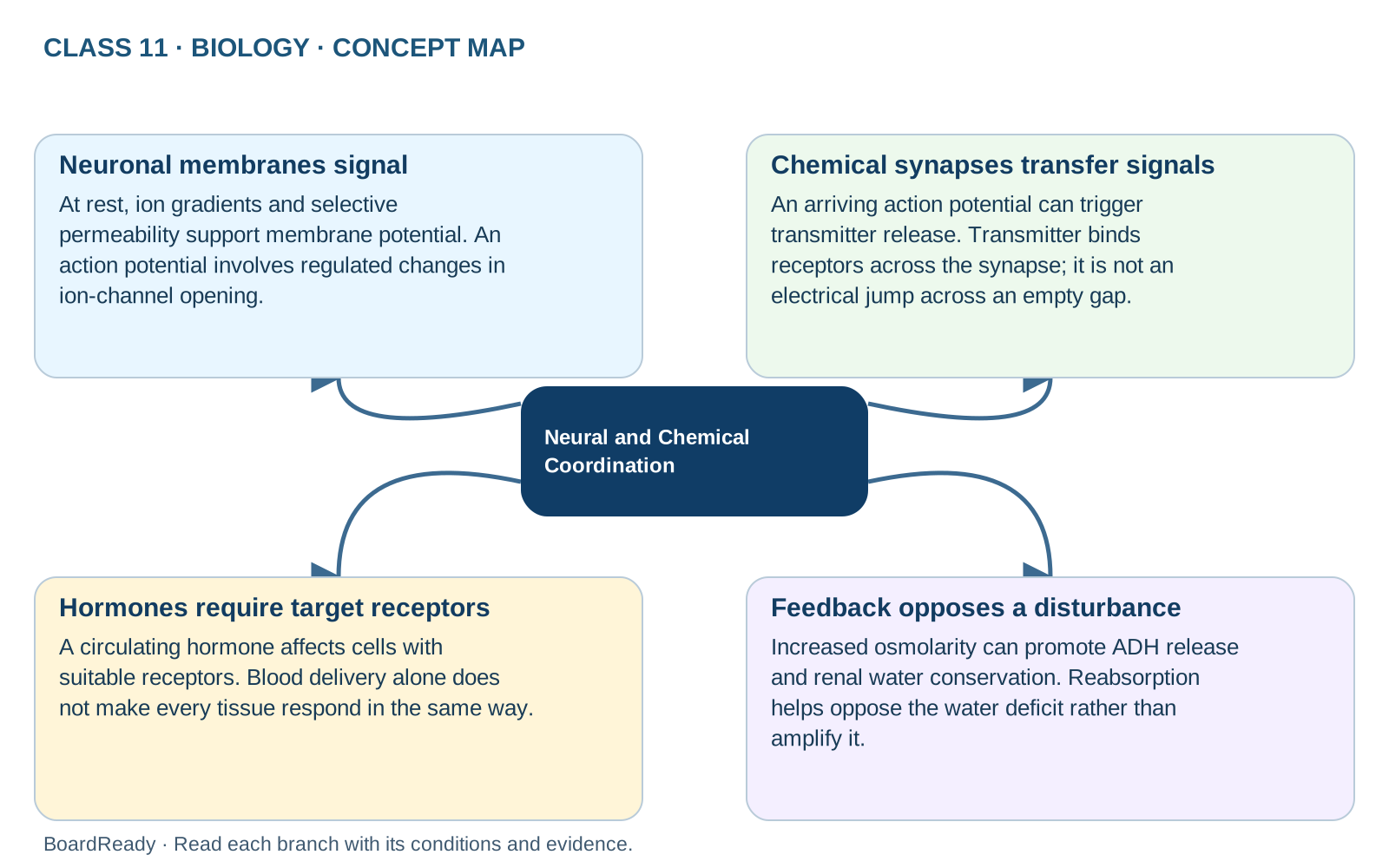
Connect electrical signals, synaptic transmission and hormone action to coordinated responses and feedback. Neuronal membranes signal: At rest, ion gradients and selective permeability support membrane potential. An action potential involves regulated changes in ion-channel opening. Chemical synapses transfer signals: An arriving action potential can trigger transmitter release. Transmitter binds receptors across the synapse; it is not an electrical jump across an empty gap. Hormones require target receptors: A circulating hormone affects cells with suitable receptors. Blood delivery alone does not make every tissue respond in the same way. Feedback opposes a disturbance: Increased osmolarity can promote ADH release and renal water conservation. Reabsorption helps oppose the water deficit rather than amplify it.Exam cue: Identify signal, receptor and effector, then explain the response and feedback direction instead of listing hormone names alone.
- 1Neural and Chemical Coordination -> Neuronal membranes signal: At rest, ion gradients and selective permeability support membrane potential. An action potential involves regulated changes in ion-channel opening.
- 2Neural and Chemical Coordination -> Chemical synapses transfer signals: An arriving action potential can trigger transmitter release. Transmitter binds receptors across the synapse; it is not an electrical jump across an empty gap.
- 3Neural and Chemical Coordination -> Hormones require target receptors: A circulating hormone affects cells with suitable receptors. Blood delivery alone does not make every tissue respond in the same way.
- 4Neural and Chemical Coordination -> Feedback opposes a disturbance: Increased osmolarity can promote ADH release and renal water conservation. Reabsorption helps oppose the water deficit rather than amplify it.