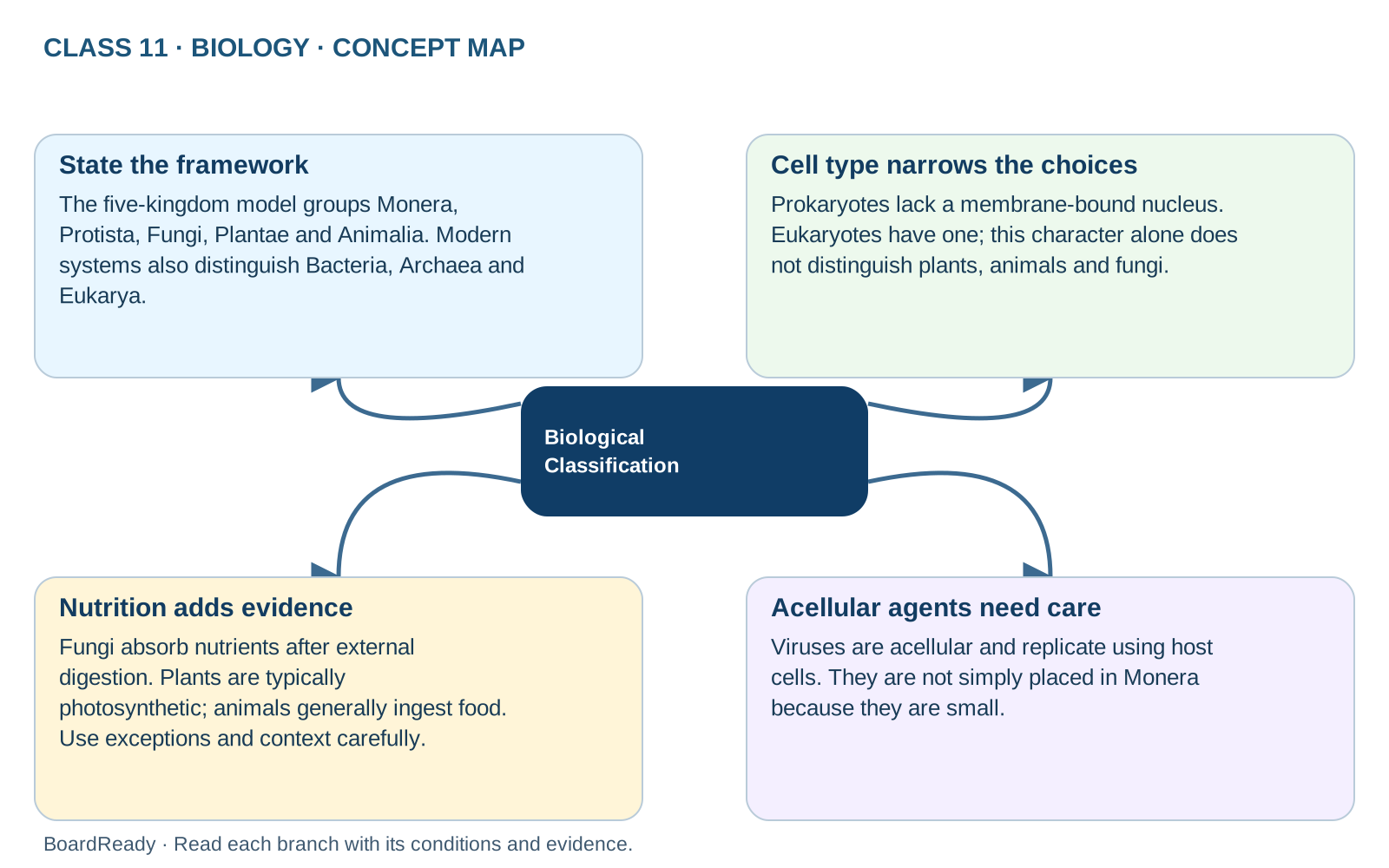
Comparison map
Biological Classification: relationships and examples
Compare organisms within a stated classification framework using cell type, body organisation and nutrition together. State the framework: The five-kingdom model groups Monera, Protista, Fungi, Plantae and Animalia. Modern systems also distinguish Bacteria, Archaea and Eukarya. Cell type narrows the choices: Prokaryotes lack a membrane-bound nucleus. Eukaryotes have one; this character alone does not distinguish plants, animals and fungi. Nutrition adds evidence: Fungi absorb nutrients after external digestion. Plants are typically photosynthetic; animals generally ingest food. Use exceptions and context carefully. Acellular agents need care: Viruses are acellular and replicate using host cells. They are not simply placed in Monera because they are small.Exam cue: Name the model, compare the same properties across groups and justify an identification using several observations.
- 1Biological Classification -> State the framework: The five-kingdom model groups Monera, Protista, Fungi, Plantae and Animalia. Modern systems also distinguish Bacteria, Archaea and Eukarya.
- 2Biological Classification -> Cell type narrows the choices: Prokaryotes lack a membrane-bound nucleus. Eukaryotes have one; this character alone does not distinguish plants, animals and fungi.
- 3Biological Classification -> Nutrition adds evidence: Fungi absorb nutrients after external digestion. Plants are typically photosynthetic; animals generally ingest food. Use exceptions and context carefully.
- 4Biological Classification -> Acellular agents need care: Viruses are acellular and replicate using host cells. They are not simply placed in Monera because they are small.