Comparison map
Light Review: relationships and examples
Connect signed image calculations, refraction conditions and light frequency. An angle or wavelength needs its medium and convention.Exam cue: State distances in the same unit and identify the incident medium. TIR requires higher-to-lower index and incidence above the critical angle.
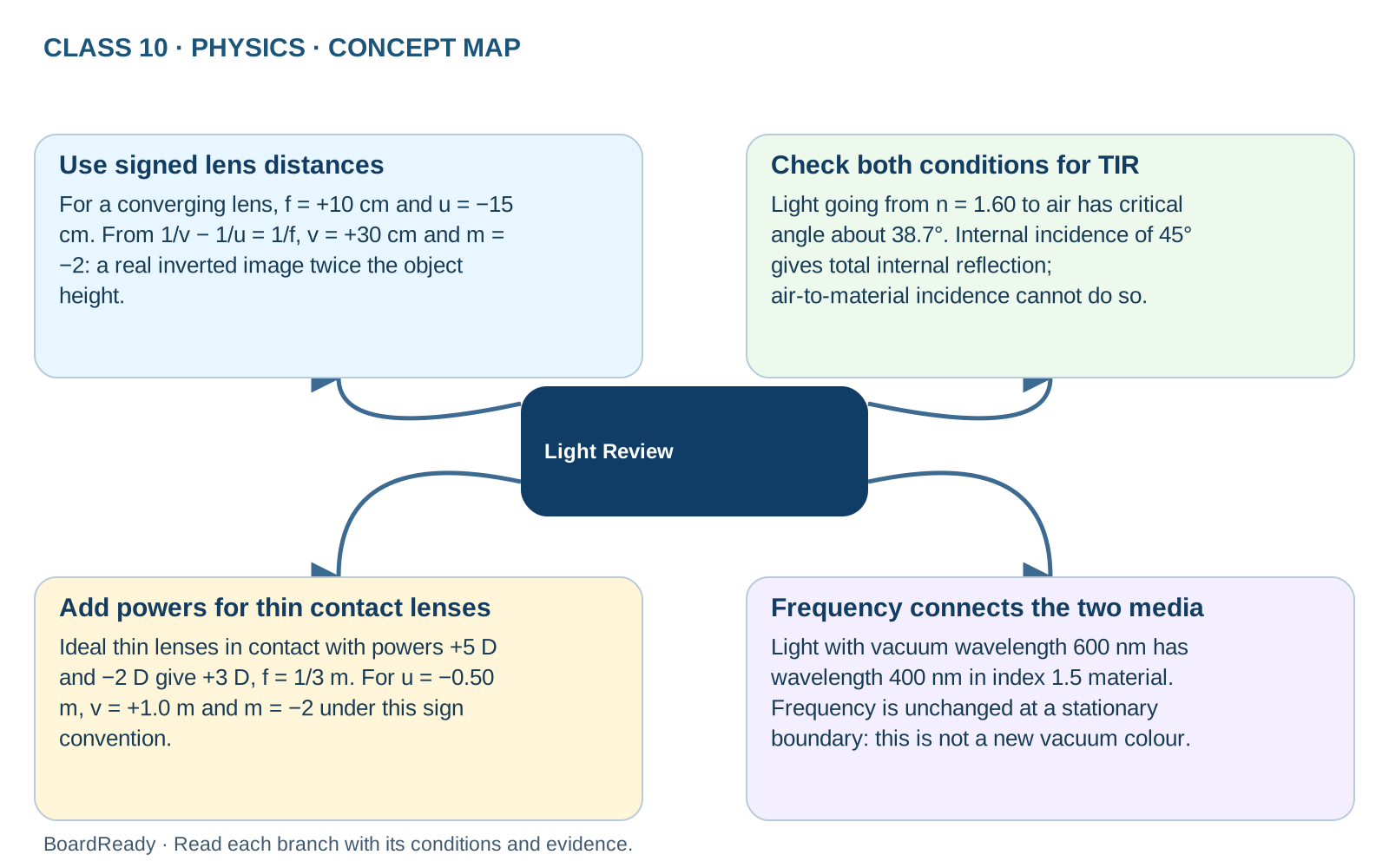
- 1Light Review -> Use signed lens distances: For a converging lens, f = +10 cm and u = −15 cm. From 1/v − 1/u = 1/f, v = +30 cm and m = −2: a real inverted image twice the object height.
- 2Light Review -> Check both conditions for TIR: Light going from n = 1.60 to air has critical angle about 38.7°. Internal incidence of 45° gives total internal reflection; air-to-material incidence cannot do so.
- 3Light Review -> Add powers for thin contact lenses: Ideal thin lenses in contact with powers +5 D and −2 D give +3 D, f = 1/3 m. For u = −0.50 m, v = +1.0 m and m = −2 under this sign convention.
- 4Light Review -> Frequency connects the two media: Light with vacuum wavelength 600 nm has wavelength 400 nm in index 1.5 material. Frequency is unchanged at a stationary boundary: this is not a new vacuum colour.