Comparison map
Uniform Circular Motion: relationships and examples
Constant speed around a circle still requires acceleration because the velocity direction keeps changing.Exam cue: Acceleration is a change of velocity, which includes direction. Uniform circular motion has nonzero inward acceleration.
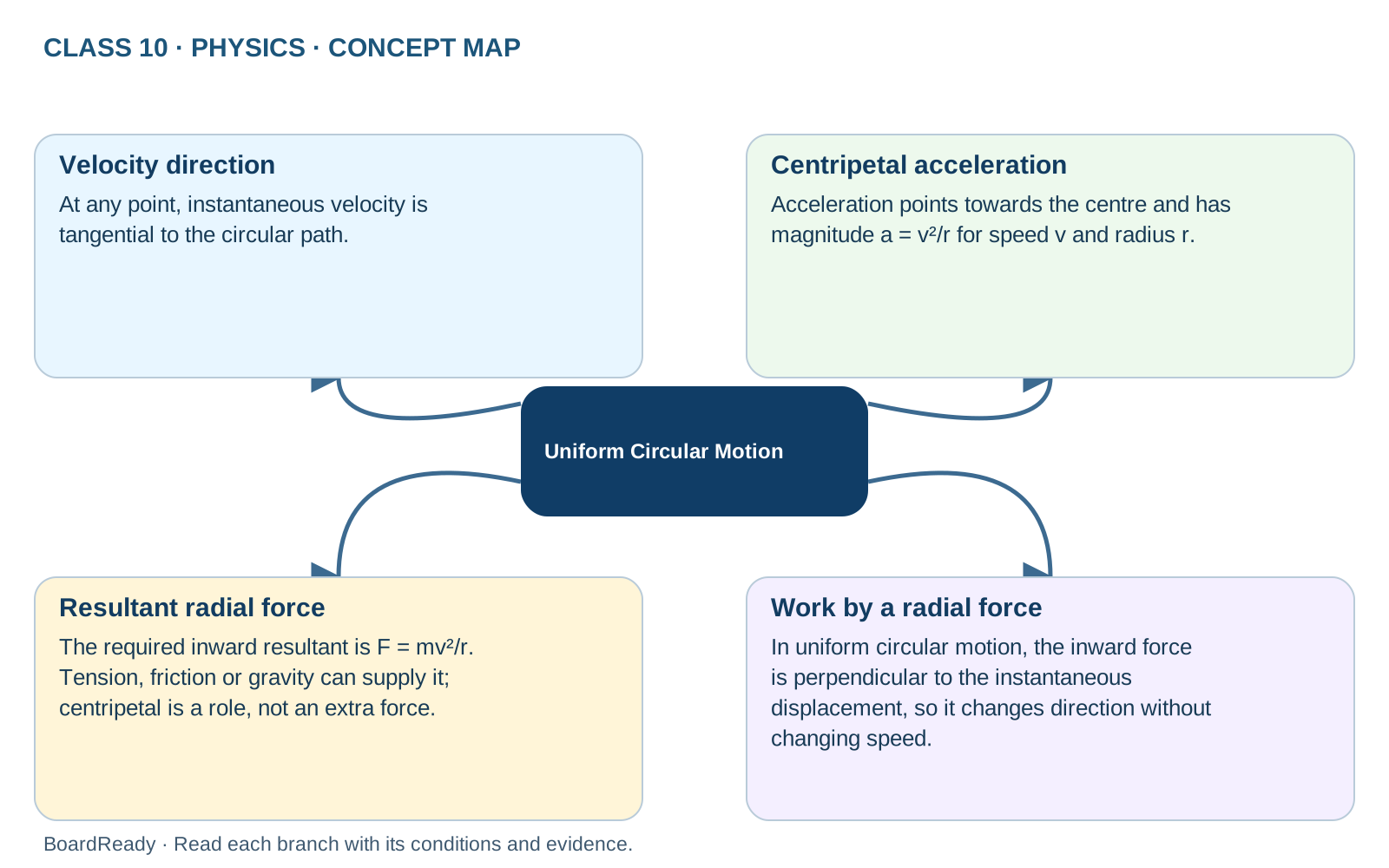
- 1Uniform Circular Motion -> Velocity direction: At any point, instantaneous velocity is tangential to the circular path.
- 2Uniform Circular Motion -> Centripetal acceleration: Acceleration points towards the centre and has magnitude a = v²/r for speed v and radius r.
- 3Uniform Circular Motion -> Resultant radial force: The required inward resultant is F = mv²/r. Tension, friction or gravity can supply it; centripetal is a role, not an extra force.
- 4Uniform Circular Motion -> Work by a radial force: In uniform circular motion, the inward force is perpendicular to the instantaneous displacement, so it changes direction without changing speed.