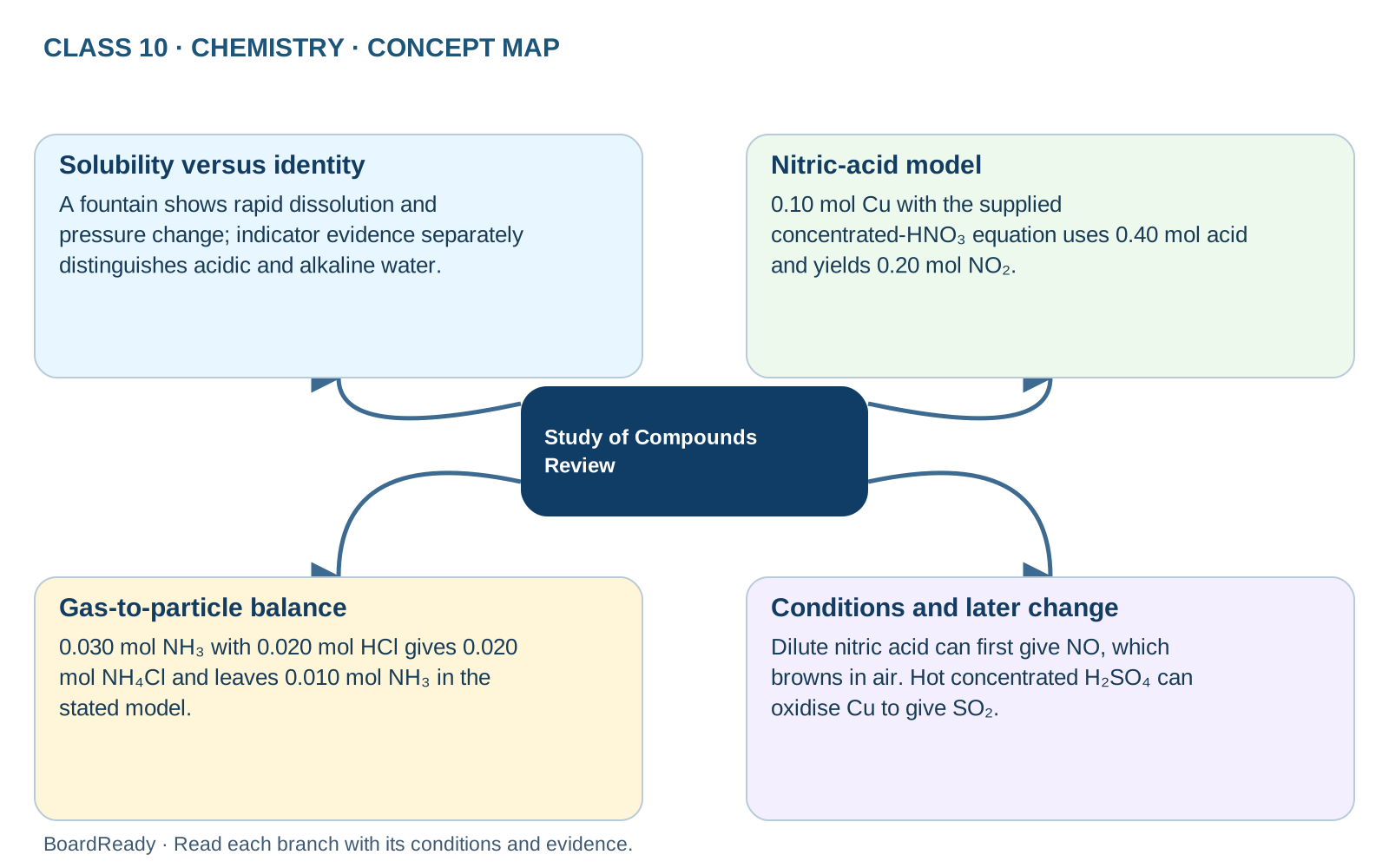
Comparison map
Study of Compounds Review: relationships and examples
Use dissolution, concentration and redox conditions to interpret the reactions of the four compounds.Exam cue: The white NH₄ Cl fumes are fine solid particles. Do not predict hydrogen from every metal–acid reaction.
- 1Study of Compounds Review -> Solubility versus identity: A fountain shows rapid dissolution and pressure change; indicator evidence separately distinguishes acidic and alkaline water.
- 2Study of Compounds Review -> Nitric-acid model: 0.10 mol Cu with the supplied concentrated-HNO₃ equation uses 0.40 mol acid and yields 0.20 mol NO₂.
- 3Study of Compounds Review -> Gas-to-particle balance: 0.030 mol NH₃ with 0.020 mol HCl gives 0.020 mol NH₄ Cl and leaves 0.010 mol NH₃ in the stated model.
- 4Study of Compounds Review -> Conditions and later change: Dilute nitric acid can first give NO, which browns in air. Hot concentrated H₂SO₄ can oxidise Cu to give SO₂.