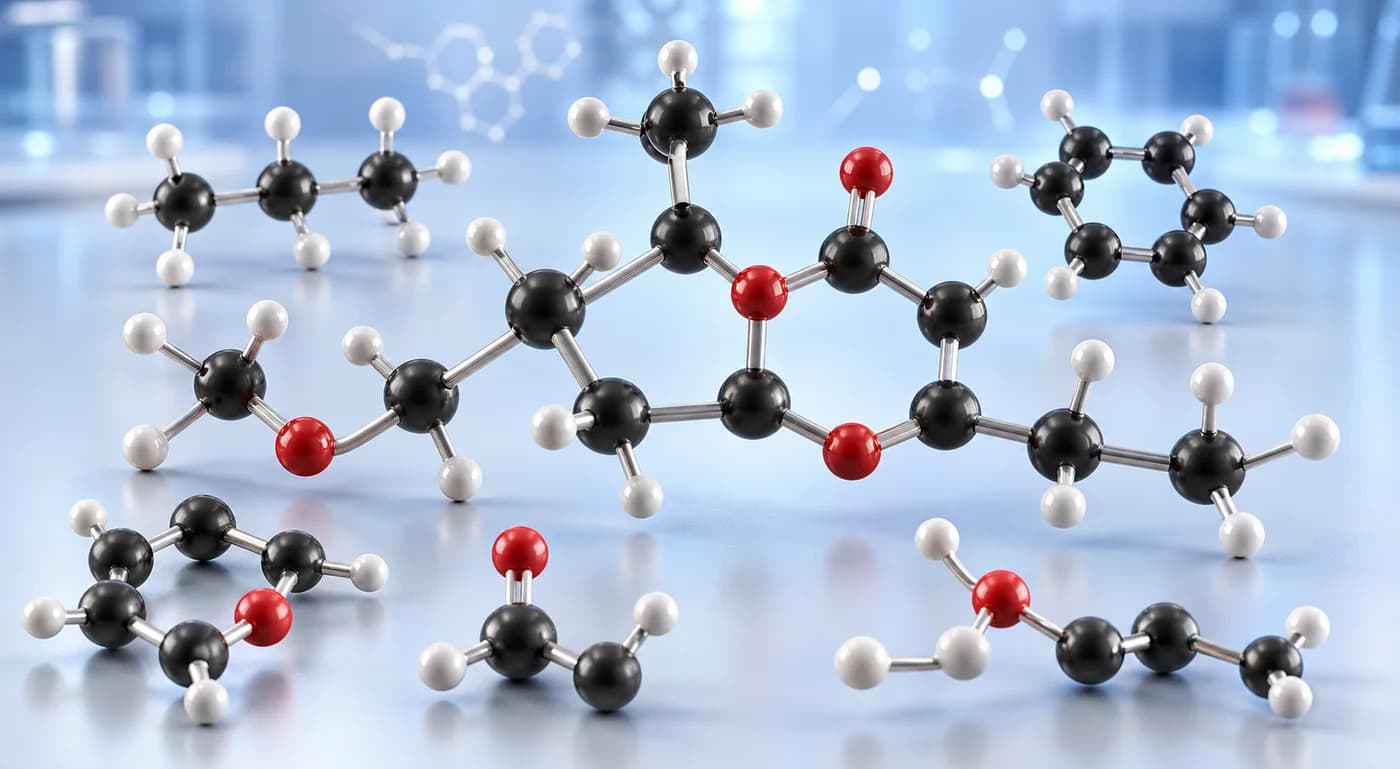
Introduction to Organic Compounds focuses on Introduction to Organic Compounds focuses on Introduction to Organic Compounds focuses on Understand carbon bonding, tetravalency, catenation, hydrocarbons, functional groups, and homologous series. Functional groups determine the chemical behavior of organic compounds. They are responsible for specific reactions like oxidation-reduction or addition-substitution. When identifying functional groups, look at the end of the carbon chain as this is often where the characteristic group will be located. Common mistake: Confusing similar-looking functional groups such as aldehyde (-CHO) and ketone (-CO-). Carbon's ability to form four covalent bonds. Organic chemistry begins with carbon compounds, covalent bonding, and homologous series. Introduction to Organic Compounds focuses on Understand carbon bonding, tetravalency, catenation, hydrocarbons, functional groups, and homologous series. Functional groups determine the chemical behavior of organic compounds. They are responsible for specific reactions like oxidation-reduction or addition-substitution. When identifying functional groups, look at the end of the carbon chain as this is often where the characteristic group will be located. Common mistake: Confusing similar-looking functional groups such as aldehyde (-CHO) and ketone (-CO-). Carbon's ability to form four covalent bonds. Functional groups determine the chemical behavior of organic compounds. They are responsible for specific reactions like oxidation-reduction or addition-substitution. Introduction to Organic Compounds must be answered with exact chemistry vocabulary, not only general description. Organic chemistry begins with carbon compounds, covalent bonding, and homologous series. Introduction to Organic Compounds focuses on Introduction to Organic Compounds focuses on Understand carbon bonding, tetravalency, catenation, hydrocarbons, functional groups, and homologous series. Functional groups determine the chemical behavior of organic compounds. They are responsible for specific reactions like oxidation-reduction or addition-substitution. When identifying functional groups, look at the end of the carbon chain as this is often where the characteristic group will be located. Common mistake: Confusing similar-looking functional groups such as aldehyde (-CHO) and ketone (-CO-). Carbon's ability to form four covalent bonds. Organic chemistry begins with carbon compounds, covalent bonding, and homologous series. Introduction to Organic Compounds focuses on Understand carbon bonding, tetravalency, catenation, hydrocarbons, functional groups, and homologous series. Functional groups determine the chemical behavior of organic compounds. They are responsible for specific reactions like oxidation-reduction or addition-substitution. When identifying functional groups, look at the end of the carbon chain as this is often where the characteristic group will be located. Common mistake: Confusing similar-looking functional groups such as aldehyde (-CHO) and ketone (-CO-). Carbon's ability to form four covalent bonds. Functional groups determine the chemical behavior of organic compounds. They are responsible for specific reactions like oxidation-reduction or addition-substitution. Introduction to Organic Compounds must be answered with exact chemistry vocabulary, not only general description. Organic chemistry begins with carbon compounds, covalent bonding, and homologous series. Introduction to Organic Compounds must be answered with exact chemistry vocabulary, not only general description.