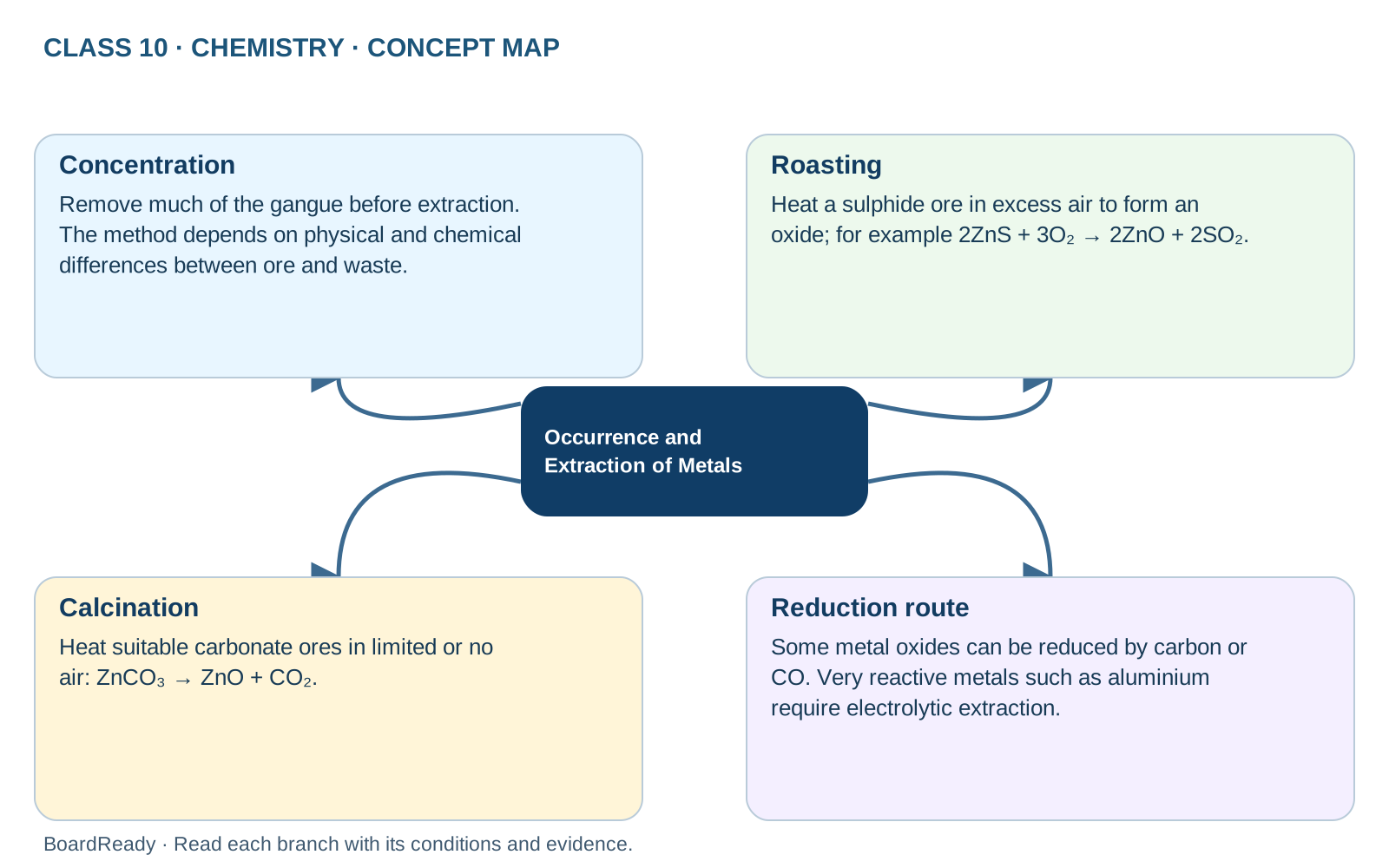
Comparison map
Occurrence and Extraction of Metals: relationships and examples
An extraction route depends on the metal's reactivity and the chemistry of its ore. A mineral is an ore only when extraction is economically worthwhile.Exam cue: Roasting uses air, commonly for sulphides. Calcination decomposes suitable ores with limited or no air, commonly carbonates.
- 1Occurrence and Extraction of Metals -> Concentration: Remove much of the gangue before extraction. The method depends on physical and chemical differences between ore and waste.
- 2Occurrence and Extraction of Metals -> Roasting: Heat a sulphide ore in excess air to form an oxide; for example 2ZnS + 3O₂ → 2ZnO + 2SO₂.
- 3Occurrence and Extraction of Metals -> Calcination: Heat suitable carbonate ores in limited or no air: ZnCO₃ → ZnO + CO₂.
- 4Occurrence and Extraction of Metals -> Reduction route: Some metal oxides can be reduced by carbon or CO. Very reactive metals such as aluminium require electrolytic extraction.