Comparison map
Chemical Bonding Review: relationships and examples
Link charge accounting, structural arrangement and mobile particles to chemical properties.Exam cue: For melting behaviour, distinguish separate molecules from a giant covalent network instead of using a universal covalent rule.
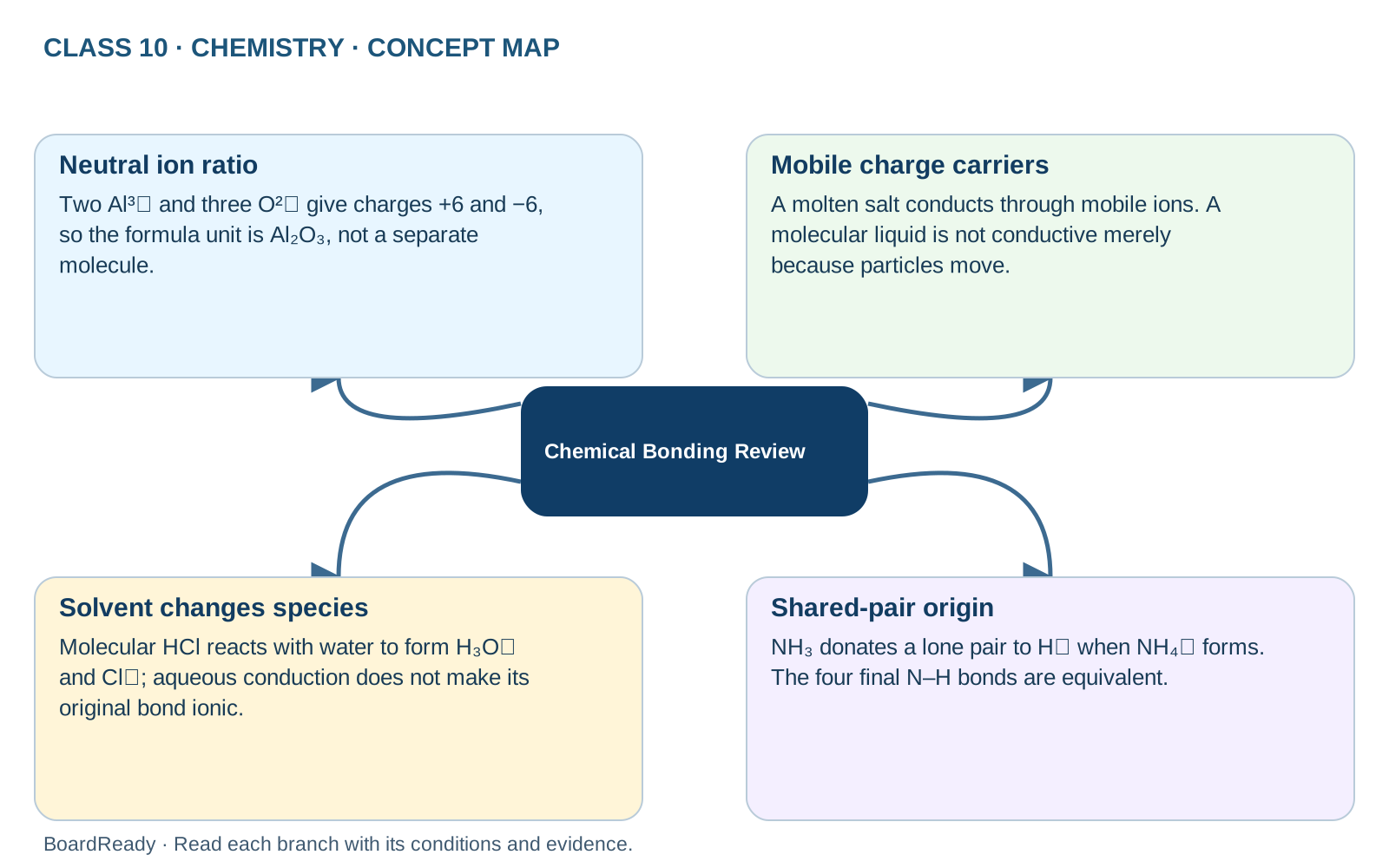
- 1Chemical Bonding Review -> Neutral ion ratio: Two Al³⁺ and three O²⁻ give charges +6 and −6, so the formula unit is Al₂O₃, not a separate molecule.
- 2Chemical Bonding Review -> Mobile charge carriers: A molten salt conducts through mobile ions. A molecular liquid is not conductive merely because particles move.
- 3Chemical Bonding Review -> Solvent changes species: Molecular HCl reacts with water to form H₃O⁺ and Cl⁻; aqueous conduction does not make its original bond ionic.
- 4Chemical Bonding Review -> Shared-pair origin: NH₃ donates a lone pair to H⁺ when NH₄⁺ forms. The four final N–H bonds are equivalent.