
Comparison map
Work, Energy, and Power: relationships and examples
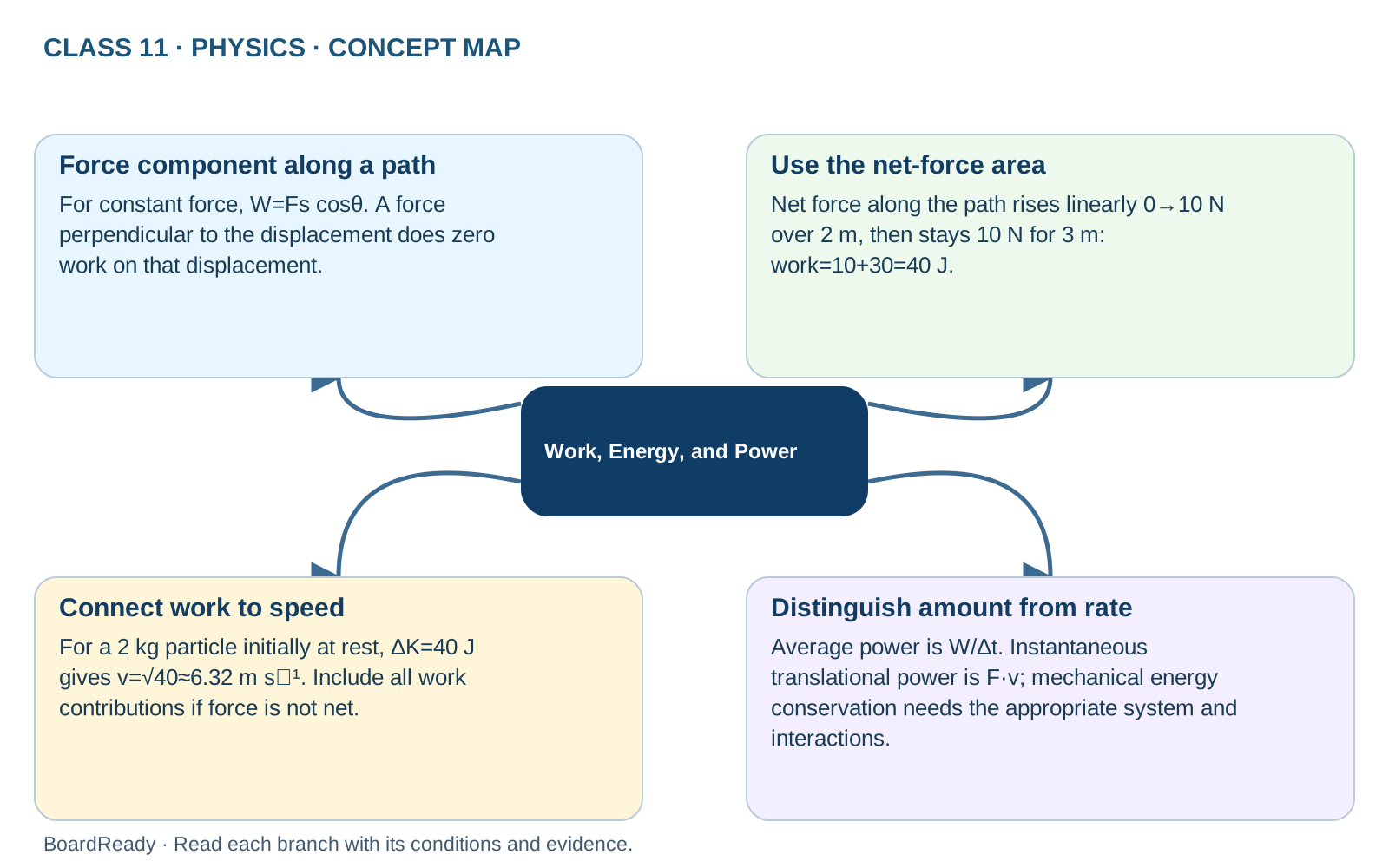
Work, kinetic energy and power describe an energy transfer, its effect and its rate. Force component along a path: For constant force, W=Fs cosθ. A force perpendicular to the displacement does zero work on that displacement. Use the net-force area: Net force along the path rises linearly 0→10 N over 2 m, then stays 10 N for 3 m: work=10+30=40 J. Connect work to speed: For a 2 kg particle initially at rest, ΔK=40 J gives v=√40≈6.32 m s⁻¹. Include all work contributions if force is not net. Distinguish amount from rate: Average power is W/Δt. Instantaneous translational power is F·v; mechanical energy conservation needs the appropriate system and interactions.Exam cue: State the system and distinguish net work, individual work contributions and power.
- 1Work, Energy, and Power -> Force component along a path: For constant force, W=Fs cosθ. A force perpendicular to the displacement does zero work on that displacement.
- 2Work, Energy, and Power -> Use the net-force area: Net force along the path rises linearly 0→10 N over 2 m, then stays 10 N for 3 m: work=10+30=40 J.
- 3Work, Energy, and Power -> Connect work to speed: For a 2 kg particle initially at rest, ΔK=40 J gives v=√40≈6.32 m s⁻¹. Include all work contributions if force is not net.
- 4Work, Energy, and Power -> Distinguish amount from rate: Average power is W/Δt. Instantaneous translational power is F·v; mechanical energy conservation needs the appropriate system and interactions.