
Comparison map
States of Matter: relationships and examples
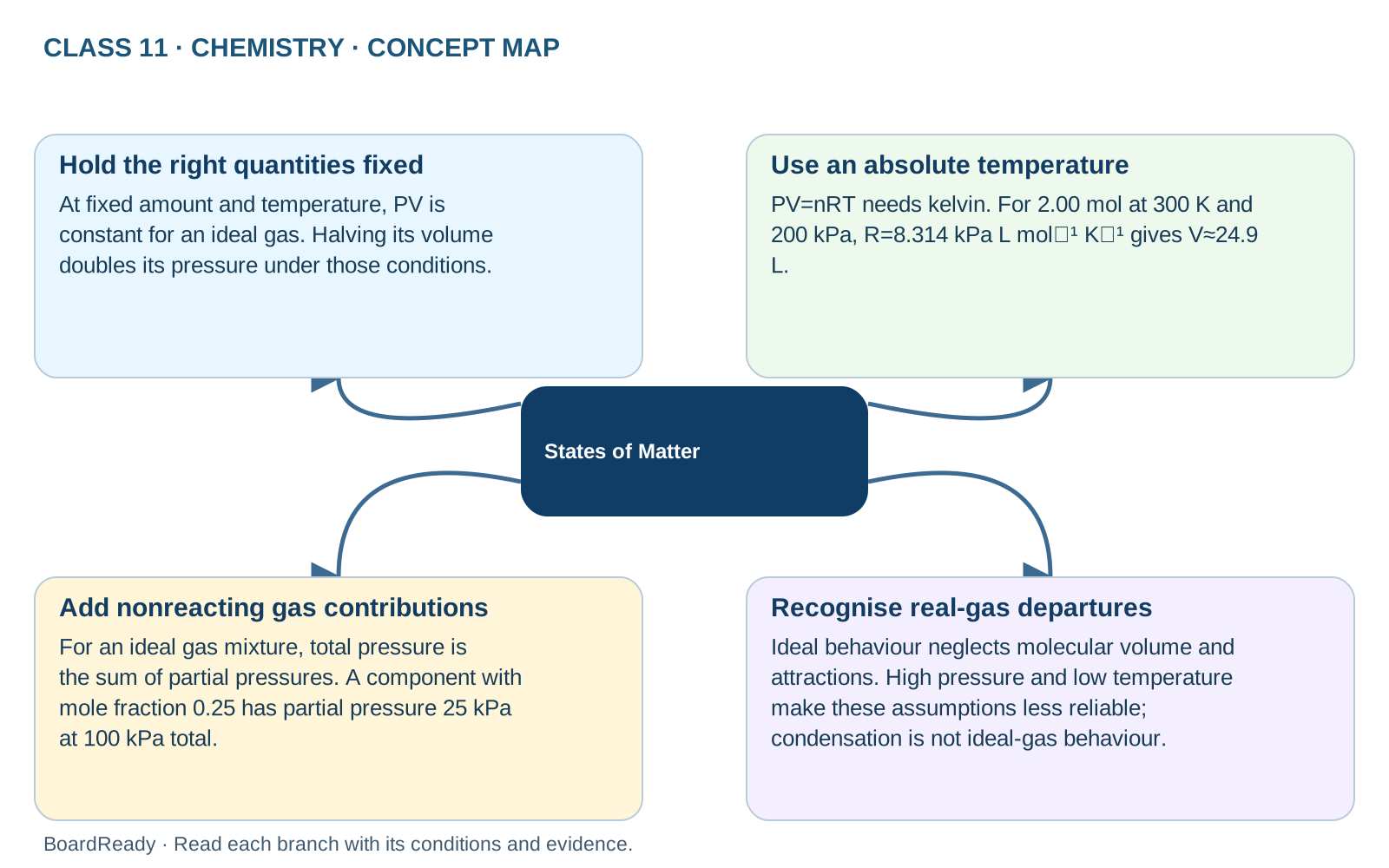
Gas laws connect macroscopic variables through a model whose assumptions must be checked. Hold the right quantities fixed: At fixed amount and temperature, PV is constant for an ideal gas. Halving its volume doubles its pressure under those conditions. Use an absolute temperature: PV=nRT needs kelvin. For 2.00 mol at 300 K and 200 kPa, R=8.314 kPa L mol⁻¹ K⁻¹ gives V≈24.9 L. Add nonreacting gas contributions: For an ideal gas mixture, total pressure is the sum of partial pressures. A component with mole fraction 0.25 has partial pressure 25 kPa at 100 kPa total. Recognise real-gas departures: Ideal behaviour neglects molecular volume and attractions. High pressure and low temperature make these assumptions less reliable; condensation is not ideal-gas behaviour.Exam cue: Name the fixed quantities, keep R compatible with the units and distinguish a gas law from a phase-change description.
- 1States of Matter -> Hold the right quantities fixed: At fixed amount and temperature, PV is constant for an ideal gas. Halving its volume doubles its pressure under those conditions.
- 2States of Matter -> Use an absolute temperature: PV=nRT needs kelvin. For 2.00 mol at 300 K and 200 kPa, R=8.314 kPa L mol⁻¹ K⁻¹ gives V≈24.9 L.
- 3States of Matter -> Add nonreacting gas contributions: For an ideal gas mixture, total pressure is the sum of partial pressures. A component with mole fraction 0.25 has partial pressure 25 kPa at 100 kPa total.
- 4States of Matter -> Recognise real-gas departures: Ideal behaviour neglects molecular volume and attractions. High pressure and low temperature make these assumptions less reliable; condensation is not ideal-gas behaviour.