
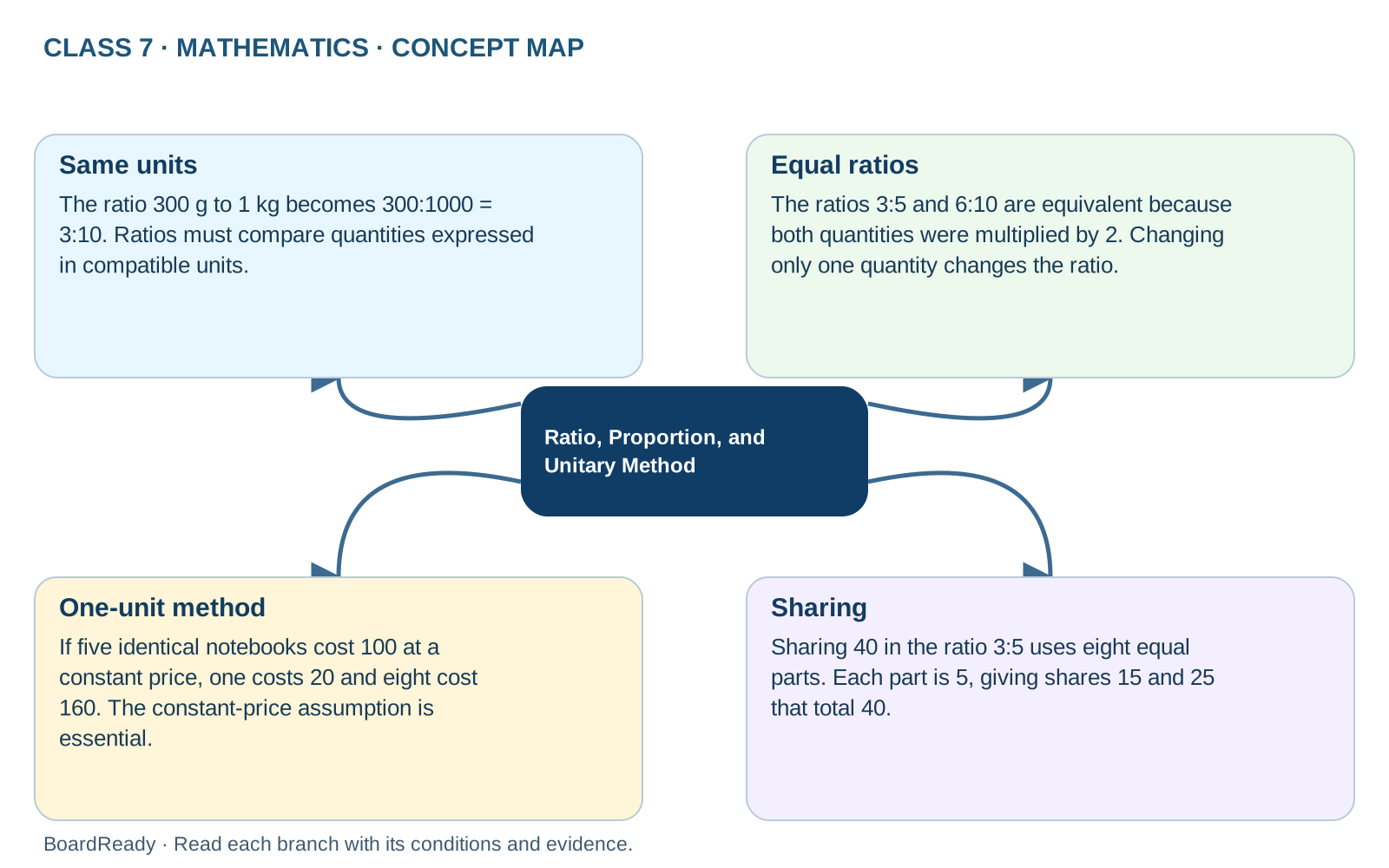
Comparison map
Ratio, Proportion, and Unitary Method: relationships and examples
Compare compatible quantities and use one-unit reasoning only when the relationship supports it.Exam cue: A proportional model must fit the situation; a fixed extra charge can break simple direct proportion.
- 1Ratio, Proportion, and Unitary Method -> Same units: The ratio 300 g to 1 kg becomes 300:1000 = 3:10. Ratios must compare quantities expressed in compatible units.
- 2Ratio, Proportion, and Unitary Method -> Equal ratios: The ratios 3:5 and 6:10 are equivalent because both quantities were multiplied by 2. Changing only one quantity changes the ratio.
- 3Ratio, Proportion, and Unitary Method -> One-unit method: If five identical notebooks cost 100 at a constant price, one costs 20 and eight cost 160. The constant-price assumption is essential.
- 4Ratio, Proportion, and Unitary Method -> Sharing: Sharing 40 in the ratio 3:5 uses eight equal parts. Each part is 5, giving shares 15 and 25 that total 40.