
Comparison map
Physical Quantities, Units, and Symbols: concepts and evidence
A measurement needs both a number and a unit. Standard units let different observers compare the same physical quantity.Exam cue: The unit tells what the number measures and its scale. A result without a needed unit can be ambiguous or misleading.
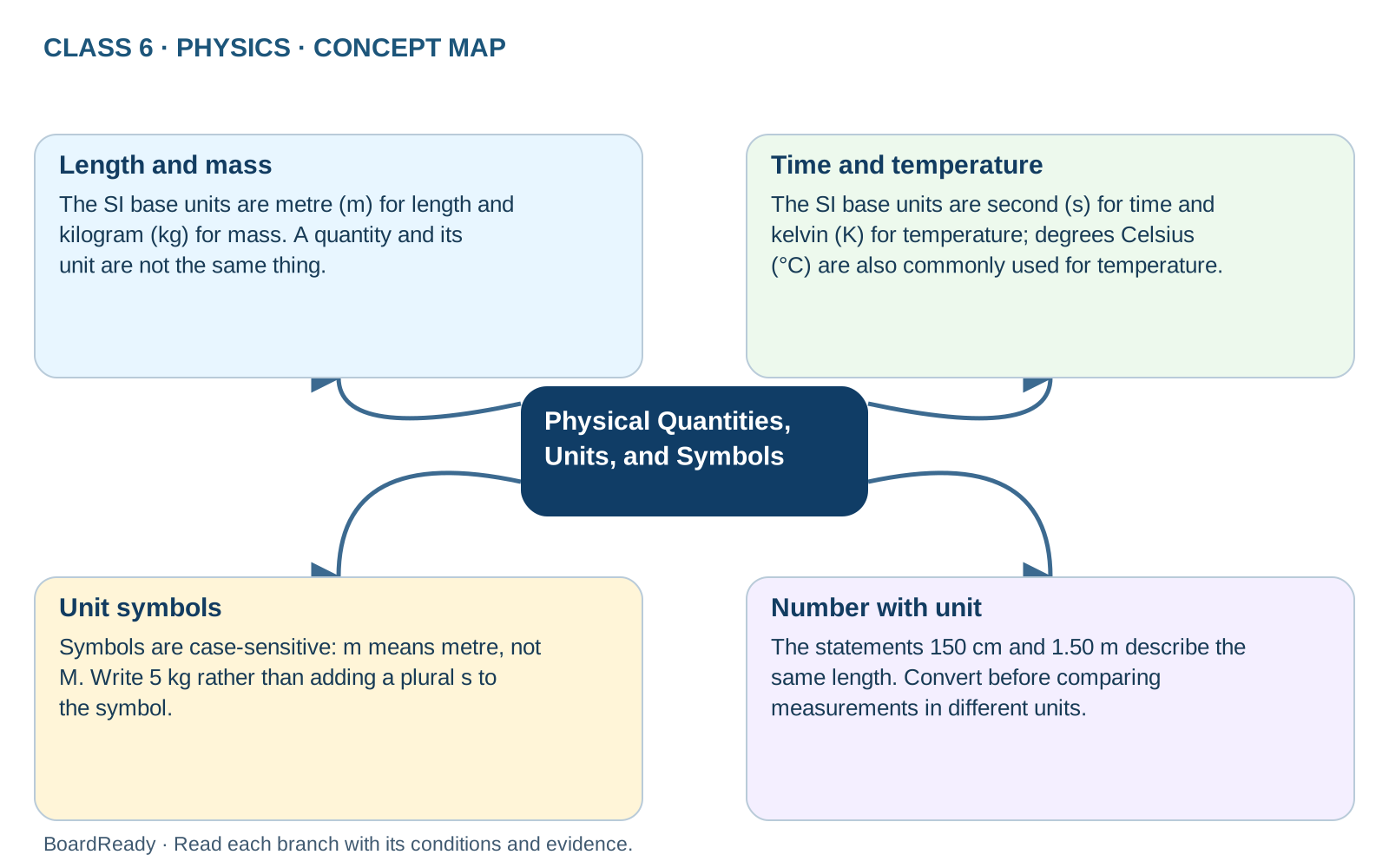
- 1Physical Quantities, Units, and Symbols -> Length and mass: The SI base units are metre (m) for length and kilogram (kg) for mass. A quantity and its unit are not the same thing.
- 2Physical Quantities, Units, and Symbols -> Time and temperature: The SI base units are second (s) for time and kelvin (K) for temperature; degrees Celsius (°C) are also commonly used for temperature.
- 3Physical Quantities, Units, and Symbols -> Unit symbols: Symbols are case-sensitive: m means metre, not M. Write 5 kg rather than adding a plural s to the symbol.
- 4Physical Quantities, Units, and Symbols -> Number with unit: The statements 150 cm and 1.50 m describe the same length. Convert before comparing measurements in different units.