
Comparison map
Classification of Elements and Periodicity: relationships and examples
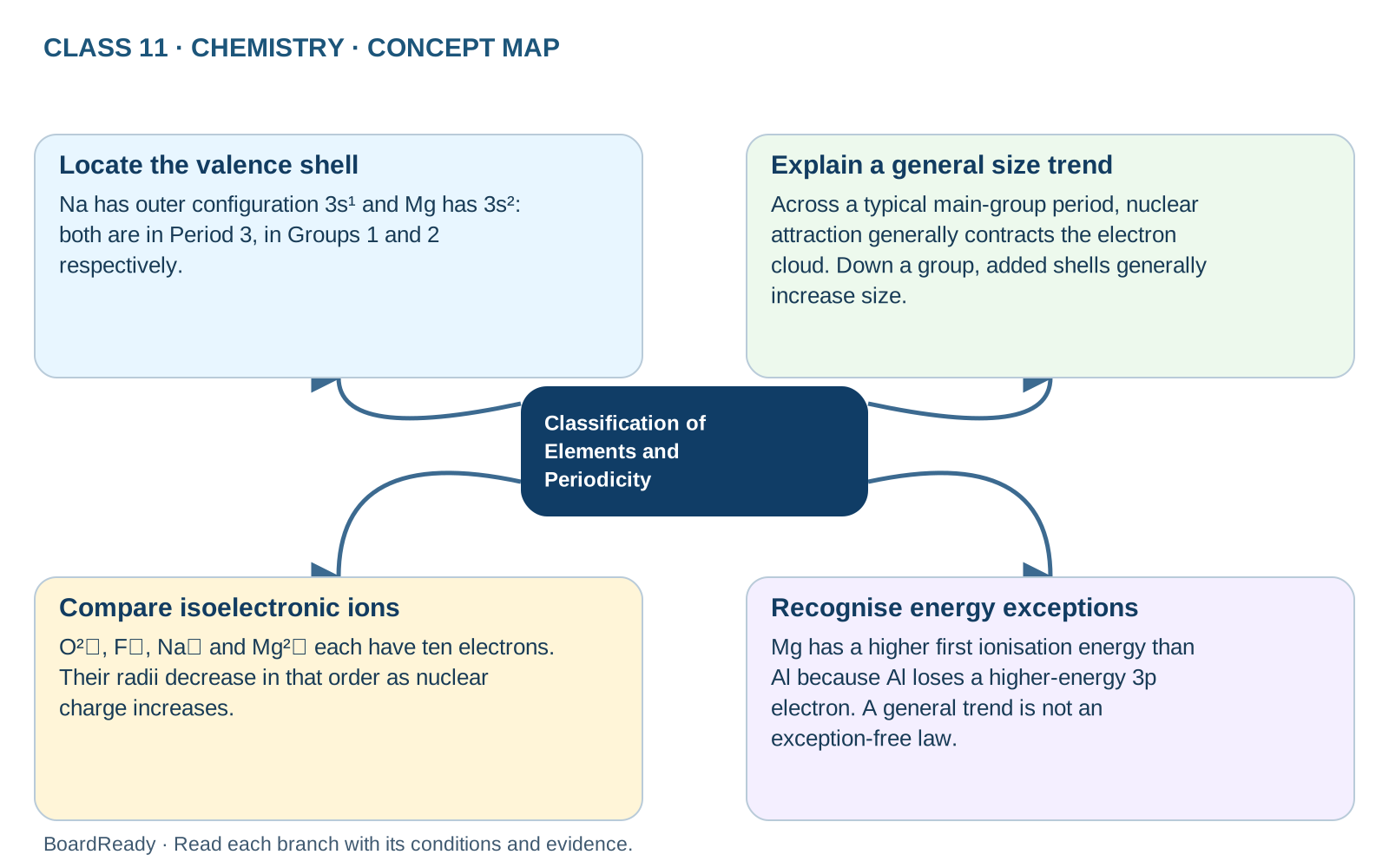
Trends become useful when explained through electron shells, shielding and nuclear attraction. Locate the valence shell: Na has outer configuration 3s¹ and Mg has 3s²: both are in Period 3, in Groups 1 and 2 respectively. Explain a general size trend: Across a typical main-group period, nuclear attraction generally contracts the electron cloud. Down a group, added shells generally increase size. Compare isoelectronic ions: O²⁻, F⁻, Na⁺ and Mg²⁺ each have ten electrons. Their radii decrease in that order as nuclear charge increases. Recognise energy exceptions: Mg has a higher first ionisation energy than Al because Al loses a higher-energy 3p electron. A general trend is not an exception-free law.Exam cue: Specify the atoms or ions, the property and the electronic reason rather than quoting only a trend direction.
- 1Classification of Elements and Periodicity -> Locate the valence shell: Na has outer configuration 3s¹ and Mg has 3s²: both are in Period 3, in Groups 1 and 2 respectively.
- 2Classification of Elements and Periodicity -> Explain a general size trend: Across a typical main-group period, nuclear attraction generally contracts the electron cloud. Down a group, added shells generally increase size.
- 3Classification of Elements and Periodicity -> Compare isoelectronic ions: O²⁻, F⁻, Na⁺ and Mg²⁺ each have ten electrons. Their radii decrease in that order as nuclear charge increases.
- 4Classification of Elements and Periodicity -> Recognise energy exceptions: Mg has a higher first ionisation energy than Al because Al loses a higher-energy 3p electron. A general trend is not an exception-free law.