
Comparison map
Modern Periodic Table: relationships and examples
Atomic number orders the modern table. Electron arrangement explains why elements recur in groups with related properties.Exam cue: The ordering property is atomic number. Isotopes of one element occupy the same position despite different masses.
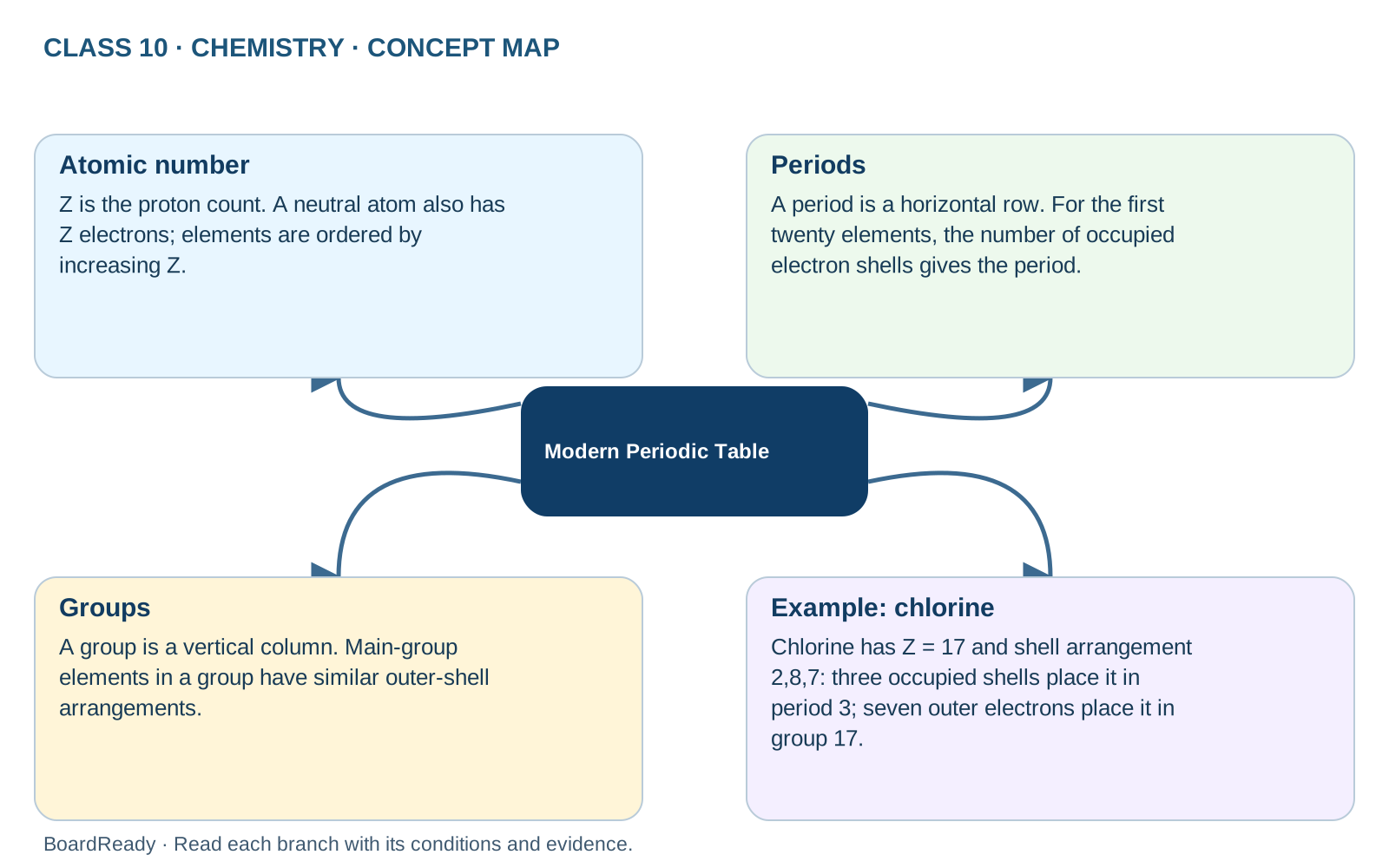
- 1Modern Periodic Table -> Atomic number: Z is the proton count. A neutral atom also has Z electrons; elements are ordered by increasing Z.
- 2Modern Periodic Table -> Periods: A period is a horizontal row. For the first twenty elements, the number of occupied electron shells gives the period.
- 3Modern Periodic Table -> Groups: A group is a vertical column. Main-group elements in a group have similar outer-shell arrangements.
- 4Modern Periodic Table -> Example: chlorine: Chlorine has Z = 17 and shell arrangement 2,8,7: three occupied shells place it in period 3; seven outer electrons place it in group 17.