
Comparison map
Organic Chemistry Basic Principles: relationships and examples
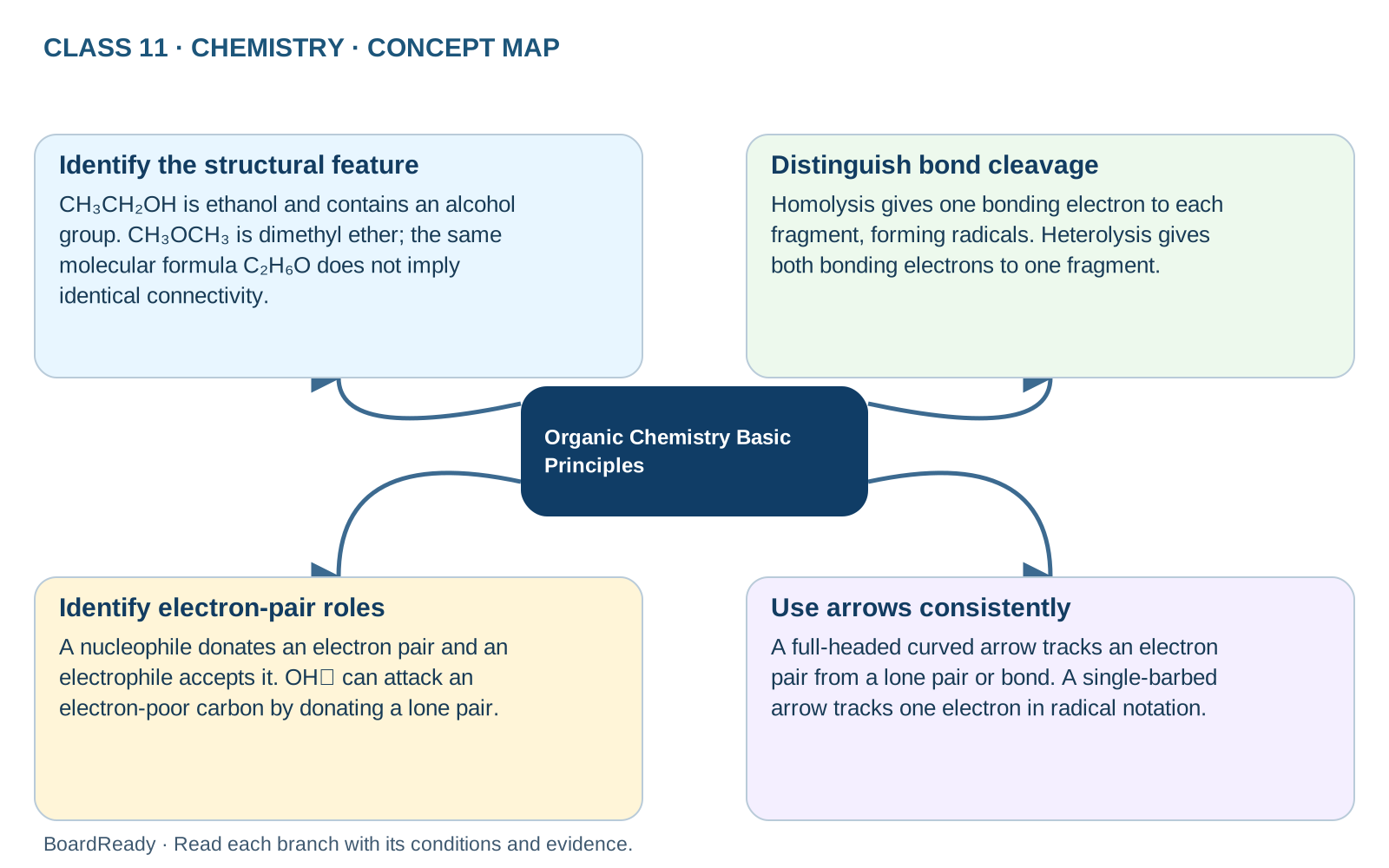
Connectivity and electron movement connect organic names, isomerism and reaction reasoning. Identify the structural feature: CH₃CH₂OH is ethanol and contains an alcohol group. CH₃OCH₃ is dimethyl ether; the same molecular formula C₂H₆O does not imply identical connectivity. Distinguish bond cleavage: Homolysis gives one bonding electron to each fragment, forming radicals. Heterolysis gives both bonding electrons to one fragment. Identify electron-pair roles: A nucleophile donates an electron pair and an electrophile accepts it. OH⁻ can attack an electron-poor carbon by donating a lone pair. Use arrows consistently: A full-headed curved arrow tracks an electron pair from a lone pair or bond. A single-barbed arrow tracks one electron in radical notation.Exam cue: Draw connectivity and label the electron source and acceptor; arrows represent electrons rather than a path taken by an atom.
- 1Organic Chemistry Basic Principles -> Identify the structural feature: CH₃CH₂OH is ethanol and contains an alcohol group. CH₃OCH₃ is dimethyl ether; the same molecular formula C₂H₆O does not imply identical connectivity.
- 2Organic Chemistry Basic Principles -> Distinguish bond cleavage: Homolysis gives one bonding electron to each fragment, forming radicals. Heterolysis gives both bonding electrons to one fragment.
- 3Organic Chemistry Basic Principles -> Identify electron-pair roles: A nucleophile donates an electron pair and an electrophile accepts it. OH⁻ can attack an electron-poor carbon by donating a lone pair.
- 4Organic Chemistry Basic Principles -> Use arrows consistently: A full-headed curved arrow tracks an electron pair from a lone pair or bond. A single-barbed arrow tracks one electron in radical notation.