
Comparison map
Soaps, Detergents and Polymers: relationships and examples
Distinguish the assembly of soap molecules from covalent addition polymerisation.Exam cue: Do not infer biodegradability from the label detergent, or describe scum as the polymer product.
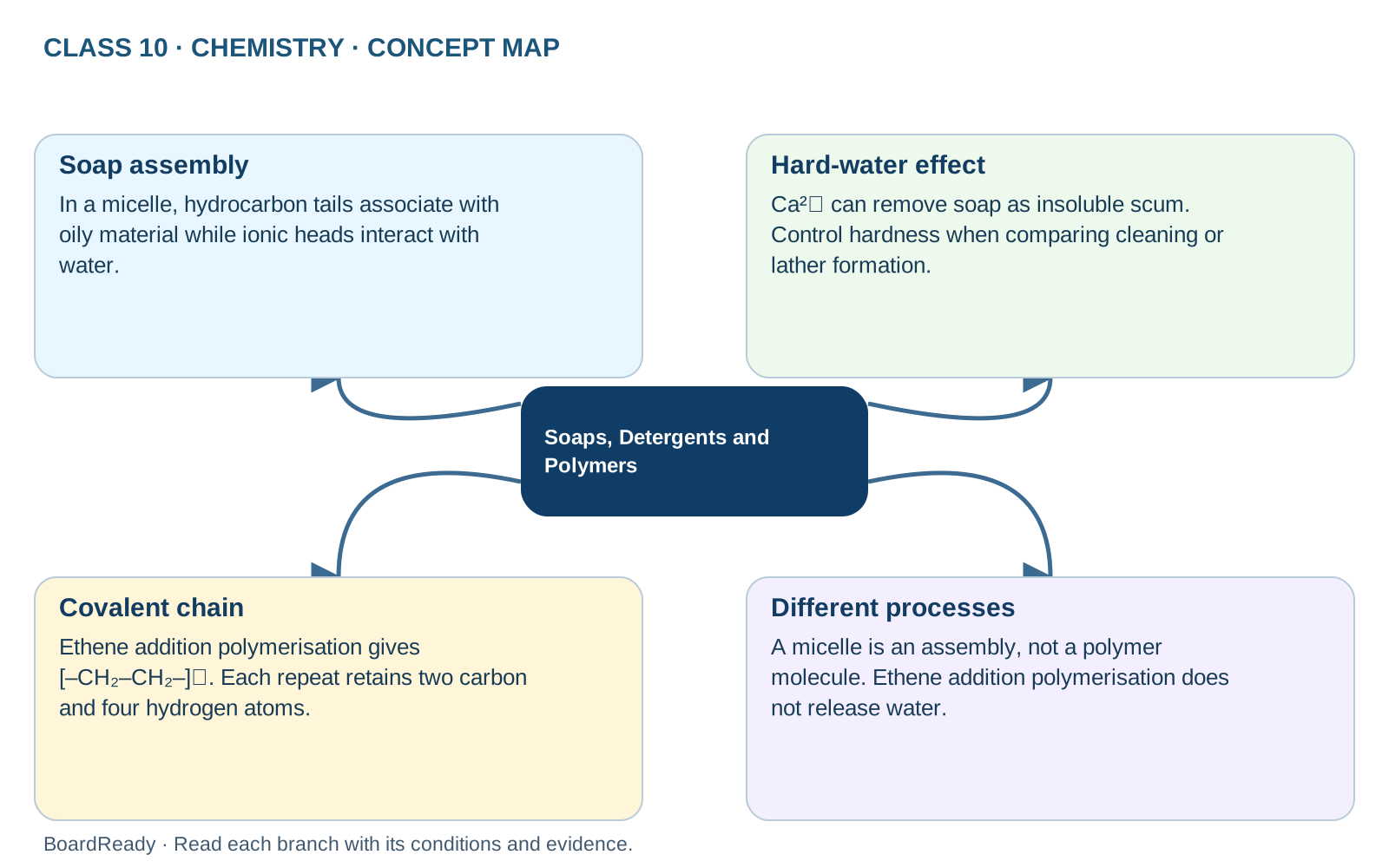
- 1Soaps, Detergents and Polymers -> Soap assembly: In a micelle, hydrocarbon tails associate with oily material while ionic heads interact with water.
- 2Soaps, Detergents and Polymers -> Hard-water effect: Ca²⁺ can remove soap as insoluble scum. Control hardness when comparing cleaning or lather formation.
- 3Soaps, Detergents and Polymers -> Covalent chain: Ethene addition polymerisation gives [–CH₂–CH₂–]ₙ. Each repeat retains two carbon and four hydrogen atoms.
- 4Soaps, Detergents and Polymers -> Different processes: A micelle is an assembly, not a polymer molecule. Ethene addition polymerisation does not release water.