
Comparison map
Number Sets: relationships and examples
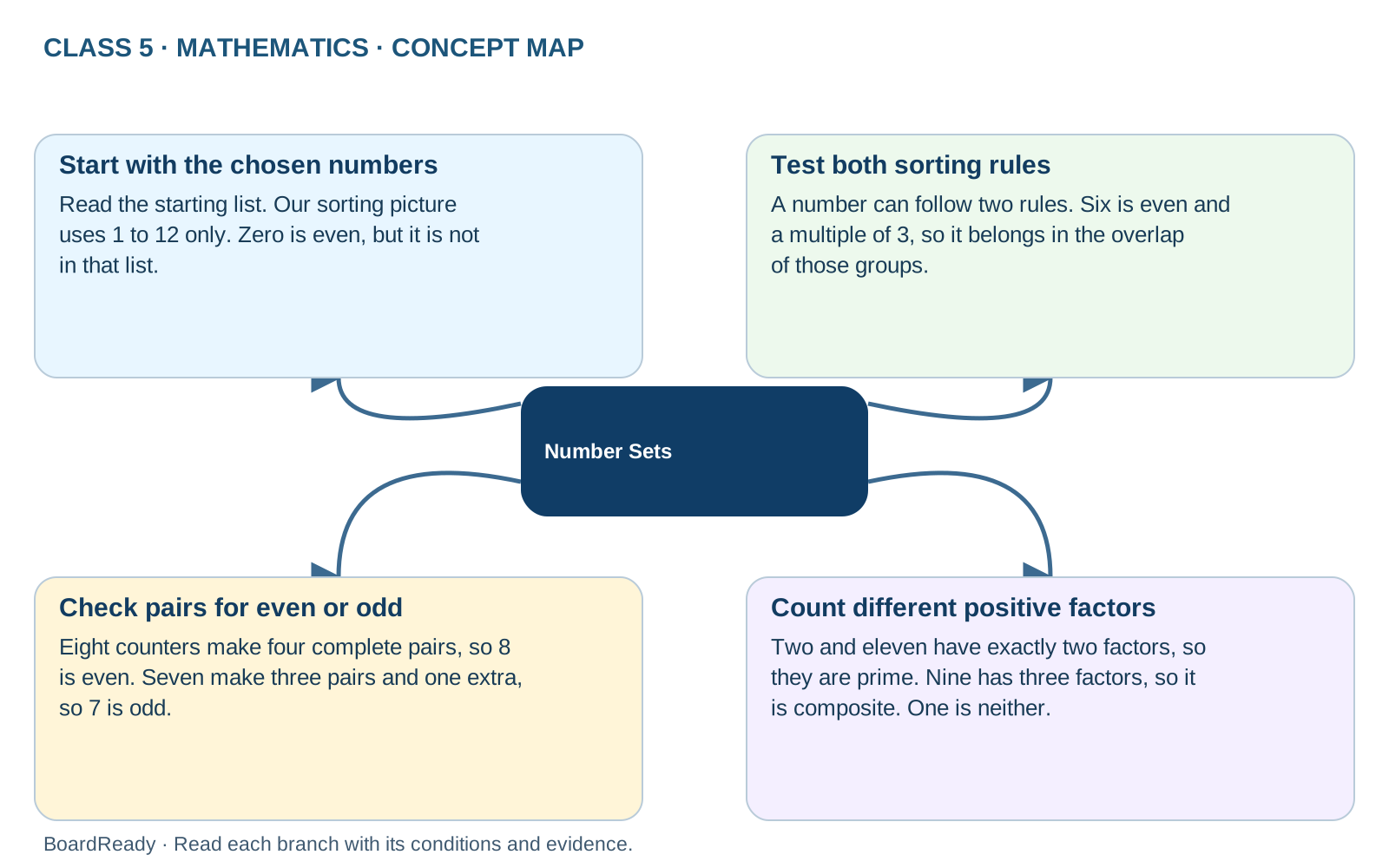
Choose a clear sorting rule and use counters or factors to explain where a number belongs. Start with the chosen numbers: Read the starting list. Our sorting picture uses 1 to 12 only. Zero is even, but it is not in that list. Test both sorting rules: A number can follow two rules. Six is even and a multiple of 3, so it belongs in the overlap of those groups. Check pairs for even or odd: Eight counters make four complete pairs, so 8 is even. Seven make three pairs and one extra, so 7 is odd. Count different positive factors: Two and eleven have exactly two factors, so they are prime. Nine has three factors, so it is composite. One is neither.Exam cue: State the list and rule before sorting. Check both rules for overlapping groups. Use pairs for even/odd and positive factors for prime/composite.
- 1Number Sets -> Start with the chosen numbers: Read the starting list. Our sorting picture uses 1 to 12 only. Zero is even, but it is not in that list.
- 2Number Sets -> Test both sorting rules: A number can follow two rules. Six is even and a multiple of 3, so it belongs in the overlap of those groups.
- 3Number Sets -> Check pairs for even or odd: Eight counters make four complete pairs, so 8 is even. Seven make three pairs and one extra, so 7 is odd.
- 4Number Sets -> Count different positive factors: Two and eleven have exactly two factors, so they are prime. Nine has three factors, so it is composite. One is neither.