
Comparison map
States and Properties of Matter: relationships and examples
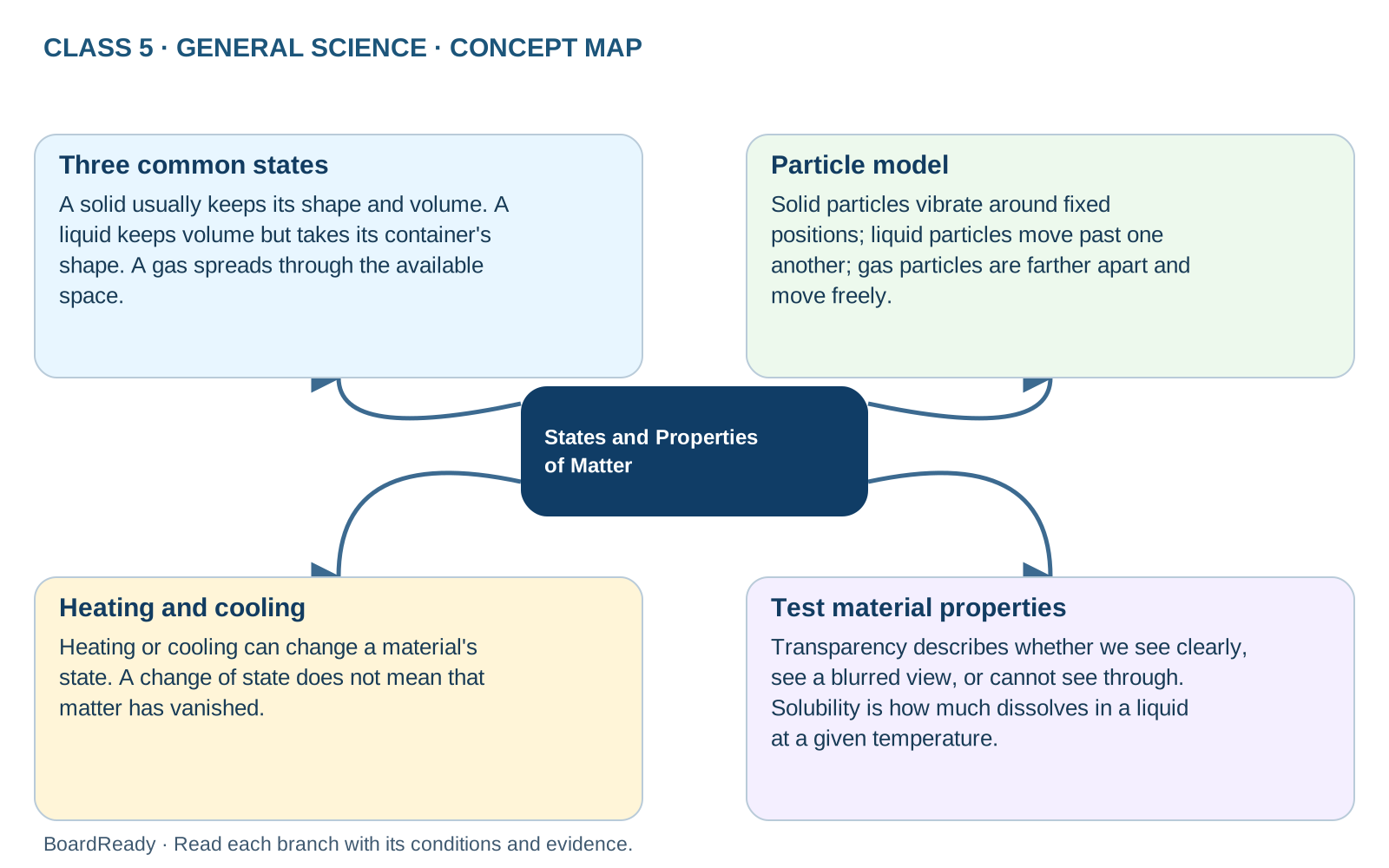
Compare states by both particle behaviour and observable shape, volume, compression, and material properties. Three common states: A solid usually keeps its shape and volume. A liquid keeps volume but takes its container's shape. A gas spreads through the available space. Particle model: Solid particles vibrate around fixed positions; liquid particles move past one another; gas particles are farther apart and move freely. Heating and cooling: Heating or cooling can change a material's state. A change of state does not mean that matter has vanished. Test material properties: Transparency describes whether we see clearly, see a blurred view, or cannot see through. Solubility is how much dissolves in a liquid at a given temperature.Exam cue: Compare shape and volume separately. For a fair material test, keep conditions such as sample depth, water amount, and temperature the same.
- 1States and Properties of Matter -> Three common states: A solid usually keeps its shape and volume. A liquid keeps volume but takes its container's shape. A gas spreads through the available space.
- 2States and Properties of Matter -> Particle model: Solid particles vibrate around fixed positions; liquid particles move past one another; gas particles are farther apart and move freely.
- 3States and Properties of Matter -> Heating and cooling: Heating or cooling can change a material's state. A change of state does not mean that matter has vanished.
- 4States and Properties of Matter -> Test material properties: Transparency describes whether we see clearly, see a blurred view, or cannot see through. Solubility is how much dissolves in a liquid at a given temperature.