
Comparison map
States of Matter: relationships and examples
Use particle arrangement and mobility to explain shape and volume.Exam cue: Distinguish moving particles from the whole sample flowing.
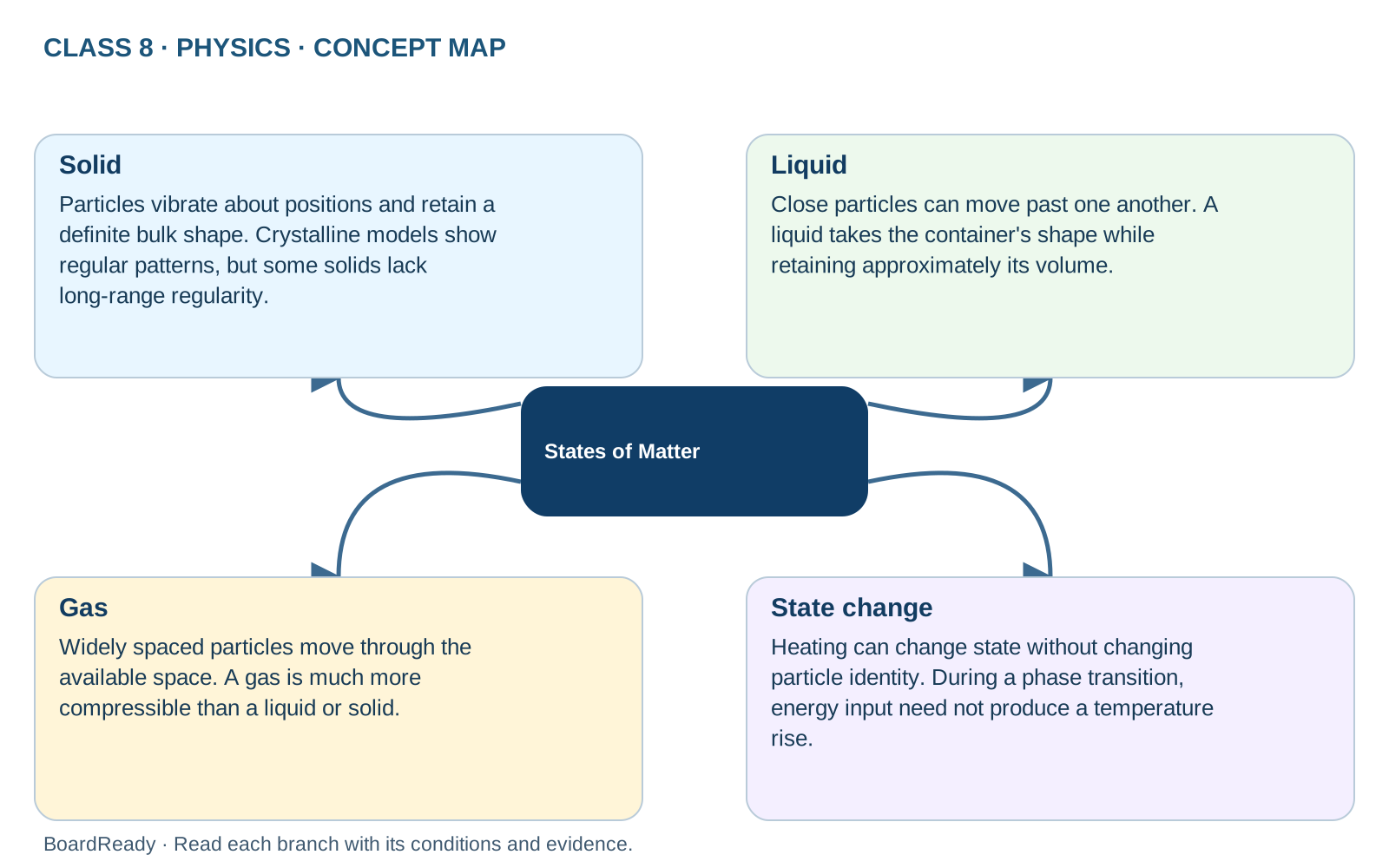
- 1States of Matter -> Solid: Particles vibrate about positions and retain a definite bulk shape. Crystalline models show regular patterns, but some solids lack long-range regularity.
- 2States of Matter -> Liquid: Close particles can move past one another. A liquid takes the container's shape while retaining approximately its volume.
- 3States of Matter -> Gas: Widely spaced particles move through the available space. A gas is much more compressible than a liquid or solid.
- 4States of Matter -> State change: Heating can change state without changing particle identity. During a phase transition, energy input need not produce a temperature rise.