
Comparison map
Statements and Connectives: relationships and examples
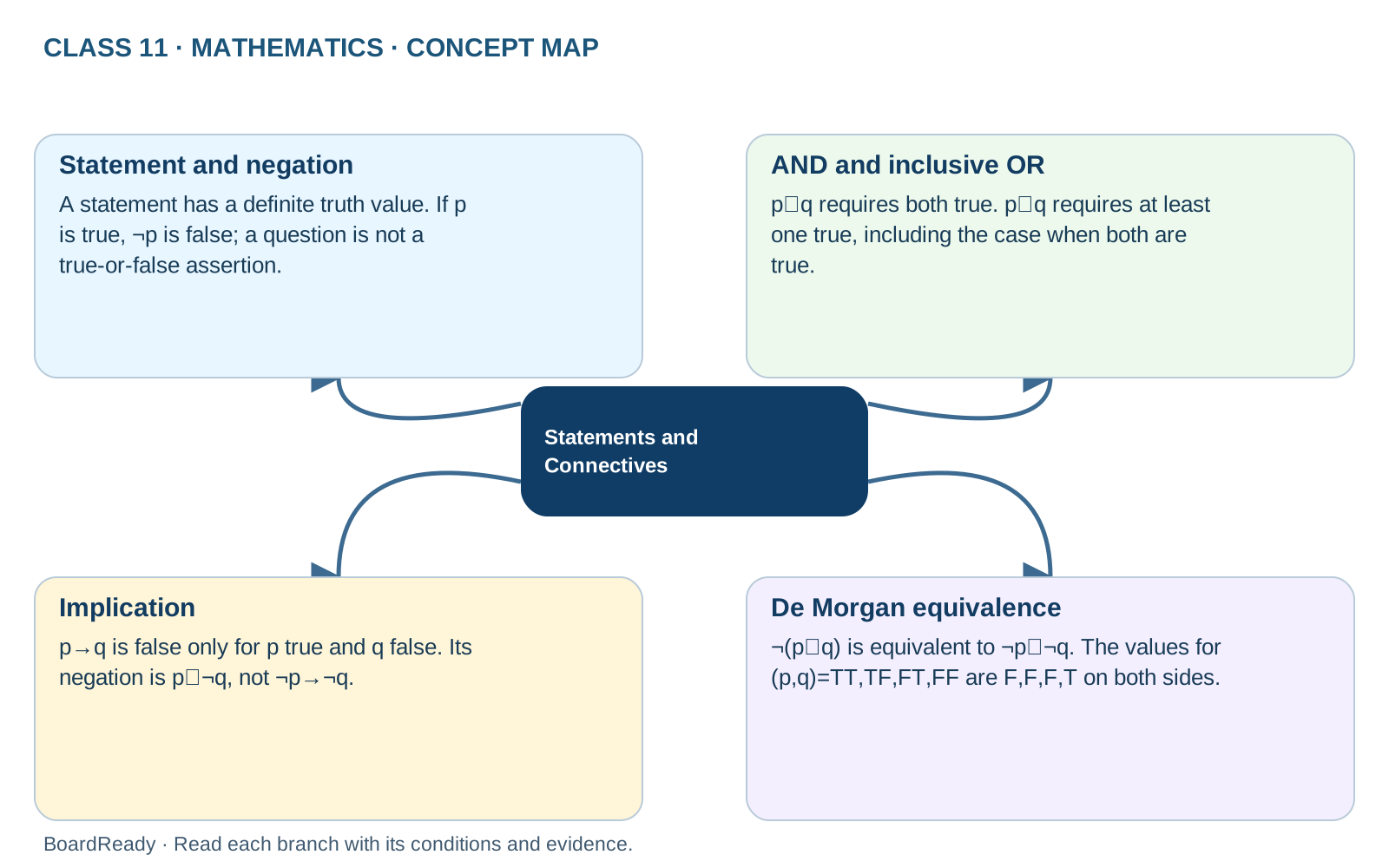
Truth conditions, rather than everyday wording, define logical connectives. Statement and negation: A statement has a definite truth value. If p is true, ¬p is false; a question is not a true-or-false assertion. AND and inclusive OR: p∧q requires both true. p∨q requires at least one true, including the case when both are true. Implication: p→q is false only for p true and q false. Its negation is p∧¬q, not ¬p→¬q. De Morgan equivalence: ¬(p∨q) is equivalent to ¬p∧¬q. The values for (p,q)=TT,TF,FT,FF are F,F,F,T on both sides.Exam cue: Use all four input pairs to check an equivalence involving two statements.
- 1Statements and Connectives -> Statement and negation: A statement has a definite truth value. If p is true, ¬p is false; a question is not a true-or-false assertion.
- 2Statements and Connectives -> AND and inclusive OR: p∧q requires both true. p∨q requires at least one true, including the case when both are true.
- 3Statements and Connectives -> Implication: p→q is false only for p true and q false. Its negation is p∧¬q, not ¬p→¬q.
- 4Statements and Connectives -> De Morgan equivalence: ¬(p∨q) is equivalent to ¬p∧¬q. The values for (p,q)=TT,TF,FT,FF are F,F,F,T on both sides.