
Comparison map
Motion in a Straight Line: relationships and examples
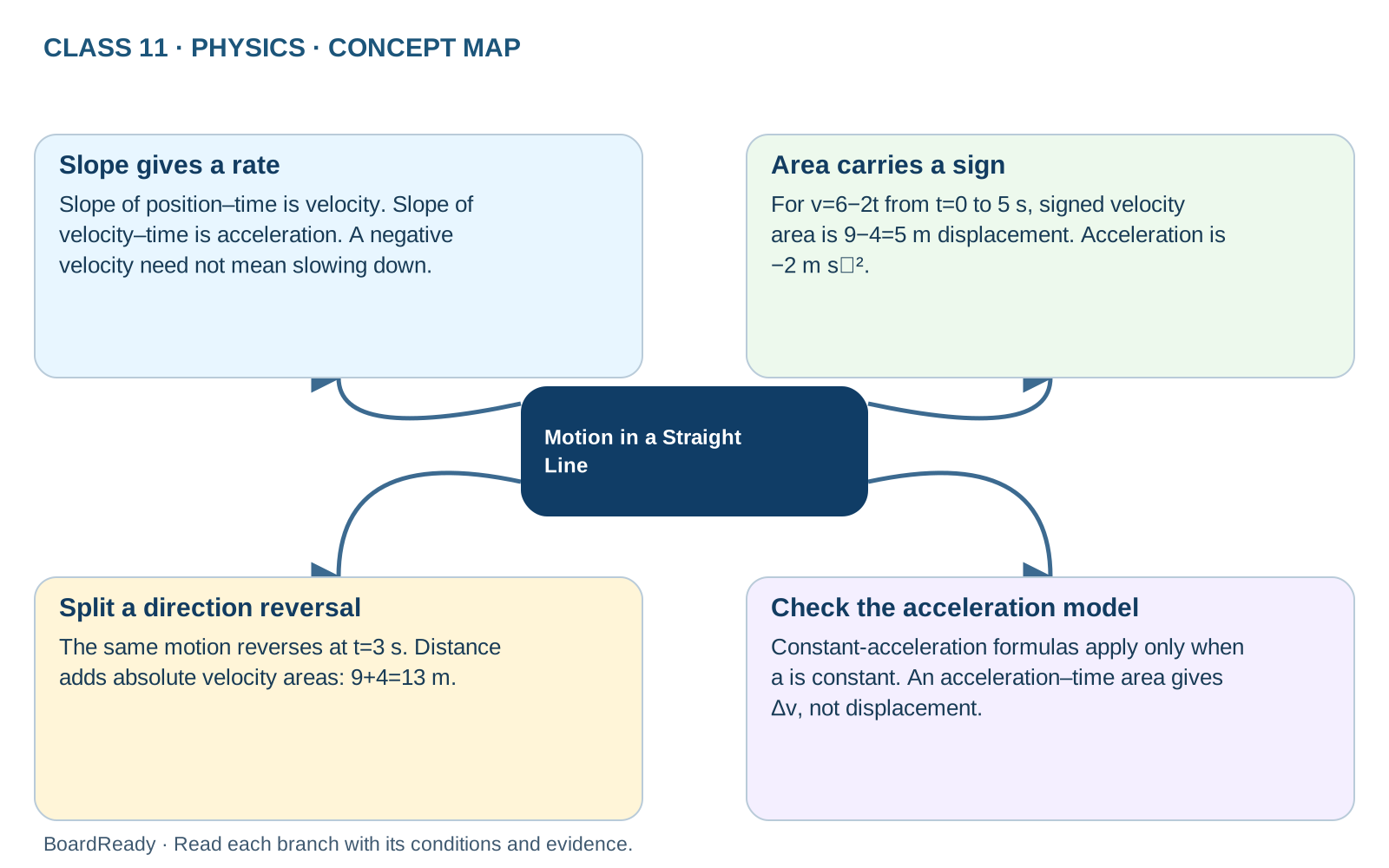
Position, velocity and acceleration give different information about one-dimensional motion. Slope gives a rate: Slope of position–time is velocity. Slope of velocity–time is acceleration. A negative velocity need not mean slowing down. Area carries a sign: For v=6−2t from t=0 to 5 s, signed velocity area is 9−4=5 m displacement. Acceleration is −2 m s⁻². Split a direction reversal: The same motion reverses at t=3 s. Distance adds absolute velocity areas: 9+4=13 m. Check the acceleration model: Constant-acceleration formulas apply only when a is constant. An acceleration–time area gives Δv, not displacement.Exam cue: Choose the positive direction and distinguish signed displacement from total path length.
- 1Motion in a Straight Line -> Slope gives a rate: Slope of position–time is velocity. Slope of velocity–time is acceleration. A negative velocity need not mean slowing down.
- 2Motion in a Straight Line -> Area carries a sign: For v=6−2t from t=0 to 5 s, signed velocity area is 9−4=5 m displacement. Acceleration is −2 m s⁻².
- 3Motion in a Straight Line -> Split a direction reversal: The same motion reverses at t=3 s. Distance adds absolute velocity areas: 9+4=13 m.
- 4Motion in a Straight Line -> Check the acceleration model: Constant-acceleration formulas apply only when a is constant. An acceleration–time area gives Δv, not displacement.