
Comparison map
Gravitation: relationships and examples
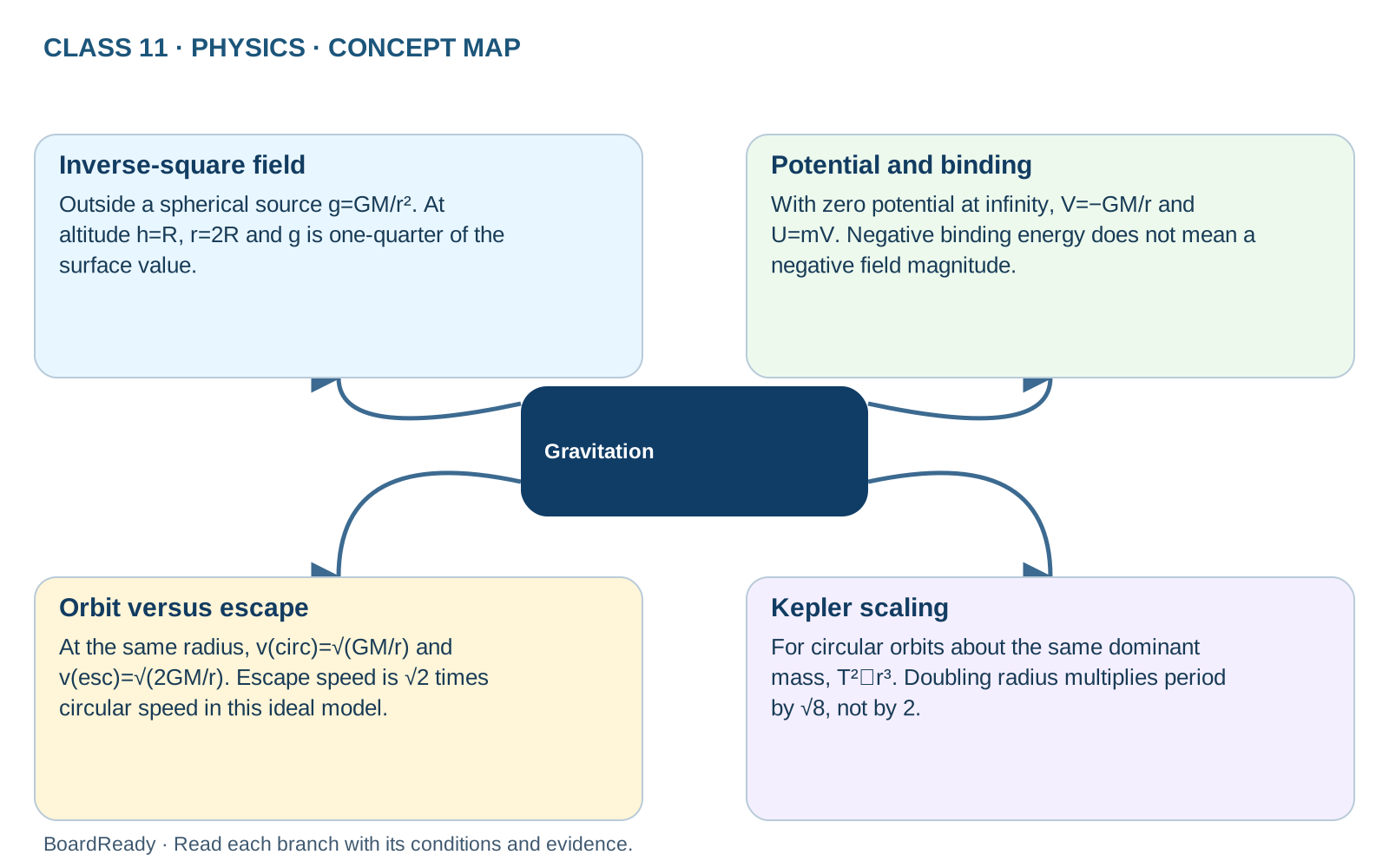
Field, potential and orbit calculations use centre distance and distinct physical meanings. Inverse-square field: Outside a spherical source g=GM/r². At altitude h=R, r=2R and g is one-quarter of the surface value. Potential and binding: With zero potential at infinity, V=−GM/r and U=mV. Negative binding energy does not mean a negative field magnitude. Orbit versus escape: At the same radius, v(circ)=√(GM/r) and v(esc)=√(2GM/r). Escape speed is √2 times circular speed in this ideal model. Kepler scaling: For circular orbits about the same dominant mass, T²∝r³. Doubling radius multiplies period by √8, not by 2.Exam cue: Use centre distance and state the spherical-source and isolated-orbit assumptions.
- 1Gravitation -> Inverse-square field: Outside a spherical source g=GM/r². At altitude h=R, r=2R and g is one-quarter of the surface value.
- 2Gravitation -> Potential and binding: With zero potential at infinity, V=−GM/r and U=mV. Negative binding energy does not mean a negative field magnitude.
- 3Gravitation -> Orbit versus escape: At the same radius, v(circ)=√(GM/r) and v(esc)=√(2GM/r). Escape speed is √2 times circular speed in this ideal model.
- 4Gravitation -> Kepler scaling: For circular orbits about the same dominant mass, T²∝r³. Doubling radius multiplies period by √8, not by 2.