
Comparison map
Types of Forces: relationships and examples
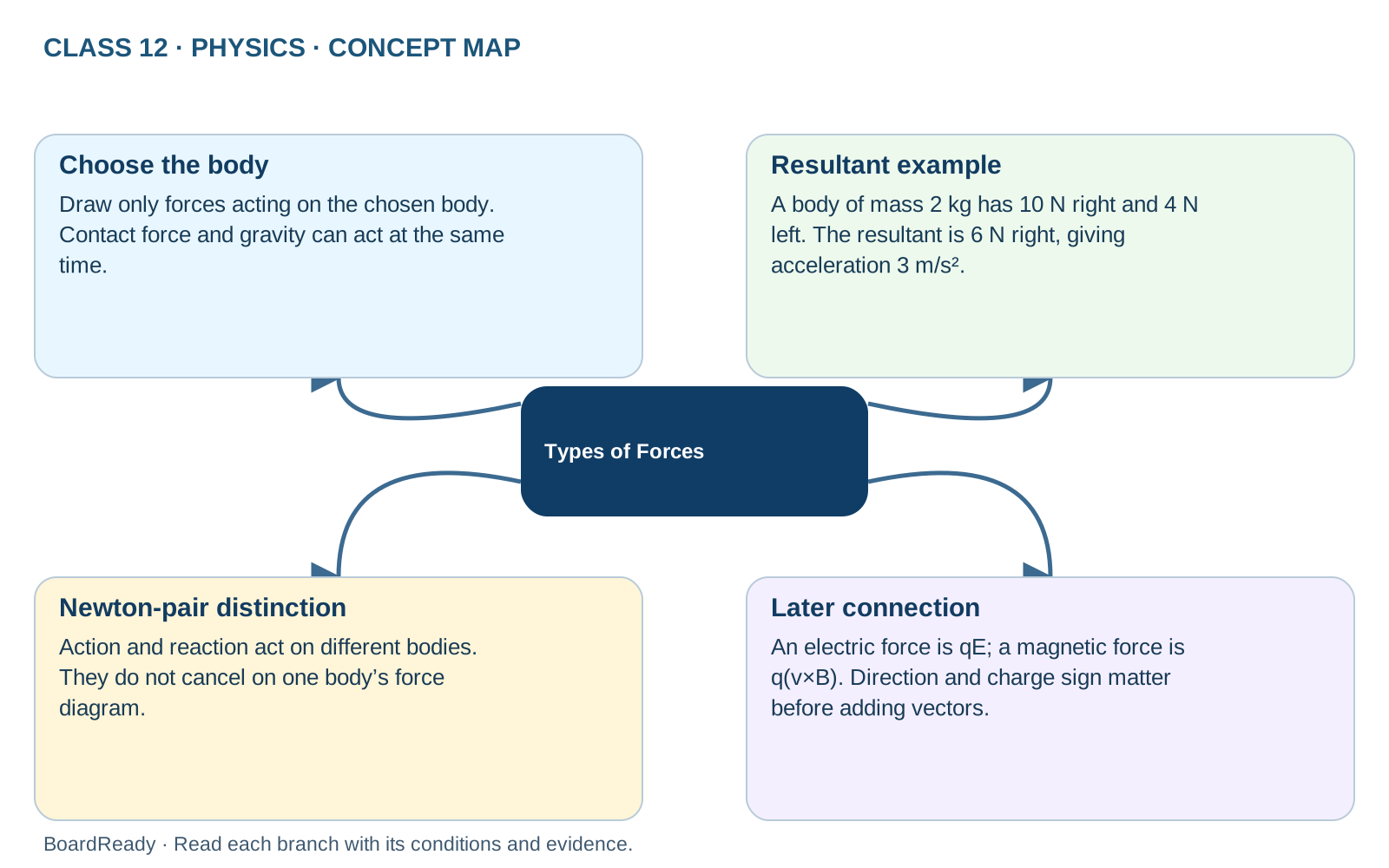
Prerequisite recap: build a force diagram before resolving a resultant. Choose the body: Draw only forces acting on the chosen body. Contact force and gravity can act at the same time. Resultant example: A body of mass 2 kg has 10 N right and 4 N left. The resultant is 6 N right, giving acceleration 3 m/s². Newton-pair distinction: Action and reaction act on different bodies. They do not cancel on one body’s force diagram. Later connection: An electric force is qE; a magnetic force is q(v×B). Direction and charge sign matter before adding vectors.Exam cue: Separate interaction pairs from forces that balance on one body; use a vector resultant.
- 1Types of Forces -> Choose the body: Draw only forces acting on the chosen body. Contact force and gravity can act at the same time.
- 2Types of Forces -> Resultant example: A body of mass 2 kg has 10 N right and 4 N left. The resultant is 6 N right, giving acceleration 3 m/s².
- 3Types of Forces -> Newton-pair distinction: Action and reaction act on different bodies. They do not cancel on one body’s force diagram.
- 4Types of Forces -> Later connection: An electric force is qE; a magnetic force is q(v×B). Direction and charge sign matter before adding vectors.