
Comparison map
Chemical and Ionic Equilibrium: relationships and examples
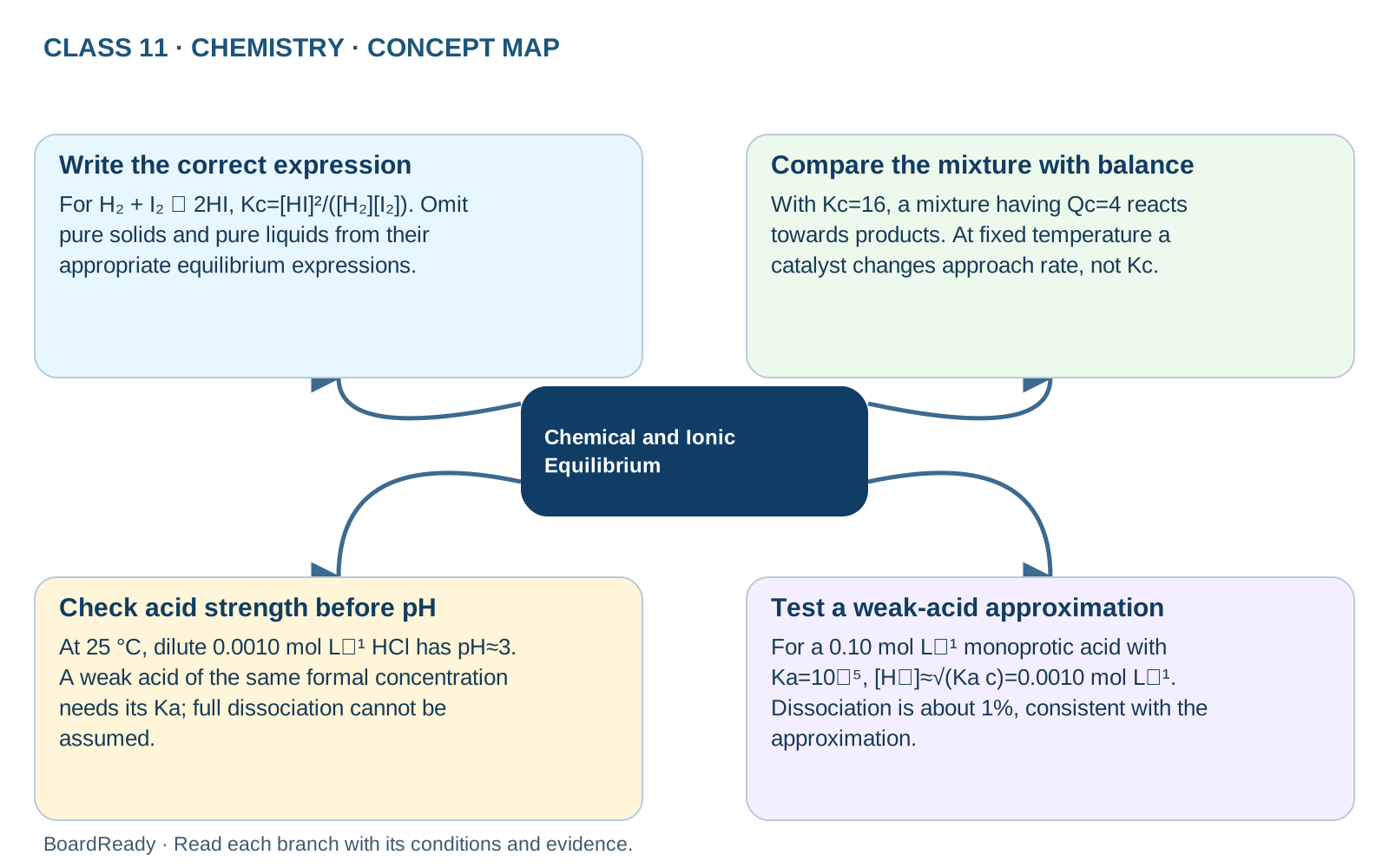
A reaction quotient, an equilibrium constant and an acid-strength model answer different questions. Write the correct expression: For H₂ + I₂ ⇌ 2HI, Kc=[HI]²/([H₂][I₂]). Omit pure solids and pure liquids from their appropriate equilibrium expressions. Compare the mixture with balance: With Kc=16, a mixture having Qc=4 reacts towards products. At fixed temperature a catalyst changes approach rate, not Kc. Check acid strength before pH: At 25 °C, dilute 0.0010 mol L⁻¹ HCl has pH≈3. A weak acid of the same formal concentration needs its Ka; full dissociation cannot be assumed. Test a weak-acid approximation: For a 0.10 mol L⁻¹ monoprotic acid with Ka=10⁻⁵, [H⁺]≈√(Ka c)=0.0010 mol L⁻¹. Dissociation is about 1%, consistent with the approximation.Exam cue: Equal forward and reverse rates do not require equal concentrations. State temperature and test any small-change assumption.
- 1Chemical and Ionic Equilibrium -> Write the correct expression: For H₂ + I₂ ⇌ 2HI, Kc=[HI]²/([H₂][I₂]). Omit pure solids and pure liquids from their appropriate equilibrium expressions.
- 2Chemical and Ionic Equilibrium -> Compare the mixture with balance: With Kc=16, a mixture having Qc=4 reacts towards products. At fixed temperature a catalyst changes approach rate, not Kc.
- 3Chemical and Ionic Equilibrium -> Check acid strength before pH: At 25 °C, dilute 0.0010 mol L⁻¹ HCl has pH≈3. A weak acid of the same formal concentration needs its Ka; full dissociation cannot be assumed.
- 4Chemical and Ionic Equilibrium -> Test a weak-acid approximation: For a 0.10 mol L⁻¹ monoprotic acid with Ka=10⁻⁵, [H⁺]≈√(Ka c)=0.0010 mol L⁻¹. Dissociation is about 1%, consistent with the approximation.