
Comparison map
Electric Charges and Fields: relationships and examples
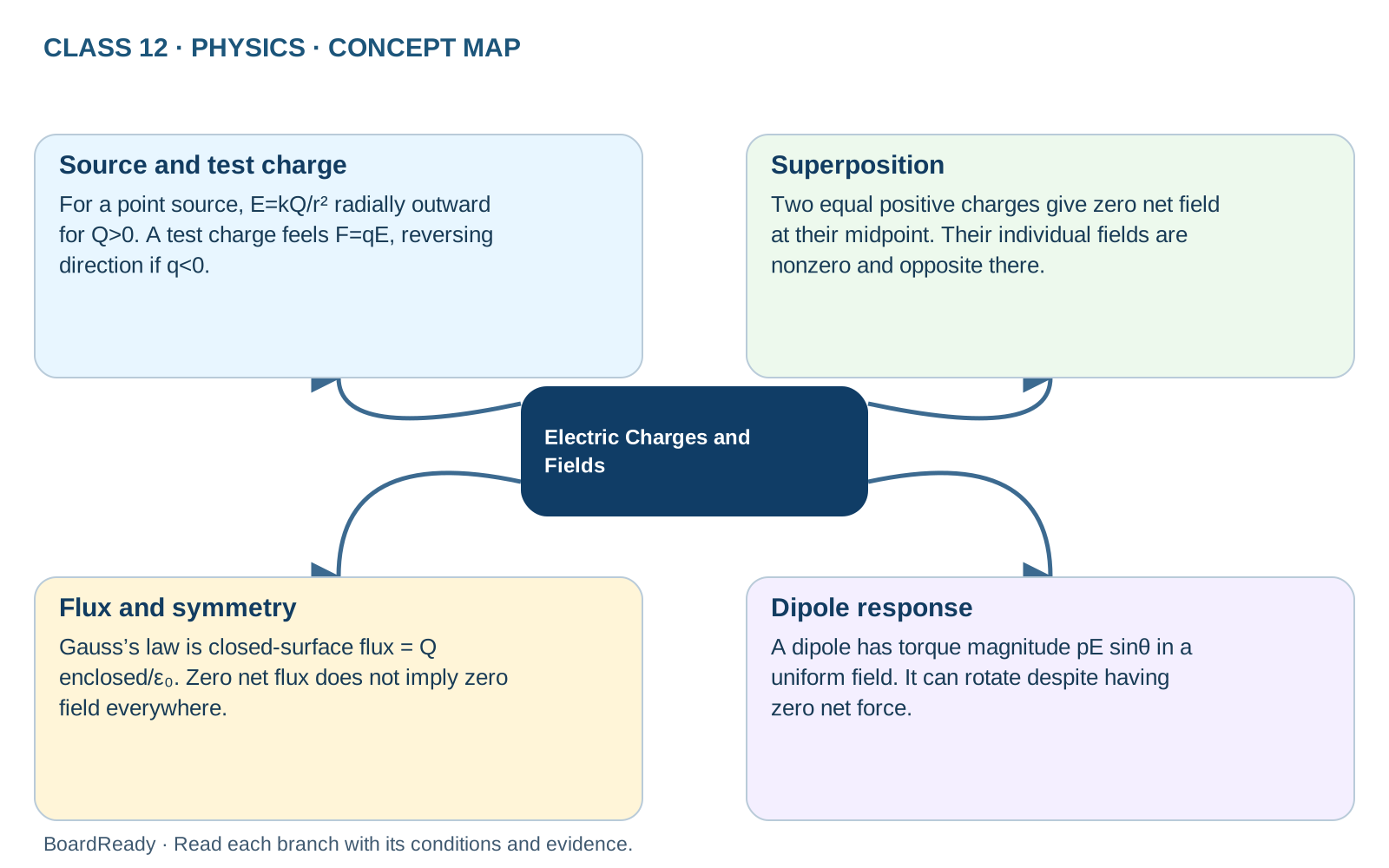
Use vector superposition and distinguish field from its flux. Source and test charge: For a point source, E=kQ/r² radially outward for Q>0. A test charge feels F=qE, reversing direction if q<0. Superposition: Two equal positive charges give zero net field at their midpoint. Their individual fields are nonzero and opposite there. Flux and symmetry: Gauss’s law is closed-surface flux = Q enclosed/ε₀. Zero net flux does not imply zero field everywhere. Dipole response: A dipole has torque magnitude pE sinθ in a uniform field. It can rotate despite having zero net force.Exam cue: Sketch field directions first. Use symmetry before replacing a flux integral with E times an area.
- 1Electric Charges and Fields -> Source and test charge: For a point source, E=kQ/r² radially outward for Q>0. A test charge feels F=qE, reversing direction if q<0.
- 2Electric Charges and Fields -> Superposition: Two equal positive charges give zero net field at their midpoint. Their individual fields are nonzero and opposite there.
- 3Electric Charges and Fields -> Flux and symmetry: Gauss’s law is closed-surface flux = Q enclosed/ε₀. Zero net flux does not imply zero field everywhere.
- 4Electric Charges and Fields -> Dipole response: A dipole has torque magnitude pE sinθ in a uniform field. It can rotate despite having zero net force.