
Comparison map
Organisms, Populations, and Ecosystems: relationships and examples
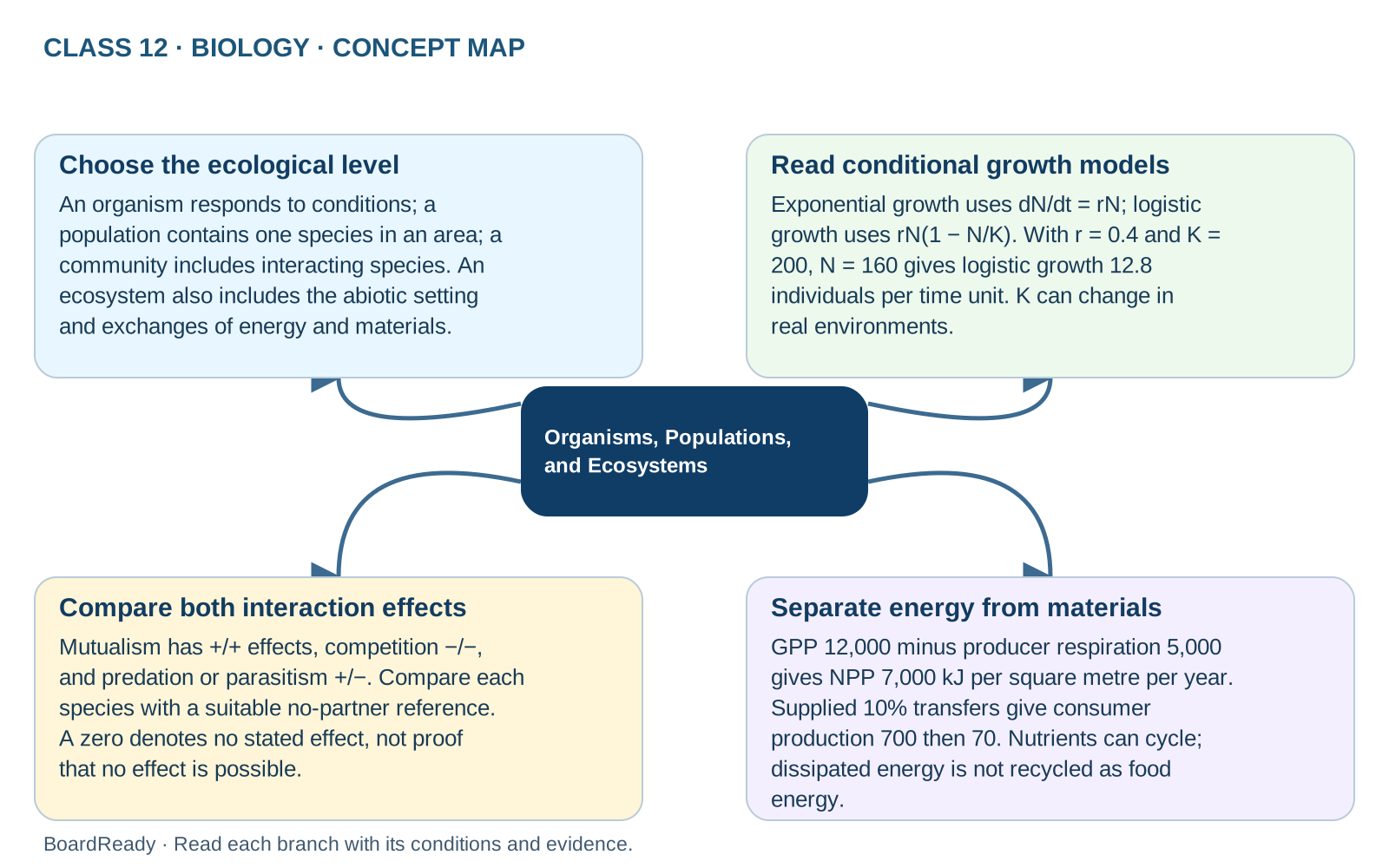
Connect ecological levels, conditional population models, effects of species interactions and ecosystem production using explicit units and comparisons. Choose the ecological level: An organism responds to conditions; a population contains one species in an area; a community includes interacting species. An ecosystem also includes the abiotic setting and exchanges of energy and materials. Read conditional growth models: Exponential growth uses dN/dt = rN; logistic growth uses rN(1 − N/K). With r = 0.4 and K = 200, N = 160 gives logistic growth 12.8 individuals per time unit. K can change in real environments. Compare both interaction effects: Mutualism has +/+ effects, competition −/−, and predation or parasitism +/−. Compare each species with a suitable no-partner reference. A zero denotes no stated effect, not proof that no effect is possible. Separate energy from materials: GPP 12,000 minus producer respiration 5,000 gives NPP 7,000 kJ per square metre per year. Supplied 10% transfers give consumer production 700 then 70. Nutrients can cycle; dissipated energy is not recycled as food energy.Exam cue: Name the ecological scale, reference, units and model assumptions. Compare population growth rates, distinguish interaction signs from mechanisms, and keep standing biomass separate from production per unit time.
- 1Organisms, Populations, and Ecosystems -> Choose the ecological level: An organism responds to conditions; a population contains one species in an area; a community includes interacting species. An ecosystem also includes the abiotic setting and exchanges of energy and materials.
- 2Organisms, Populations, and Ecosystems -> Read conditional growth models: Exponential growth uses dN/dt = rN; logistic growth uses rN(1 − N/K). With r = 0.4 and K = 200, N = 160 gives logistic growth 12.8 individuals per time unit. K can change in real environments.
- 3Organisms, Populations, and Ecosystems -> Compare both interaction effects: Mutualism has +/+ effects, competition −/−, and predation or parasitism +/−. Compare each species with a suitable no-partner reference. A zero denotes no stated effect, not proof that no effect is possible.
- 4Organisms, Populations, and Ecosystems -> Separate energy from materials: GPP 12,000 minus producer respiration 5,000 gives NPP 7,000 kJ per square metre per year. Supplied 10% transfers give consumer production 700 then 70. Nutrients can cycle; dissipated energy is not recycled as food energy.