
Comparison map
Air, Water, and Weather: relationships and examples
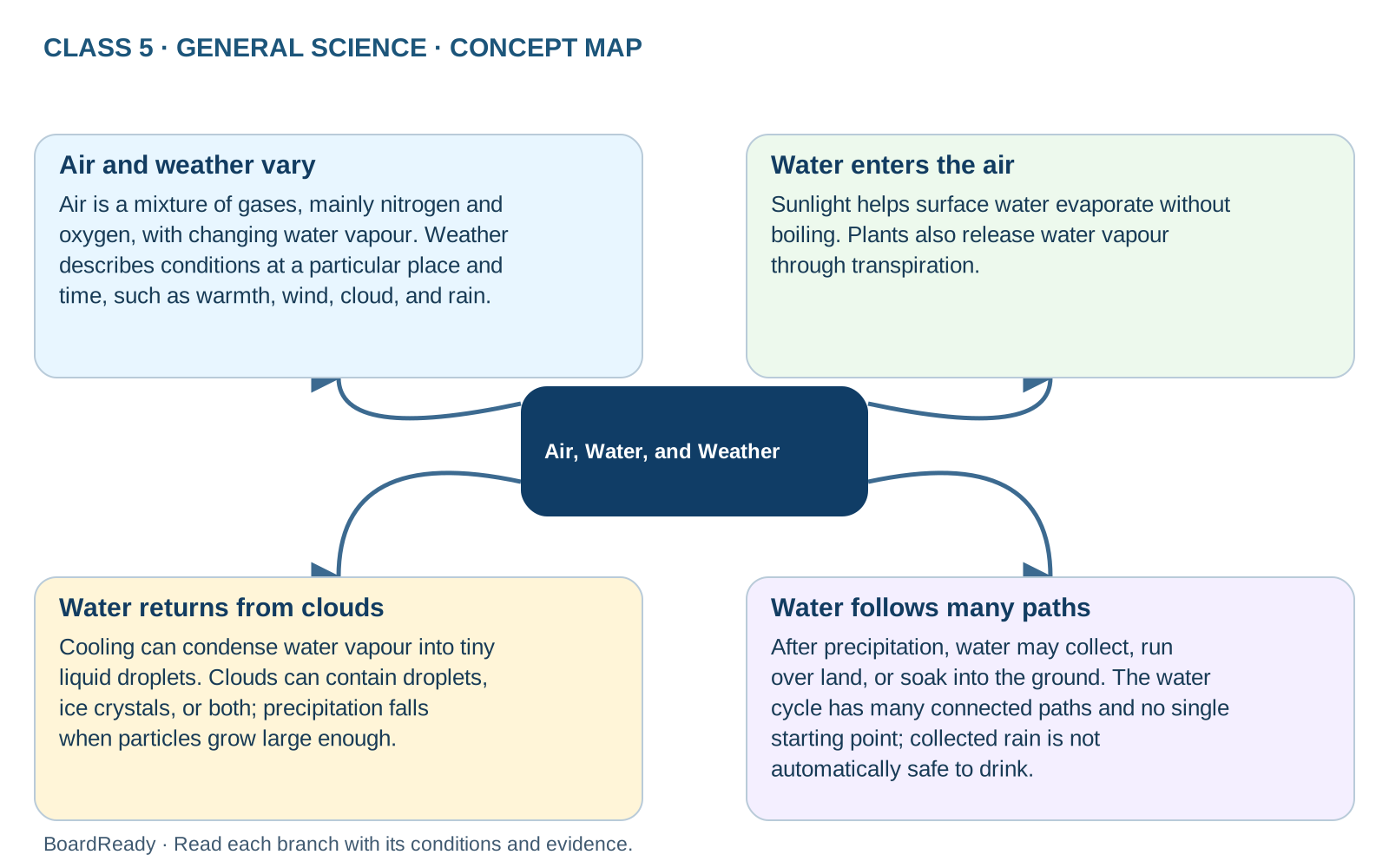
Follow water through evaporation, condensation, precipitation, and collection, and describe air and weather with evidence from a place and time. Air and weather vary: Air is a mixture of gases, mainly nitrogen and oxygen, with changing water vapour. Weather describes conditions at a particular place and time, such as warmth, wind, cloud, and rain. Water enters the air: Sunlight helps surface water evaporate without boiling. Plants also release water vapour through transpiration. Water returns from clouds: Cooling can condense water vapour into tiny liquid droplets. Clouds can contain droplets, ice crystals, or both; precipitation falls when particles grow large enough. Water follows many paths: After precipitation, water may collect, run over land, or soak into the ground. The water cycle has many connected paths and no single starting point; collected rain is not automatically safe to drink.Exam cue: Name the state change and direction: evaporation or transpiration adds vapour; condensation forms liquid; precipitation falls; then water follows several possible paths.
- 1Air, Water, and Weather -> Air and weather vary: Air is a mixture of gases, mainly nitrogen and oxygen, with changing water vapour. Weather describes conditions at a particular place and time, such as warmth, wind, cloud, and rain.
- 2Air, Water, and Weather -> Water enters the air: Sunlight helps surface water evaporate without boiling. Plants also release water vapour through transpiration.
- 3Air, Water, and Weather -> Water returns from clouds: Cooling can condense water vapour into tiny liquid droplets. Clouds can contain droplets, ice crystals, or both; precipitation falls when particles grow large enough.
- 4Air, Water, and Weather -> Water follows many paths: After precipitation, water may collect, run over land, or soak into the ground. The water cycle has many connected paths and no single starting point; collected rain is not automatically safe to drink.