
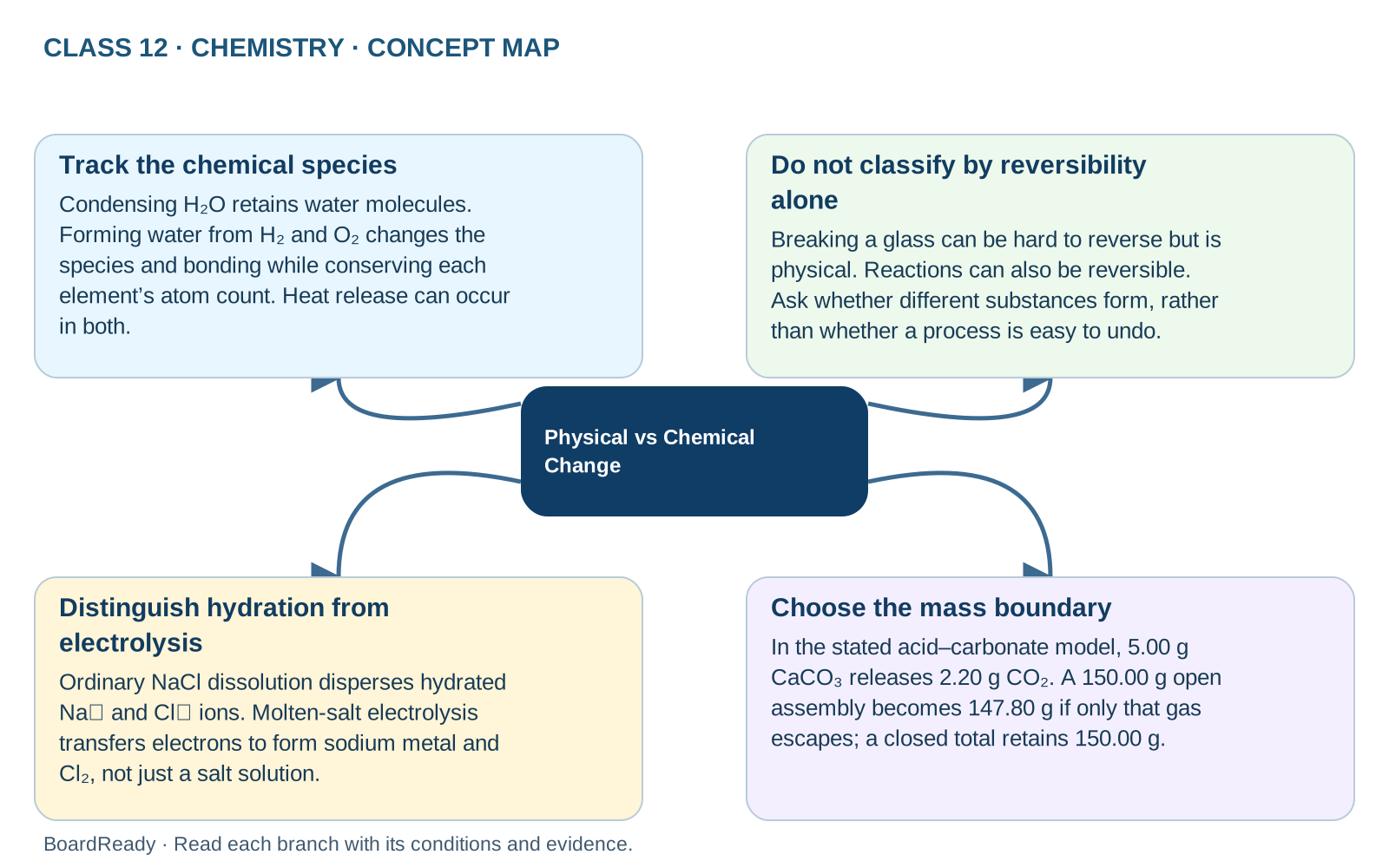
Comparison map
Physical vs Chemical Change: relationships and examples
Foundation refresher: distinguish species identity, physical rearrangement, electron transfer and the chosen mass boundary. Track the chemical species: Condensing H₂O retains water molecules. Forming water from H₂ and O₂ changes the species and bonding while conserving each element’s atom count. Heat release can occur in both. Do not classify by reversibility alone: Breaking a glass can be hard to reverse but is physical. Reactions can also be reversible. Ask whether different substances form, rather than whether a process is easy to undo. Distinguish hydration from electrolysis: Ordinary NaCl dissolution disperses hydrated Na⁺ and Cl⁻ ions. Molten-salt electrolysis transfers electrons to form sodium metal and Cl₂, not just a salt solution. Choose the mass boundary: In the stated acid–carbonate model, 5.00 g CaCO₃ releases 2.20 g CO₂. A 150.00 g open assembly becomes 147.80 g if only that gas escapes; a closed total retains 150.00 g.Exam cue: Name initial and final species, then check atoms and charge. Separate an observation from its interpretation. Include escaped or retained gas in a clearly stated system boundary before judging mass conservation.
- 1Physical vs Chemical Change -> Track the chemical species: Condensing H₂O retains water molecules. Forming water from H₂ and O₂ changes the species and bonding while conserving each element’s atom count. Heat release can occur in both.
- 2Physical vs Chemical Change -> Do not classify by reversibility alone: Breaking a glass can be hard to reverse but is physical. Reactions can also be reversible. Ask whether different substances form, rather than whether a process is easy to undo.
- 3Physical vs Chemical Change -> Distinguish hydration from electrolysis: Ordinary NaCl dissolution disperses hydrated Na⁺ and Cl⁻ ions. Molten-salt electrolysis transfers electrons to form sodium metal and Cl₂, not just a salt solution.
- 4Physical vs Chemical Change -> Choose the mass boundary: In the stated acid–carbonate model, 5.00 g CaCO₃ releases 2.20 g CO₂. A 150.00 g open assembly becomes 147.80 g if only that gas escapes; a closed total retains 150.00 g.