
Comparison map
Cell Organelles: relationships and examples
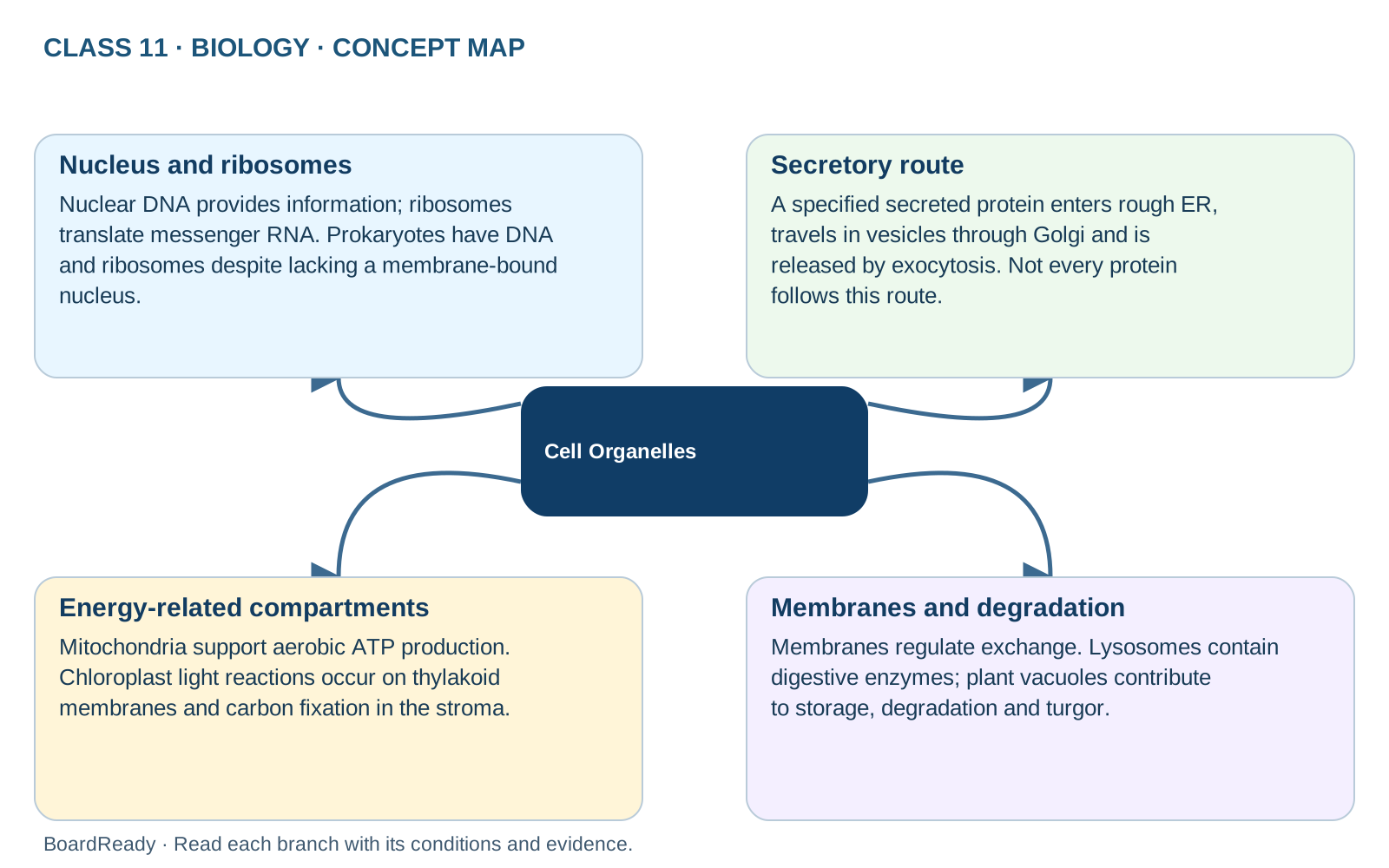
Trace cellular jobs through distinct compartments, remembering that an organelle is part of a connected cell. Nucleus and ribosomes: Nuclear DNA provides information; ribosomes translate messenger RNA. Prokaryotes have DNA and ribosomes despite lacking a membrane-bound nucleus. Secretory route: A specified secreted protein enters rough ER, travels in vesicles through Golgi and is released by exocytosis. Not every protein follows this route. Energy-related compartments: Mitochondria support aerobic ATP production. Chloroplast light reactions occur on thylakoid membranes and carbon fixation in the stroma. Membranes and degradation: Membranes regulate exchange. Lysosomes contain digestive enzymes; plant vacuoles contribute to storage, degradation and turgor.Exam cue: State the compartment and the molecule being moved or transformed; do not describe organelles as unrelated labels.
- 1Cell Organelles -> Nucleus and ribosomes: Nuclear DNA provides information; ribosomes translate messenger RNA. Prokaryotes have DNA and ribosomes despite lacking a membrane-bound nucleus.
- 2Cell Organelles -> Secretory route: A specified secreted protein enters rough ER, travels in vesicles through Golgi and is released by exocytosis. Not every protein follows this route.
- 3Cell Organelles -> Energy-related compartments: Mitochondria support aerobic ATP production. Chloroplast light reactions occur on thylakoid membranes and carbon fixation in the stroma.
- 4Cell Organelles -> Membranes and degradation: Membranes regulate exchange. Lysosomes contain digestive enzymes; plant vacuoles contribute to storage, degradation and turgor.