
Comparison map
Some Basic Concepts of Chemistry: relationships and examples
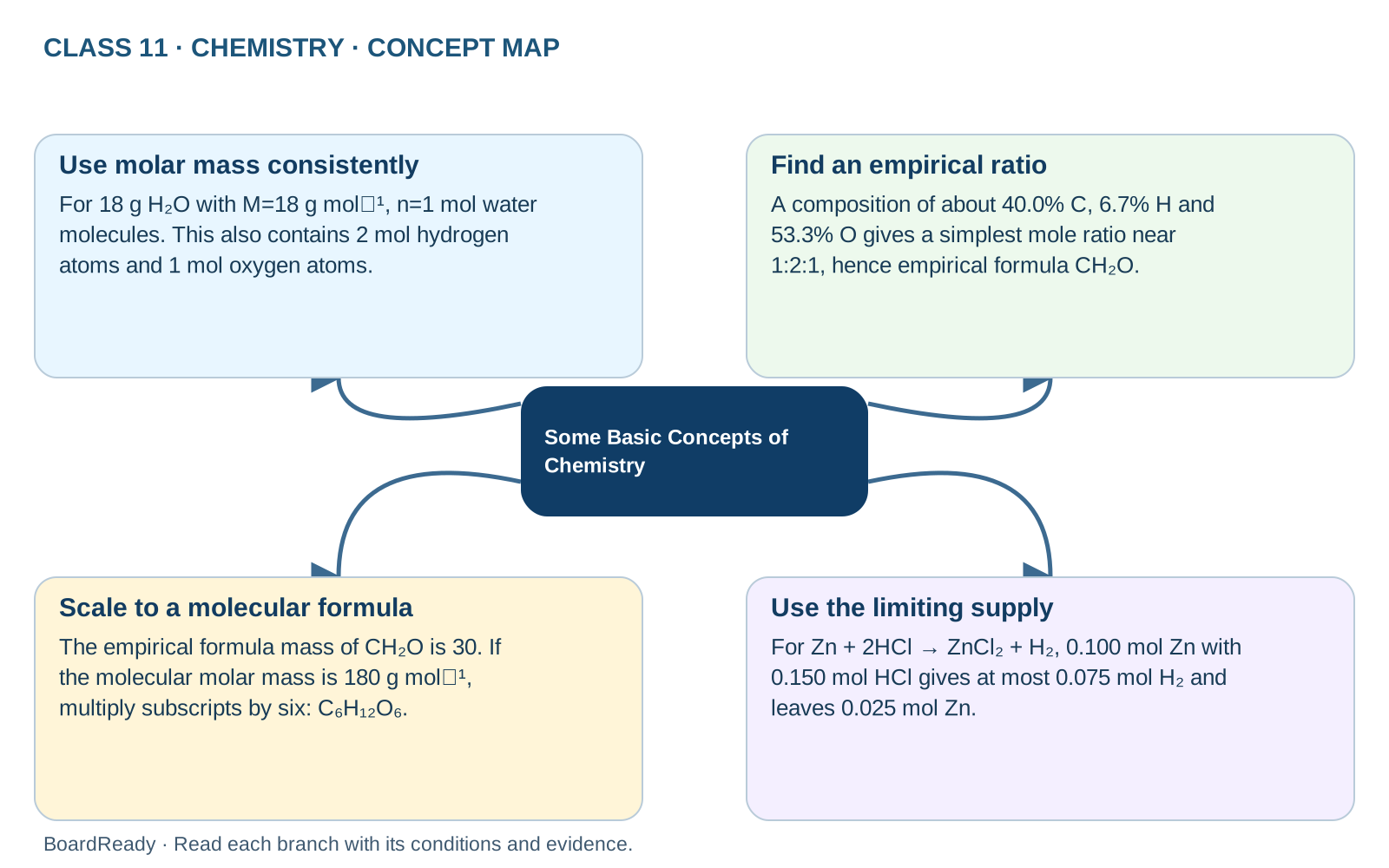
Quantitative chemistry links composition, amount, balanced ratios and the difference between actual and theoretical yield. Use molar mass consistently: For 18 g H₂O with M=18 g mol⁻¹, n=1 mol water molecules. This also contains 2 mol hydrogen atoms and 1 mol oxygen atoms. Find an empirical ratio: A composition of about 40.0% C, 6.7% H and 53.3% O gives a simplest mole ratio near 1:2:1, hence empirical formula CH₂O. Scale to a molecular formula: The empirical formula mass of CH₂O is 30. If the molecular molar mass is 180 g mol⁻¹, multiply subscripts by six: C₆H₁₂O₆. Use the limiting supply: For Zn + 2HCl → ZnCl₂ + H₂, 0.100 mol Zn with 0.150 mol HCl gives at most 0.075 mol H₂ and leaves 0.025 mol Zn.Exam cue: Balance atoms and use mole ratios; do not mistake an empirical formula for a unique molecular formula.
- 1Some Basic Concepts of Chemistry -> Use molar mass consistently: For 18 g H₂O with M=18 g mol⁻¹, n=1 mol water molecules. This also contains 2 mol hydrogen atoms and 1 mol oxygen atoms.
- 2Some Basic Concepts of Chemistry -> Find an empirical ratio: A composition of about 40.0% C, 6.7% H and 53.3% O gives a simplest mole ratio near 1:2:1, hence empirical formula CH₂O.
- 3Some Basic Concepts of Chemistry -> Scale to a molecular formula: The empirical formula mass of CH₂O is 30. If the molecular molar mass is 180 g mol⁻¹, multiply subscripts by six: C₆H₁₂O₆.
- 4Some Basic Concepts of Chemistry -> Use the limiting supply: For Zn + 2HCl → ZnCl₂ + H₂, 0.100 mol Zn with 0.150 mol HCl gives at most 0.075 mol H₂ and leaves 0.025 mol Zn.