Comparison map
Laws of Exponents for Real Numbers: relationships and examples
The exponent operation depends on whether powers are multiplied, divided or raised to another power.Exam cue: Keep brackets around the complete base and state non-zero conditions.
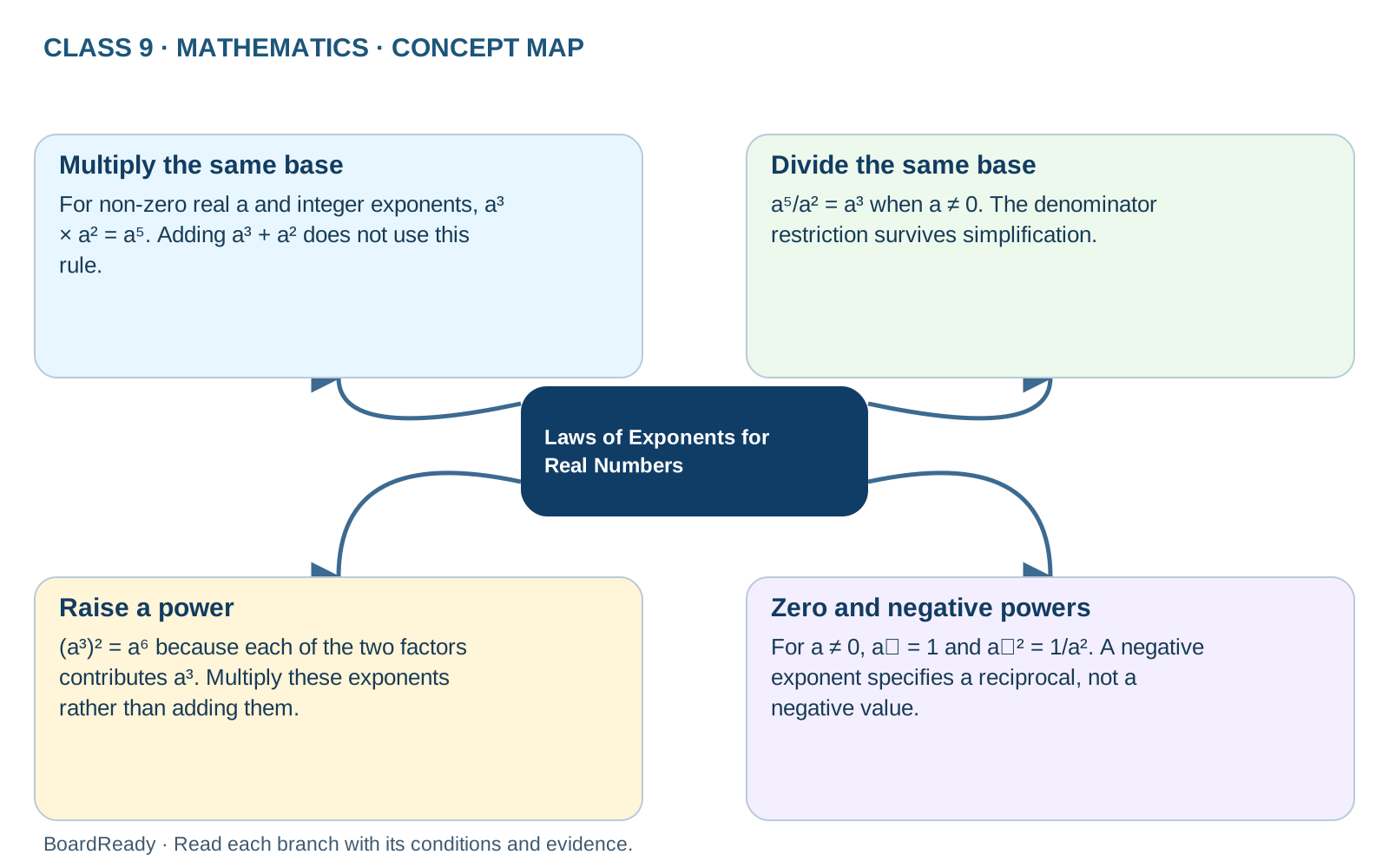
- 1Laws of Exponents for Real Numbers -> Multiply the same base: For non-zero real a and integer exponents, a³ × a² = a⁵. Adding a³ + a² does not use this rule.
- 2Laws of Exponents for Real Numbers -> Divide the same base: a⁵/a² = a³ when a ≠ 0. The denominator restriction survives simplification.
- 3Laws of Exponents for Real Numbers -> Raise a power: (a³)² = a⁶ because each of the two factors contributes a³. Multiply these exponents rather than adding them.
- 4Laws of Exponents for Real Numbers -> Zero and negative powers: For a ≠ 0, a⁰ = 1 and a⁻² = 1/a². A negative exponent specifies a reciprocal, not a negative value.