Comparison map
Cartesian Plane: relationships and examples
An ordered pair uses perpendicular axes and a chosen origin to identify one position.Exam cue: Label both axes and their unit intervals before plotting.
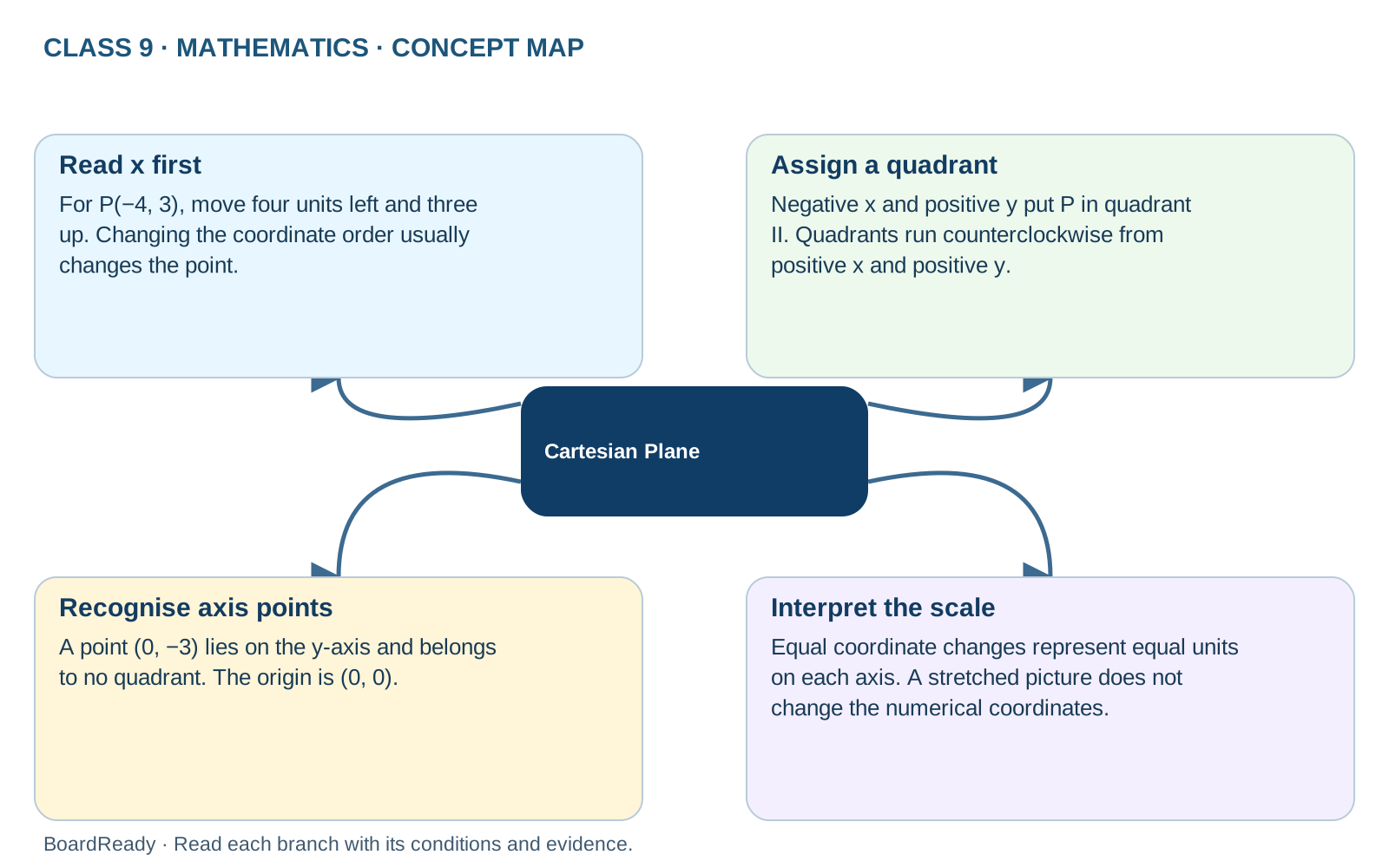
- 1Cartesian Plane -> Read x first: For P(−4, 3), move four units left and three up. Changing the coordinate order usually changes the point.
- 2Cartesian Plane -> Assign a quadrant: Negative x and positive y put P in quadrant II. Quadrants run counterclockwise from positive x and positive y.
- 3Cartesian Plane -> Recognise axis points: A point (0, −3) lies on the y-axis and belongs to no quadrant. The origin is (0, 0).
- 4Cartesian Plane -> Interpret the scale: Equal coordinate changes represent equal units on each axis. A stretched picture does not change the numerical coordinates.