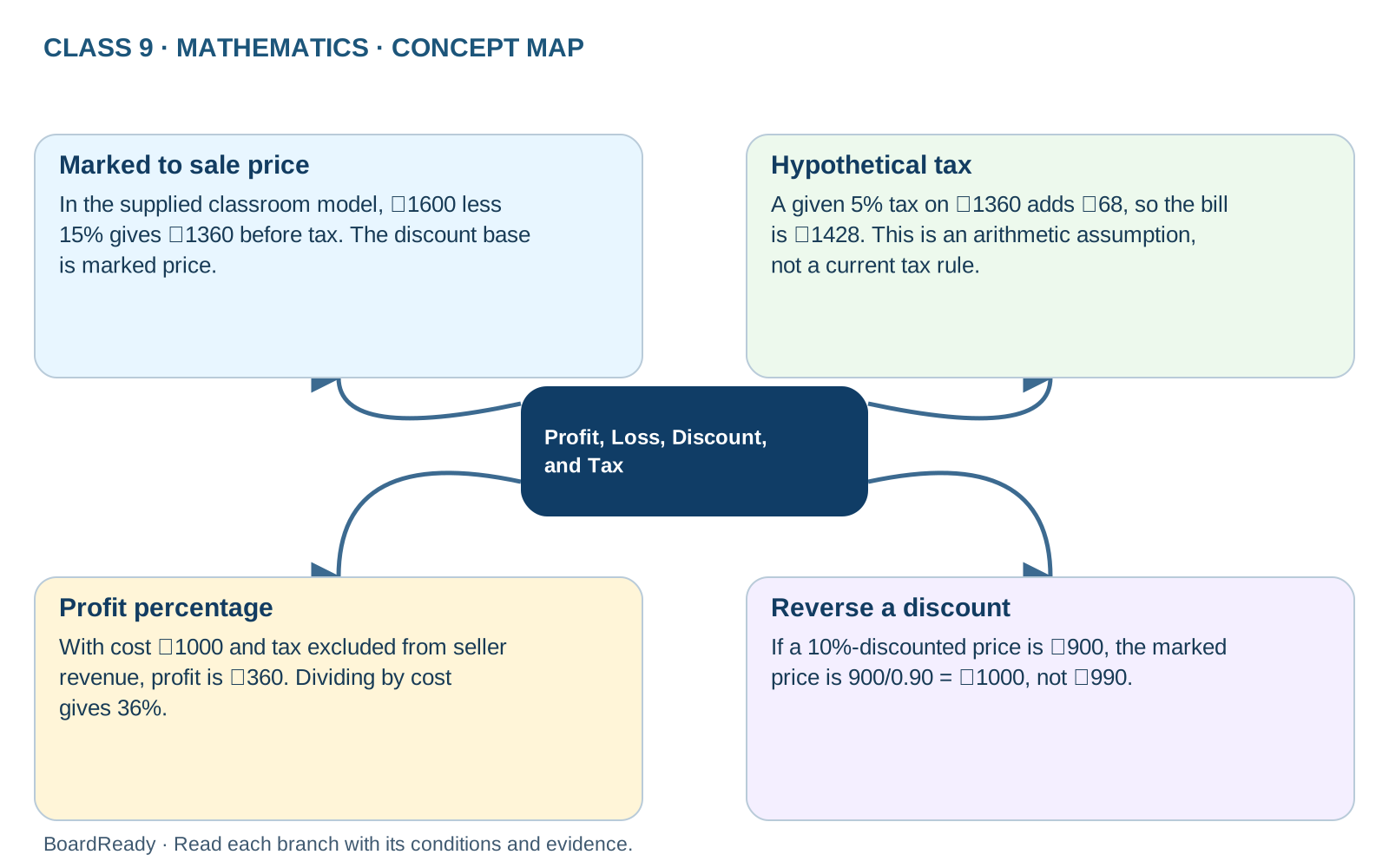
Comparison map
Profit, Loss, Discount, and Tax: relationships and examples
Track marked price, actual sale price, collected tax and cost as separate quantities.Exam cue: Name the base before applying a percentage; collected tax is not automatically profit.
- 1Profit, Loss, Discount, and Tax -> Marked to sale price: In the supplied classroom model, ₹1600 less 15% gives ₹1360 before tax. The discount base is marked price.
- 2Profit, Loss, Discount, and Tax -> Hypothetical tax: A given 5% tax on ₹1360 adds ₹68, so the bill is ₹1428. This is an arithmetic assumption, not a current tax rule.
- 3Profit, Loss, Discount, and Tax -> Profit percentage: With cost ₹1000 and tax excluded from seller revenue, profit is ₹360. Dividing by cost gives 36%.
- 4Profit, Loss, Discount, and Tax -> Reverse a discount: If a 10%-discounted price is ₹900, the marked price is 900/0.90 = ₹1000, not ₹990.