Comparison map
Commercial Mathematics Review: relationships and examples
Keep each percentage attached to its base and distinguish the final amount from the increase.Exam cue: Rates here are hypothetical arithmetic inputs; check the base and compounding period.
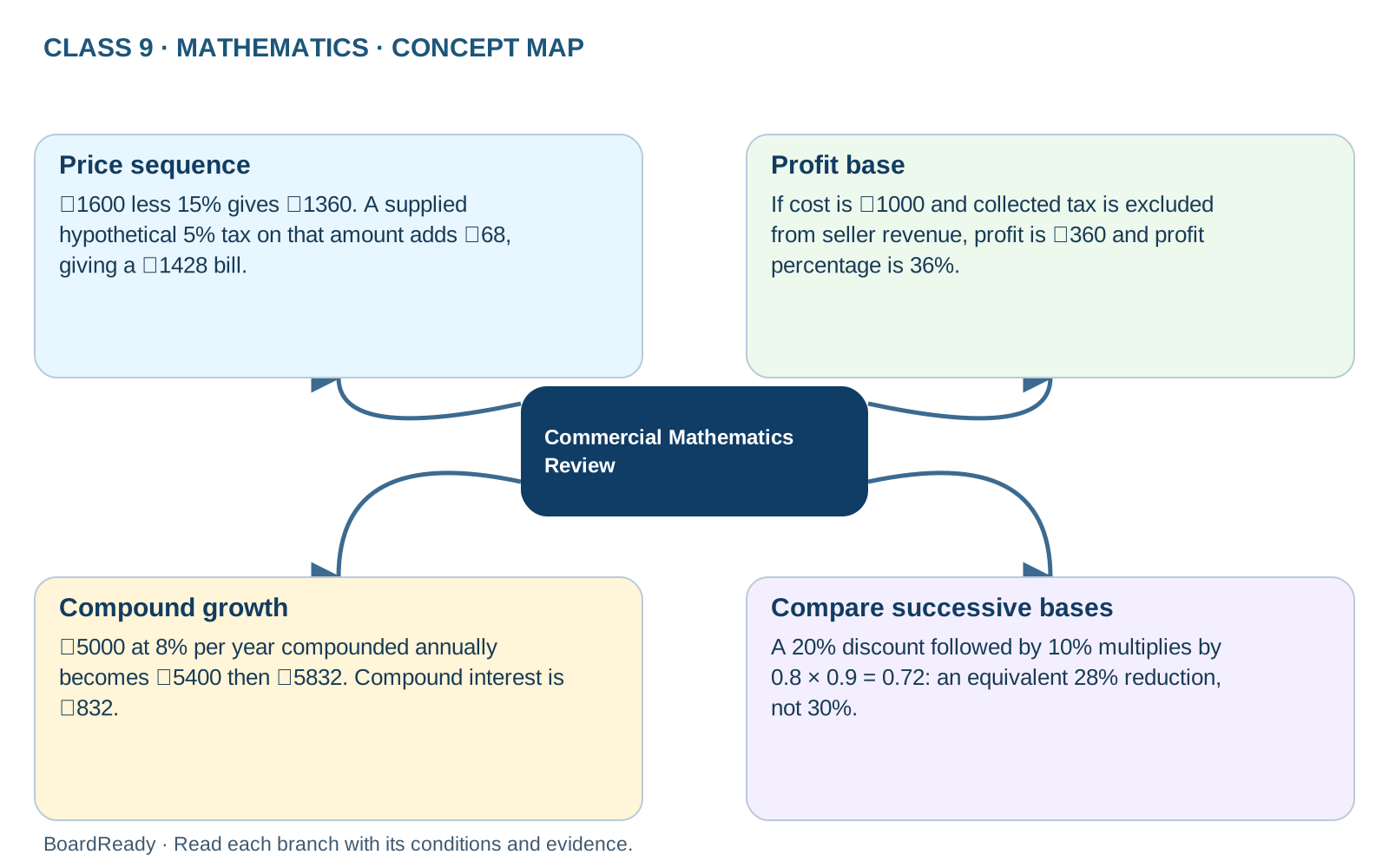
- 1Commercial Mathematics Review -> Price sequence: ₹1600 less 15% gives ₹1360. A supplied hypothetical 5% tax on that amount adds ₹68, giving a ₹1428 bill.
- 2Commercial Mathematics Review -> Profit base: If cost is ₹1000 and collected tax is excluded from seller revenue, profit is ₹360 and profit percentage is 36%.
- 3Commercial Mathematics Review -> Compound growth: ₹5000 at 8% per year compounded annually becomes ₹5400 then ₹5832. Compound interest is ₹832.
- 4Commercial Mathematics Review -> Compare successive bases: A 20% discount followed by 10% multiplies by 0.8 × 0.9 = 0.72: an equivalent 28% reduction, not 30%.